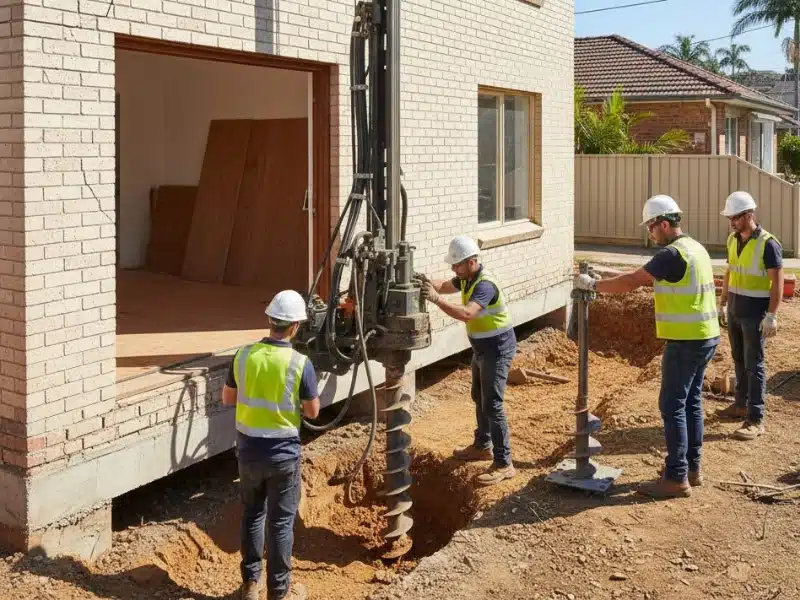
Underpinning and resin injection both stabilise a home that has moved, but they work in different ways. Traditional underpinning extends the footing down to firmer ground with new concrete or piers. Resin injection leaves the footing in place and strengthens the ground beneath with expanding polyurethane. Which one suits your home depends on the engineering assessment.
We do both at Raise & Relevel, so we have no reason to push one over the other. We find what is moving the house, fix the cause, and then the damage. This guide compares the two methods side by side, shows where each fits and where it does not, and explains what to check before you accept a quote. If you already know you need help, our underpinning services page explains how we assess and repair foundations.
What is the difference between underpinning and resin injection?
Underpinning adds new support below the existing footing, transferring the building’s weight to deeper, firmer ground. Resin injection improves the soil that the footing already sits on by filling voids and compacting weak ground with expanding polyurethane. Put simply, underpinning changes the foundation and resin injection changes the ground. Both can relevel a home when conditions suit.
How traditional underpinning works
Mass concrete underpinning is the long-established method. The crew digs a pit beside and under the footing in short sections, often called bays or pins, so the wall is never left unsupported along a long length. Each bay is filled with concrete down to a level the engineer has set, usually firmer ground. When one bay has cured, the next one is dug.
Screw piles and other piers are a related approach. Steel piles are screwed or driven to a design depth and then connected to the footing. They are often used where firm ground is too deep to reach by digging. Our guide to types of underpinning covers these options. A step-by-step walk-through of what happens during house underpinning.
Figure 1. Traditional underpinning: a new concrete pad is placed under the existing footing, one bay at a time, down to firmer ground. Schematic only.
How polyurethane resin injection works
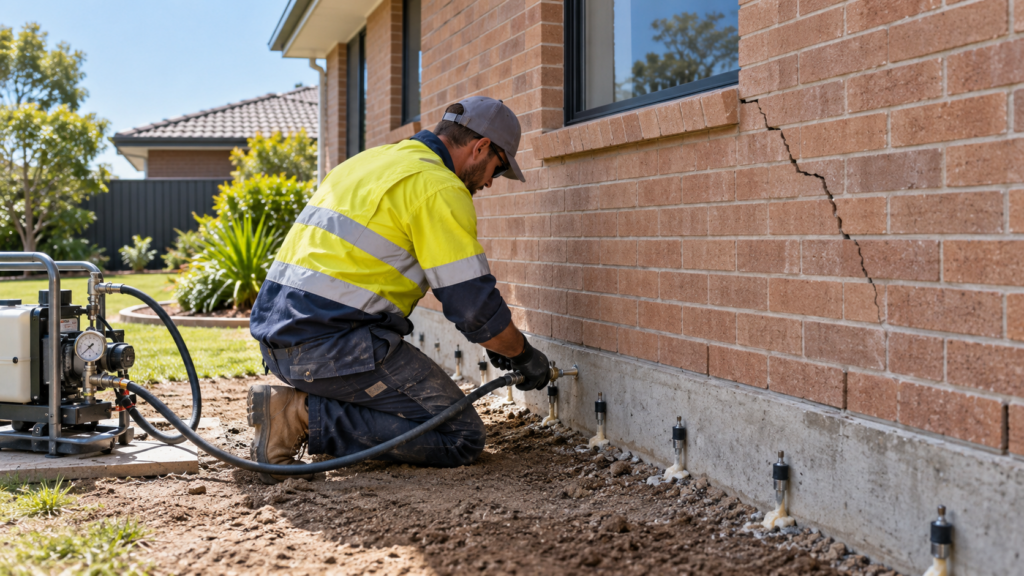
With resin injection, small holes are drilled through or beside the slab or footing. Injection tubes are set to the depths in the injection plan, and a two-part polyurethane resin is pumped in. The resin expands and sets quickly, filling voids and pushing into loose or soft soil. Where lift is needed, the team monitors levels during injection and stops at the target.
Most jobs need no large excavation, which is why resin injection is sometimes called resin underpinning or chemical underpinning. Our resin injection page explains how we plan and carry out the work.
Figure 2. Resin injection: tubes deliver expanding polyurethane into voids and weak soil below the existing footing. Schematic only.
Underpinning vs resin injection: side-by-side comparison
The table compares mass concrete underpinning, screw piles and polyurethane resin injection on the points homeowners ask about most. Use it as a general guide only. Your soil investigation, level survey, and leak testing determine which method suits your home, not a table.
| Criteria | Mass concrete underpinning | Screw piles/piers | Polyurethane resin injection |
| How it works | Digs under the footing in staged bays and pours new concrete down to firmer ground. | Steel piles are screwed or driven to a design depth, then connected to the footing. | Resin is injected through small holes. It expands to fill voids and firm up weak soil, and can lift. |
| Suitable soil and foundation conditions | Shallow or undersized strip footings where firmer ground sits at a depth that can be dug safely. | Firm ground is deep, access is tight, or digging is unsuitable. | Voids and loose or soft soil within reach under slabs and footings. Localised settlement. Sound concrete that has dropped. |
| Limitations | Adds weight. Deep, firm ground makes it slow and costly. Groundwater and buried services complicate digging. | Needs design for the soil. Buried rubble or rock can stop piles. Connection details matter. | Does not fix a broken or undersized footing. Less suited where weak soil runs deeper than the injection reaches. Reactive clay needs careful assessment. An active leak keeps causing movement. |
| Invasiveness | High. Pits beside and under walls, spoil removal, garden and paving reinstatement. | Low to moderate. Small excavations at each pile; machinery access needed. | Low. Small drill holes, hoses and a rig vehicle. Little or no excavation. |
| Typical project stages | Assessment and engineering design; approvals where needed; staged excavation; pour and cure; backfill; relevel and crack repair. | Assessment and design; locate services; install piles; connect to footing; relevel; reinstate. | Assessment and levels survey; injection plan; drilling; staged injection with level monitoring; seal holes; final levels. |
| Cost drivers | Depth to firm ground, number of bays, access, soil, groundwater, and reinstatement. | Number and depth of piles, machinery access, and connection design. | Area and depth treated, resin volume (large voids use more), lift needed, and access. |
| Longevity considerations | Depends on reaching stable ground, concrete quality and moisture control around the house. | Depends on pile design, corrosion protection and the founding layer. | Depends on correct diagnosis, injection depth and pattern, soil type and moisture control. |
| Professional assessment needed | Yes. Engineering design and a licensed contractor. | Yes. Pile design by an engineer and a licensed contractor. | Yes. Site assessment to confirm the voids and soil suit resin, plus a licensed contractor. |
For pricing guidance, our Melbourne underpinning page lists most underpinning projects at $5,000 to $30,000, depending on the method, the number of piers or injection points, depth to stable soil, and access. Your own quote depends on your site.
Which method is right for your home?
There is no universal winner. Method choice depends on engineering assessment and site conditions: the soil type, how deep firm ground sits, whether the footing itself is sound, and whether a leak or tree is still driving movement. A good assessor tells you which method suits and why, and also tells you when neither one does.
What a proper assessment includes
- Crack mapping, graded against the damage categories in the CSIRO foundation maintenance guide.
- A floor levels survey to show where the house has dropped and by how much.
- Soil investigation where needed, such as probes or boreholes, to find soft layers and firm ground.
- Plumbing and stormwater leak testing. Leaks are a common cause, as explained in the section on how water leaks cause subsidence.
- A check of the footing type and condition, and engineering input where a design is needed.
On reactive clay, moisture changes drive much of the movement. CSIRO notes that “all clays react to the presence of water by slowly absorbing it, making the soil increase in volume”. Our article on reactive clay and moisture explains why this matters for any repair.
When resin injection is often the better fit
- Voids or soft soil sit close under a sound slab or footing.
- Settlement is localised, such as one corner or one room.
- Access is tight, or you want to avoid digging up gardens and paving.
- The cause, such as a leak, has been found and fixed.
When underpinning or piers are the better fit
- The footing is cracked, undersized or deteriorated.
- Weak soil runs deeper than the injection can reach, so the load needs to go to firmer ground.
- New loads are planned, such as a second storey, and an engineer specifies deeper support.
- The ground has been disturbed by nearby excavation.
Our underpinning team carries out mass concrete underpinning, screw piling, and resin injection, so the recommendation is based on the diagnosis.
Can resin injection fix a sinking slab?
Often, yes. When a slab has dropped due to voids or soft soil beneath it, polyurethane resin can fill the gaps, firm up the ground, and lift the slab back toward level. It is a common fix for driveways, paths, garage floors and house slabs. It is not the right fix for every sinking slab, so an assessment comes first.
Our slab jacking service uses the same approach on driveways, paths, patios, garage floors and pool surrounds. For house slabs and footings, see the resin injection section. Resin is not the answer when:
- A leaking pipe or broken stormwater line is still wetting the soil.
- Soft soil runs deeper than the injection can reach.
- The slab or footing has cracked structurally, or was undersized from the start.
In those cases, the cause is fixed first, and the support may need to be underpinned.
How do cost, disruption and timing compare?
Resin injection is often less expensive and less disruptive for suitable jobs, because there is less digging, labour and reinstatement. That is a tendency, not a rule. A large void can use a lot of resin, and a small underpinning job can cost less than a big injection. Compare quotes that solve the same diagnosed problem.
What drives the cost
For underpinning, the main drivers are depth to firm ground, the number of bays or piles, access and reinstatement. For resin injection, the treated area and depth, the resin volume, the required lift, and access are key. Ask each contractor to state the diagnosis, the method, the target levels and what is excluded so that you can compare like with like.
Can you stay at home during work?
With resin injection, most households stay in place, as work is done through small holes. Underpinning depends on the scope. Pits beside walls, noise and restricted access are common, and on larger jobs, some families choose to stay elsewhere for part of the work. Timing depends on the job’s size, so ask for a schedule in your quote.
Will insurance cover it?
Sometimes. Insurance may respond to damage caused by a sudden insured event, while damage that develops gradually is treated differently by most policies. Your product disclosure statement decides it. MoneySmart has a plain guide to choosing home insurance.
How long does each method last?
Both methods can give long-term support when the diagnosis is right, and moisture around the house is controlled. Neither lasts if the cause keeps going. A leak that keeps soaking clay, or tree roots drying it out, can move a house regardless of which method was used. Ask how the design addresses the cause, not just the symptom.
CSIRO warns that “even a minuscule leak can be enough to saturate a clay foundation”. Keep downpipes connected to stormwater, fix leaks early, and keep paving sloping away from the house. Our resin products carry a 100-year warranty, and our artistry a 50-year warranty. [Link to warranty terms]
Check licences and engineering before you sign
Underpinning is licensed work. In NSW, underpinning and piering are their own licensed categories of work. Check any contractor on the Victorian practitioner register, the QBCC licence registers or with Access Canberra. Where a design is needed, you can check an engineer on the National Engineering Register.
Raise & Relevel holds NSW licence 377694C, VIC CDB-U 73507, QLD 15300551 and ACT 20211579, and has raised and relevelled more than 7,000 homes.
Frequently asked questions
Is resin injection as strong as underpinning?
They do different jobs, so strength is not a fair comparison. Underpinning carries the load down to deeper ground. Resin injection improves the ground already under the footing. Where weak soil lies within reach, and the footing is sound, resin can provide a stable result. Where the ground is deep or the footing has failed, underpinning or piers are better suited.
How long does resin injection last?
Resin injection is designed as a permanent repair, and our resin products carry a 100-year warranty. How long the result lasts depends on an accurate diagnosis and moisture control around the house. If a leak or tree keeps changing soil moisture, the ground can move again around or below the treated zone.
Which is cheaper, underpinning or resin injection?
Resin injection is often cheaper for suitable jobs because there is less digging and reinstatement. Not always, though. Large voids use more resin, and some sites need underpinning regardless. Our Melbourne page lists most underpinning projects priced between $5,000 and $30,000. A site assessment gives you a quote for your home.
Can you live in the house during each method?
Usually, yes, for resin injection, because the work is done through small holes with minimal digging. Underpinning depends on the scope. Pits beside walls, noise and restricted access are common, and on some larger jobs, it is easier to stay elsewhere for part of the work. Ask your contractor before work starts.
Can resin injection be used on any soil?
No. It suits voids and loose or soft soil it can reach. Reactive clay requires careful assessment because its volume changes with moisture content. Very deep soft layers, ground kept wet by an active leak, or rubble and rock in the way can rule it out. A soil and leak check comes first.
Get the right fix, not just the one on offer
Underpinning and resin injection are both proven ways to stabilise a home. The right one depends on your soil, your footings and what is causing the movement. Choose a contractor who explains the diagnosis plainly and offers more than one method.
Book a site assessment with Raise & Relevel. We check the cracks, levels, soil and leaks, explain your options in plain English, and tell you if we are not the right fix. We work across Sydney, Melbourne and Brisbane. Call [1300 053 835] or contact us to arrange a consultation.