Underpinning Melbourne

Raise & Relevel underpins and relevels homes across Melbourne, from single cracked walls to whole-house subsidence. We have relevelled more than 7,000 homes, we quote a fixed price after a free on-site assessment, and every job is backed by a 100 year product guarantee and a 50 year workmanship guarantee.

Most Melbourne underpinning costs between $5,000 and $30,000, depending on the method, the soil, and how far the house has moved. We are fully licensed and insured (Victorian builder’s licence CDB-U 73507), and the person who assesses your home is the person who quotes it.

What is underpinning?

Underpinning is the process of strengthening or extending a building’s existing footings so they can carry the load properly, usually because the original footing is no longer adequately supported by the ground beneath it. Footings are the concrete elements that transfer a building’s weight into the ground, and when the supporting soil moves, settles, or loses strength, the footing can no longer do that job reliably.

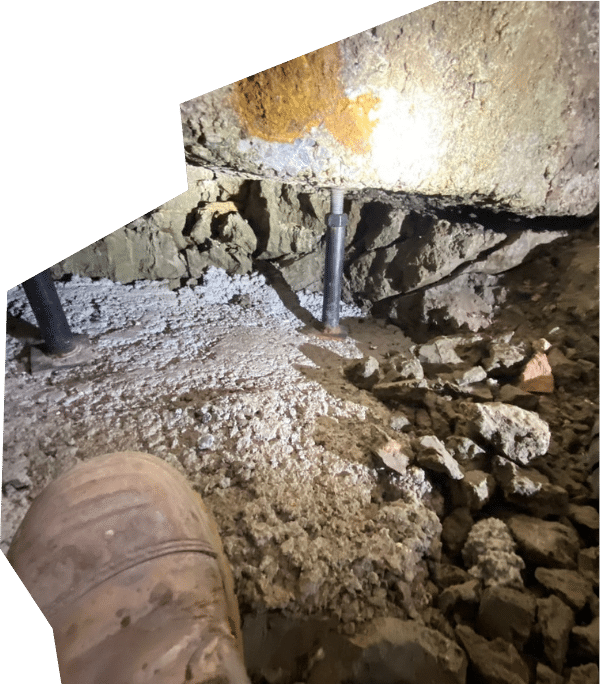
In practical terms, underpinning adds new support beneath or beside the existing footing, engineered to reach ground that will not move the way the original founding material has. Once that new support is in place and bearing the load, the movement that caused the original cracking or settlement should stop, provided the underlying cause, whether that is reactive clay, drainage, or something else, is also managed.

Underpinning is a distinct service from lifting a slab that has simply sunk. Our national underpinning page provides the broader picture if you are comparing underpinning with other foundation repair options.

Why Melbourne homes move in the first place

Melbourne homes move because the ground beneath them changes with the seasons, and reactive clay is the main reason. Reactive clay swells when it takes on water and shrinks as it dries out, so a house built on it sits on ground that lifts slightly in winter and drops slightly in summer. Over years, that movement is rarely even: one corner of the house typically moves more than another, and the walls crack where the difference is greatest. This single mechanism, repeated season after season, underpins most of the work we do across Melbourne.

What makes this hard to notice day-to-day is the timescale. The movement in any single season is often only a few millimetres, well within what a home can absorb without visible damage. It is the accumulation over many wet and dry cycles, combined with uneven drying across a block (shaded side versus sun-exposed side, garden bed versus paved area), that eventually produces the differential movement that shows up as cracking, sticking doors or an out-of-level floor. This is also why symptoms often become noticeable after a run of unusually dry or unusually wet weather, rather than gradually and evenly over time.

Soil movement potential is measured using the AS 2870 site classification system, which rates a block from stable to extremely reactive. Class A is sand or rock with negligible seasonal movement. Class S is slightly reactive clay, up to about 20mm of surface movement. Class M is moderately reactive, about 20 to 40mm, and common across much of Melbourne. Class H1 is highly reactive clay at about 40 to 60mm, enough to crack masonry, and H2 is very highly reactive at about 60 to 75mm. Class E is extremely reactive, more than about 75mm, and Class P covers problem sites such as fill, soft soil, landslip or mine subsidence. A “-D” suffix indicates deep-seated moisture change, more common in drier inland climates than metropolitan Melbourne. (Source: AS 2870, Residential Slabs and Footings.)

Three other causes account for most of the rest. Thirsty tree roots draw moisture out of the clay on one side of the house, which is often why the worst cracking shows up on the side nearest a large tree. Drainage failure, such as leaking stormwater, a blocked downpipe or a broken sewer line, saturates one corner of the site. And poorly compacted fill and ageing timber stumps are more common in older Melbourne housing stock.

As a general tendency rather than a claim about any specific address, Melbourne’s western and northern suburbs commonly sit on basalt-derived clay, which tends to be heavier and more reactive, while bayside and south-eastern suburbs often have sandier profiles that behave differently through the seasons. Your own site classification report, or a free assessment, is the only reliable way to know what applies to your property. If you want to understand more about the symptom side before choosing a repair, our Melbourne house subsidence page covers how to assess what you are seeing.

How much does underpinning cost in Melbourne?

Underpinning in Melbourne typically falls into three bands. Minor underpinning, addressing a single wall or a small area, generally costs $5,000 to $10,000. Moderate underpinning, covering a larger section of a house, generally runs from $10,000 to $30,000 or more. Commercial and larger structural underpinning projects generally run from $30,000 to $100,000 or more.

What moves the price

  • The underpinning method used
  • The number of piers or injection points required
  • The depth to stable, load-bearing soil
  • Site access for machinery and equipment
  • The site’s soil classification
  • Whether the house is brick or weatherboard construction
  • Whether engineering reports and certification are required

What a fixed price quote includes

A properly scoped fixed-price quote should state the underpinning method, the number of piers or injection points, what site preparation and reinstatement are included, whether engineering input is included or charged separately, and what the warranty covers. This is the question every homeowner has after collecting three quotes that turn out not to be comparable, since a cheaper number often means a narrower scope rather than a better price for the same work.

It is worth asking specifically whether a quote includes reinstatement of gardens, paving or driveways disturbed by excavation, since this is a common source of unexpected additional cost once the main structural work is underway. A fixed price should cover the entire job as scoped in the free assessment, not just the underpinning work itself.

The only way to move from a band to an exact figure for your property is with a free on-site assessment, after which we provide a fixed-price quote rather than an estimate that can change once work begins.

What are the different types of underpinning?

There is no single best underpinning method. The right one depends on your soil, how deep stable ground sits, access to the site, and what your house is built from.

Mass concrete underpinning

The traditional method: sections of the existing footing are excavated in a controlled sequence, and new concrete is poured beneath it to extend the support down to more stable soil. It suits established damage where the required additional depth is not extreme and the house can tolerate staged excavation around its perimeter.

Screw piles and piers

Steel piles are driven or screwed down to reach stable, load-bearing material, then connected to the existing footing with a bracket. This suits sites where stable ground lies deeper or where loads exceed what mass concrete underpinning can economically support, and it typically requires machinery access to the affected area. Mass concrete and screw pile underpinning both work by installing new support beneath the existing footing, with the work sequenced so the building remains supported throughout.

Resin injection and slab jacking

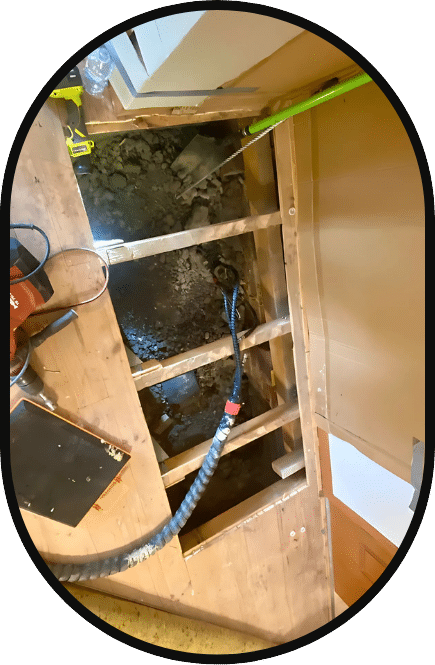
Where the slab or footing itself is basically sound, and the problem is a void or minor settlement, resin injection or slab jacking can often achieve the result with far less disruption than traditional underpinning: no excavation, small injection holes only. Resin injection is not a universal substitute, though. It is not the answer when a footing has failed structurally, when loads need to be transferred to deeper, stable ground, or when the extent of ground movement exceeds what void filling can address. Being upfront about where it is not the right fit is part of giving you an accurate recommendation rather than a sales pitch.

Our Melbourne concrete repair page covers damage to the concrete itself, separate from the foundation support issues addressed on this page. A free on-site assessment is the only reliable way to know which approach suits your specific property.

When do you need underpinning?

Most homes that actually need underpinning show three or four of these signs at once. A single hairline crack on its own usually does not mean subsidence, so the signs below are worth reading together rather than in isolation.

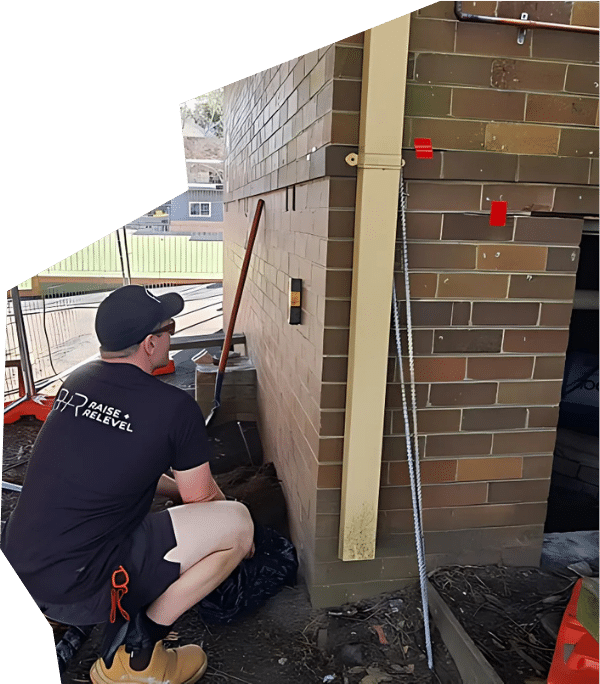
Crack width is the first thing most people look at. As a general guide, a hairline crack that is barely visible is common and often just due to seasonal changes or shrinkage. A fine but noticeable crack is worth watching, especially if it is new or changing. A noticeable crack alongside doors or windows that have started sticking is worth a professional assessment. A wide crack, or one that has been growing over weeks or months, warrants an assessment sooner rather than later. A severe crack, stepped-through brickwork, or structural elements visibly out of alignment should be assessed as a priority. For cracks that are being actively monitored and need treatment, Melbourne crack injection is often the first step before any structural work is considered.

The non-crack signs are just as telling:

  • Doors and windows that stick in one season and not another
  • Gaps opening between skirting boards and the floor
  • Sloping or bouncy floors
  • A visible step in brickwork above a window or door
  • Gaps appearing at the roofline from outside

For homes where the floor itself has become noticeably uneven, our unlevel buildings page covers what to expect. If you are seeing several of these together, the next step is a free on-site assessment, not a guess based on the crack alone. A structural assessment is the only way to confirm what is actually happening beneath your home.

How can Raise + Relevel Help?

From the first call to the completed job, the process is designed to give you a clear diagnosis and a fixed price before any work begins.

  1. First call and phone triage. We ask what you are seeing, when it started, and whether it is getting worse, so we can advise whether an assessment is warranted.
  2. Free on-site assessment. An assessor inspects the affected areas, checks crack patterns and floor levels, and identifies the likely cause of the movement.
  3. Engineering input where needed. For significant or structural cases, we arrange engineering assessment to confirm the diagnosis and inform the repair design.
  4. Fixed price quote. You receive a written quote that names the method, scope, and price, with no surprises once work begins.
  5. The works. Underpinning or injection work is carried out to the agreed scope, with movement monitored throughout.
  6. Completion and guarantee documentation. We confirm that the work meets our standards and hand over your guarantee documentation for the completed job.

Why Melbourne homeowners choose Raise & Relevel for underpinning

  • Every job is backed by a 100-year product guarantee and a 50-year workmanship guarantee, covering both the materials and the standard of our work. If the problem returns, we return.
  • We hold Victorian builder’s licence CDB-U 73507 and are fully licensed and insured.
  • We have relevelled more than 7,000 homes across Australia.
  • The person who assesses and quotes your job is the person who does it. No call centres, no sales people.
  • You get a fixed price quote after a free on-site assessment, not an estimate that changes once work starts.

We provide underpinning across greater Melbourne, with particularly strong coverage in the south east given our base in Seaford: Frankston, Carrum, Chelsea, Mordialloc, Mentone, Cheltenham, Brighton, Dandenong and the Mornington Peninsula in the south east and bayside; Richmond, Hawthorn, Camberwell, Box Hill, Doncaster and Ringwood in the inner east; Brunswick, Preston, Reservoir, Bundoora and Eltham in the north; and Footscray, Sunshine, Werribee, Point Cook and Melton in the west. See our Melbourne hub for the full range of services we offer across the city.

Cracked walls, sticking doors or an uneven floor do not get better by waiting. Book a free on-site assessment, and we will confirm the cause and provide a fixed-price quote before any work begins. Booking an assessment does not commit you to anything. Call us on 1300 053 835 to talk to the team directly.

Why Raise + Relevel?

Better.

Better quality workmanship for a better price R+R delivers value to our customers by offering the highest quality services at the most competitve price.

Experience.

Over 100 years of genuine experience in relevelling structures – we are ground surgeons.

Guaranteed.

We stand behind the quality of our products and workmanship. Our warranty provides 100-year warranty on our resin products and 50-year warranty on our workmanship – If the problem returns, we return.

FAQ

Your home is everything to you and your family, so before going ahead with any subsidence repairs, we’ve put together a list of questions our customers should ask:

Minor underpinning generally costs $5,000 to $10,000, moderate underpinning $10,000 to $30,000 or more, and commercial or larger structural projects $30,000 to $100,000 or more. The exact figure depends on the method, the number of piers or injection points, and site access. A free on-site assessment gives you a fixed price quote rather than an estimate.

Traditional underpinning methods involve excavation, can take longer than other repair options, and cost more than surface-level fixes. It also treats the structural support problem specifically, so if drainage, tree roots or other contributing causes are not addressed, the underlying movement can continue even after underpinning is complete. An honest assessment should identify all contributing causes, not just the footing itself, and disruption during the works is worth discussing upfront rather than discovering partway through.

It depends entirely on your policy. Most home insurance policies exclude gradual earth movement and subsidence, though some cover sudden events like a burst pipe causing rapid ground loss. Check your policy wording directly, or speak to your insurer, since this varies significantly between providers and policies. A written assessment report can support a conversation with your insurer either way.

Sometimes. Resin injection, slab jacking, drainage correction and root barriers can each address specific causes of movement without full underpinning, depending on what is actually causing the problem. None of these is a universal substitute: the right option depends on whether the issue is a void, a slab, a drainage source, or the footing itself failing structurally.

For the right conditions, yes, and it is often less disruptive. Resin injection suits void filling and controlled lifting where the existing structure is basically sound. It is not a substitute for traditional underpinning where a footing has failed structurally or where loads need to reach much deeper stable ground. See our Melbourne resin injection page for more detail.

For the right conditions, yes, and it is often less disruptive. Resin injection suits void filling and controlled lifting where the existing structure is basically sound. It is not a substitute for traditional underpinning where a footing has failed structurally or where loads need to reach much deeper stable ground. See our Melbourne resin injection page for more detail.

Timeframes vary significantly by method, by how many piers or injection points are needed, and by site access. Simpler resin injection jobs are typically much faster than traditional pier or mass concrete underpinning across a larger section of a house. Your fixed price quote will include a realistic timeframe specific to your job.

In most cases, no, though this depends on the scope and method of the specific job. We will explain exactly what to expect during the works as part of your quote, including which areas of the property will be affected and for how long.

Underpinning addresses the structural cause of the movement, stopping further movement from that cause. It does not automatically close or repair existing cosmetic cracks in walls, which is usually a separate cosmetic repair once the structure has been stabilised and monitored. Your quote will state clearly what is included and what is not.

We service greater Melbourne, with particularly strong coverage across the south east, bayside, inner and eastern suburbs, and the north and west. See the Where We Work section above for named suburbs by region, or get in touch to confirm coverage for your specific address.

of Combined Experience
Homes Relevelled
Guaranteed

At Raise + Relevel, experience matters. With a century of combined expertise and over 7,000 homes re-levelled, we deliver lasting results—guaranteed.

100% Product Guarantee

Quality materials built to last

50-Year Workmanship Guarantee

Proven expertise you can trust

Every home is unique. We provide tailored solutions at the best value, ensuring stability without compromise.

Have More Questions?

Name