Slab jacking vs underpinning comes down to what’s actually failing: slab jacking lifts and re-supports a settled slab, while underpinning strengthens or extends a foundation that can no longer carry its load. Similar symptoms, cracked walls, sunken concrete, sticking doors, can have different causes, so the affected element, soil, and drainage need checking before the cheaper option ends up costing more.
| Quick answer
Slab jacking is generally used to lift and re-support a settled concrete slab by injecting material beneath it. Underpinning is used when existing footings or foundations require deeper, stronger, or more stable support. Resin injection may be an alternative in some settlement conditions, but it isn’t a universal substitute for underpinning. The correct repair can’t be selected from cracks or uneven floors alone. It should follow diagnosis of the movement’s cause and the elements affected. |
Slab Jacking vs Underpinning: What’s the Difference?
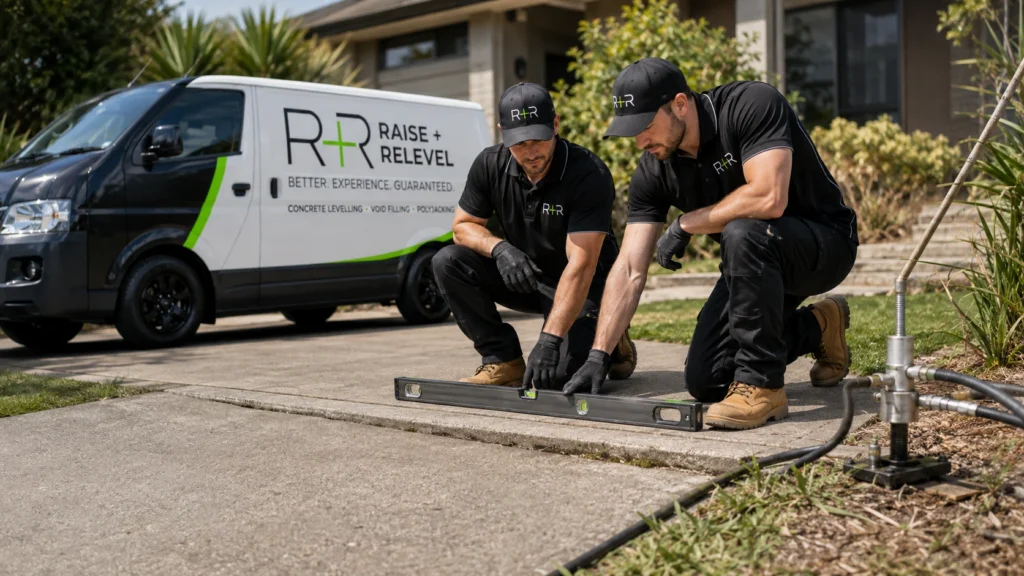
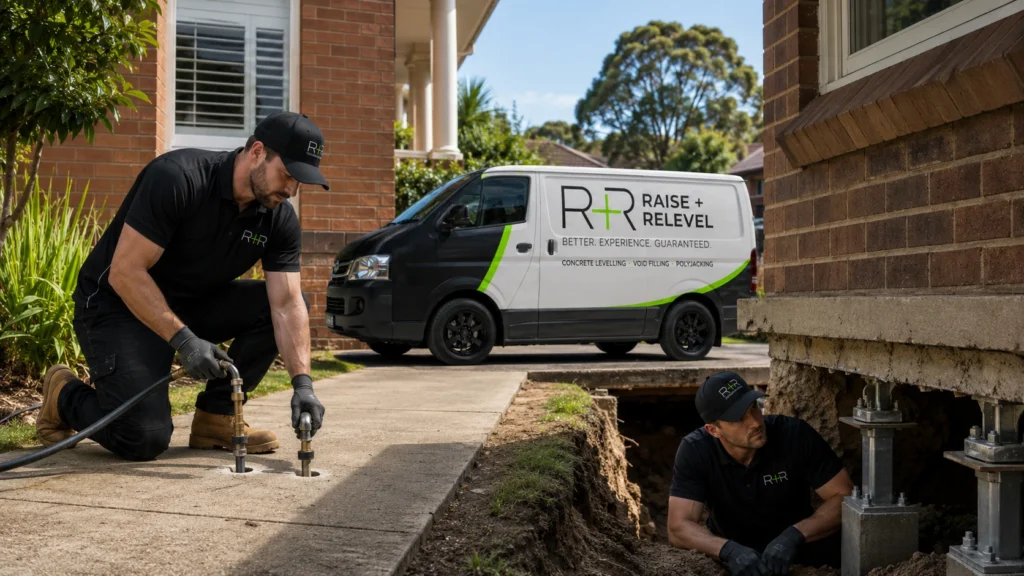
Slab jacking primarily fills voids and raises settled concrete, a form of concrete levelling, whereas underpinning alters or supplements the support beneath a building’s existing foundation. One addresses a slab that has lost the ground support beneath it; the other addresses a footing that can no longer carry the structure above it.
| Comparison Factor | Slab Jacking or Resin Injection | Underpinning |
| Primary purpose | Lift, level, or re-support settled concrete | Strengthen, stabilise, or deepen foundations |
| Typical applications | Driveways, paths, patios, floors, and suitable slabs | Load-bearing walls, footings, and foundations |
| Basic method | Material is injected beneath the slab | New supports are installed beneath or alongside existing footings |
| Common materials | Cementitious grout or expanding structural resin | Concrete, piles, piers, brackets, or engineered systems |
| Excavation | Usually limited | Often more extensive, depending on the method |
| Installation time | Commonly shorter | Commonly longer |
| Disruption | Usually lower | Often higher |
| Structural capacity | Project- and system-specific | Engineered for the affected foundation and loads |
| Main limitation | Cannot correct every footing or structural failure | More invasive and potentially more expensive |
| Best suited to | Suitable settlement or void-related slab problems | Foundation instability requiring additional support |
Resin injection vs underpinning isn’t a cheap-versus-expensive version of the same repair; each treats different conditions. A slab can settle independently of a building’s primary footings, and surface levelling doesn’t necessarily stabilise a failing foundation. Some projects need both ground improvement and footing repair, and lifting concrete introduces forces that must be carefully controlled. Whichever method is used, the original cause, such as drainage failure, erosion, or unsuitable fill, may also need correcting, or the movement is likely to return.
What Signs Suggest Your Home May Need Foundation Repair?
Visible symptoms can indicate movement, but they don’t identify the cause or prove that underpinning is required. The same crack can point to a minor issue in one home and a structural one in another.
Signs to investigate
- Cracks that are widening or recurring
- Stepped cracks through brickwork or masonry
- Separation around windows, doors, ceilings, or cornices
- Doors and windows that suddenly stick or distort
- Noticeably sloping or uneven floors
- Gaps between walls, floors, or skirting boards
- Localised sinking of patios, paths, or driveways
- Water pooling near the building
- Cracked or displaced footings
- Movement following flooding, drought, excavation, or drainage problems
It helps to differentiate between cosmetic cracking, seasonal movement, localised slab settlement, differential footing movement, and potential structural distress, since each points toward a different fix. Don’t diagnose severity from crack width alone: location, direction, rate of change, and surrounding conditions matter too.
Photographing and dating changes can help establish whether movement is active, and sticking doors don’t always mean foundation trouble; humidity, hinges, or frame problems can also be the cause. Drainage and plumbing defects can contribute to soil-moisture changes, and reactive soils shrink and swell as conditions change. Some movement is normal; progressive or significant symptoms warrant investigation. The Building and Plumbing Commission Victoria notes that soil moisture changes, settlement, erosion, and tree roots can contribute to foundation movement, and that significant damage should be assessed by a qualified professional.
When Is Slab Jacking the Right Solution?
Slab jacking, sometimes referred to as concrete slab lifting, may be appropriate when a concrete element has settled because of voids, weak fill, erosion, or loss of support, and the slab itself remains suitable for controlled lifting.
Potential applications
- Sunken driveways
- Uneven concrete paths
- Settled patios or outdoor slabs
- Suitable garage or internal floor slabs
- Concrete affected by underlying voids
- Localised settlement where injection can restore support
- Projects where limited excavation is beneficial
Traditional slab jacking commonly uses a cementitious grout, while resin injection uses an expanding material delivered through smaller injection points. Resin can expand quickly and may allow controlled lifting, but which product suits a project depends on soil, voids, loading, and moisture, not on which sounds more modern. If resin injection underpinning looks like it could handle your settlement problem on its own, it’s worth understanding the process before ruling out slab jacking or full underpinning.
Cases where slab jacking may not be enough
- Severely cracked or deteriorated concrete
- Footings that lack adequate bearing capacity
- Deep or continuing ground instability
- Structural failure unrelated to a settled slab
- Unresolved erosion, water leaks, or drainage problems
- Movement outside the injection system’s design capability
- Situations requiring new load paths or deeper founding
Levelling and structural stabilisation are related but not identical outcomes, and filling a void doesn’t automatically correct its cause. Injection pressure must be monitored to avoid uncontrolled lifting, and existing pipes, services, and adjacent structures affect the repair plan. Resin injection shouldn’t be presented as a universal underpinning alternative; it’s a good fit for some settlement problems and not others.
When Does a Foundation Require Underpinning?
Underpinning may be required when existing footings can’t adequately transfer loads to stable ground, or when a qualified professional determines the foundation needs additional support.
Situations that may lead to underpinning
- Inadequate or deteriorated existing footings
- Significant differential settlement
- Weak, disturbed, or unsuitable founding material
- Erosion or loss of soil beneath a footing
- Changes to structural loads
- Nearby excavation affecting foundation support
- Persistent movement that drainage or ground treatment alone can’t resolve
- Structural alterations requiring additional foundation capacity
Underpinning covers several distinct methods, including mass concrete underpinning, beam-and-base systems, screw or helical piles, micropiles, and pier-and-bracket systems. No single system suits every property: the right one depends on load, access, soil profile, founding depth, and engineering design. If footings need direct structural support, our underpinning foundations page covers mass concrete, beam-and-base, and screw pile methods in more detail.
Underpinning should address a diagnosed load-support problem, and stabilising a foundation doesn’t always restore every cosmetic defect automatically. Some lifting may be neither achievable nor desirable, and excavation sequencing matters because existing loads must remain supported throughout the work. The National Construction Code notes that foundation bearing capacity varies by site and may require input from a qualified engineer.
How Do Costs, Repair Time, and Long-Term Results Compare?
Slab jacking is often less expensive and less disruptive than underpinning, but only when technically suitable. Treat any national price range with caution: actual costs depend heavily on the site.
| Factor | Slab Jacking or Resin Injection | Underpinning |
| Typical relative cost | Usually lower | Usually higher |
| Project duration | Often shorter | Often longer |
| Excavation | Limited in many projects | May be substantial |
| Access requirements | Injection access and equipment | Excavation or piling access |
| Cosmetic impact | Small injection holes may remain | Excavated and repaired areas may remain |
| Design requirements | Depends on application and structural role | Commonly requires engineering design |
| Main cost drivers | Area, void volume, access, material, lifting complexity | Depth, number of supports, soil, loads, access, method |
| Long-term outcome | Depends on correct diagnosis and stable underlying conditions | Depends on design, installation, soil behaviour, and cause control |
Factors affecting price
- Extent and depth of movement
- Number and size of affected areas
- Soil and geotechnical conditions
- Building weight and construction type
- Required level of lifting
- Accessibility for equipment
- Excavation and spoil removal
- Engineering, surveying, and approval requirements
- Plumbing or drainage repairs
- Reinstatement of finishes and landscaping
The lowest upfront price doesn’t equal the lowest whole-of-repair cost, and quotes covering different scopes should be compared line by line. Cosmetic repairs should usually follow stabilisation and a monitoring period, not happen alongside it. Warranties are worth assessing for scope, exclusions, and provider viability, and no responsible provider should promise that all future movement can be eliminated.
How Does a Foundation Specialist Determine the Best Repair Method?
A specialist should diagnose the cause before recommending a repair product or method.
Diagnostic framework
- Review the history: when symptoms began, whether they’re progressing, and any nearby drainage, weather, or construction changes
- Inspect the building: crack patterns, floor levels, doors, windows, footings, and affected concrete
- Measure movement: floor levels, crack widths, displacement, and other measurements
- Investigate moisture and services: drainage defects, leaking pipes, ponding water, and abnormal soil-moisture conditions
- Assess the site and soil: review available soil reports, and determine if further geotechnical investigation is needed
- Identify the affected element: a non-structural slab, load-bearing footing, foundation, or broader ground instability
- Develop repair options: compare feasible methods by suitability, disruption, cost, risk, and expected outcome
- Specify and monitor the repair: injection locations, support positions, lift tolerances, sequencing, and post-repair monitoring
Questions homeowners should ask
- What evidence identifies the cause of the movement?
- Is the affected concrete load-bearing?
- Is the movement active or historic?
- What investigations support the recommendation?
- What alternatives were considered?
- Does the proposal include drainage or moisture-related causes?
- Who designs and supervises the work?
- Are permits, engineering documentation, or inspections required?
- What does the warranty cover and exclude?
- What happens if the structure cannot safely be returned to level?
A contractor selling one repair system may not provide an independent diagnosis, and soil classification alone doesn’t establish the cause of existing damage. Floor-level surveys can help distinguish local settlement from wider movement, and leak detection may need to happen before structural work starts. Complex or potentially structural cases may justify independent engineering advice.
Do I Need Underpinning, or Is There an Alternative?
Underpinning shouldn’t be assumed from cracks alone. Depending on the diagnosis, an alternative or supporting measure may be more appropriate.
Potential alternatives or complementary measures
- Slab jacking
- Resin injection
- Ground improvement
- Drainage correction
- Plumbing repairs
- Erosion control
- Moisture-management measures
- Localised concrete replacement
- Structural crack repair after stabilisation
- Monitoring where movement is minor and non-progressive
- Other engineer-designed foundation systems
Drainage, plumbing, or moisture management isn’t a substitute for structural support when the foundation lacks capacity. The reverse is also true: underpinning may not solve movement if the underlying moisture problem is left active. For slabs that just need lifting, our concrete slab jacking service may be the simpler, less invasive option.
The repair should match
- The cause of movement
- The affected structural element
- The current ground conditions
- The expected future loads
- The extent and rate of movement
- The required performance outcome
The Bottom Line
Slab jacking and underpinning aren’t interchangeable. Slab jacking suits suitable settled concrete and loss of support beneath a slab. Underpinning is used when the foundation or footing requires additional structural support. Resin injection can be effective in appropriate conditions but shouldn’t be positioned as a guaranteed substitute for underpinning. An inspection, and where warranted, engineering or geotechnical assessment, should precede the repair decision.
If you’ve noticed cracked walls, sunken concrete, or doors that no longer sit right, book a foundation and subsidence repair assessment before committing to a repair. Compare options against the same defined outcome rather than by price alone, and for significant or disputed symptoms, seek independent engineering advice. Raise and Relevel covers the full range, from slab jacking to engineered underpinning.
Frequently Asked Questions
Is slab jacking cheaper than underpinning?
Usually, yes, mainly because it involves less excavation. But it only saves money when it’s solving the right problem; using it on a footing that needs structural support just delays a more expensive repair. Costs depend on the affected area, soil conditions, and access, so national price ranges aren’t reliable. Compare quotes against the same defined scope, not price alone.
Can slab jacking fix serious foundation damage?
Not reliably. Slab jacking and resin injection suit settlement and void-related slab problems, but aren’t designed to correct severely cracked concrete, inadequate footing capacity, or deep, continuing ground instability. Where a new load path or deeper founding is needed, underpinning is usually required instead. A proper assessment confirms which applies to your damage.
How long do slab jacking and underpinning repairs last?
Neither method has a universally longer lifespan. Durability depends on correct diagnosis, design, materials, workmanship, soil behaviour, and whether the actual cause of movement has been controlled, not just treated at the surface. A long warranty isn’t proof of technical suitability, and closed cracks don’t necessarily mean the underlying problem is resolved.
How can I tell whether my foundation is sinking?
Watch for widening cracks, doors and windows that suddenly stick, sloping floors, and gaps around skirting boards or ceilings. These suggest movement but don’t confirm the cause or severity on their own. Photographing changes over time helps establish whether movement is active, and a professional inspection is the only reliable way to confirm genuine sinking.
Should I consult a structural engineer before choosing a repair method?
It’s worth it whenever damage is significant, progressive, disputed, or clearly structural, or when providers’ recommendations conflict. A contractor who sells one repair system may not independently weigh every alternative. An engineer can help confirm the cause, the affected element, and whether slab jacking, resin injection, or underpinning genuinely matches your property’s needs.