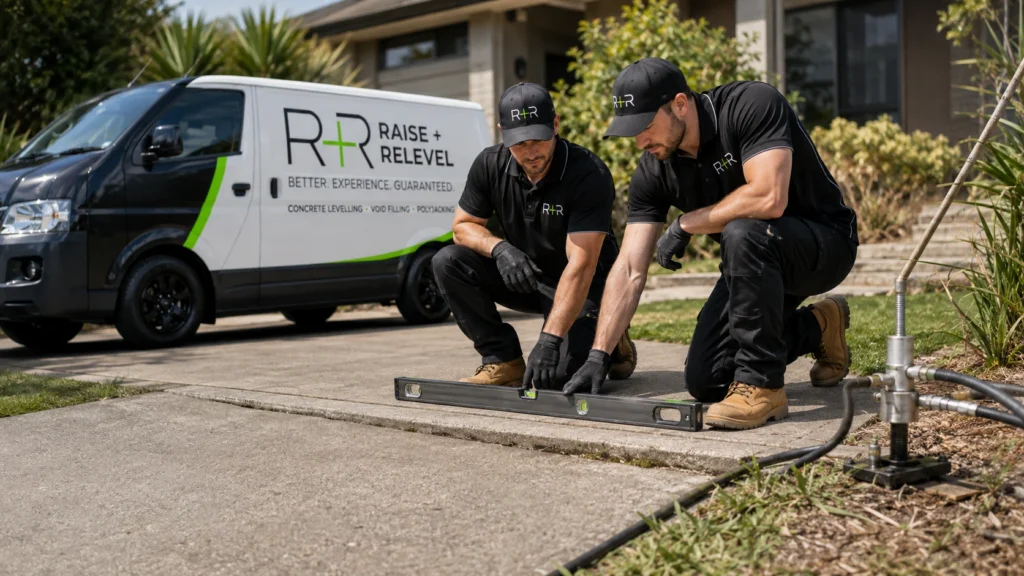
Structurally sound concrete affected by settlement can often be lifted, while badly damaged or poorly constructed concrete usually needs replacing. The right call depends on the concrete’s condition, the cause and depth of settlement, whether voids are present, drainage and erosion, and the final levels you need. Concrete lifting is generally the faster, cheaper starting point, but only when the slab itself is still sound.
| Quick answer
Lift the slab when the concrete remains reasonably intact and the main problem is lost support, voids, erosion, or settlement beneath it. Replace the slab when the concrete is severely cracked, crumbling, incorrectly constructed, extensively displaced, or unsuitable for controlled lifting. Lifting is commonly faster and less disruptive, but replacement rebuilds the slab and its base from scratch. The final decision should follow an inspection of both the concrete and the conditions beneath it. |
What Causes a Concrete Slab to Sink?
A slab sinks when the material beneath it can no longer provide even support. The concrete’s visible position is the symptom; the base condition usually determines the right repair.
Common causes
- Poorly compacted fill
- Settlement of service trenches
- Soil erosion beneath the slab
- Plumbing or drainage leaks
- Water flowing through slab joints or cracks
- Inadequate surface drainage
- Reactive soil movement
- Decomposing organic material
- Washout following heavy rain or flooding
- Tree-related moisture changes
- Ground disturbance from nearby work
- Inadequate original slab or base construction
| Possible Cause | Why the Slab Moves | Repair Consideration |
| Poorly compacted fill | Base compresses under the slab | Lifting may work if the remaining base can be improved |
| Erosion or washout | Support material is removed | Correct water source before or alongside lifting |
| Leaking pipe | Water weakens or removes supporting material | Repair leak before final slab repair |
| Reactive soil | Soil volume changes with moisture | Requires careful site assessment |
| Severe slab deterioration | Concrete can no longer act as a sound unit | Replacement may be preferable |
| Incorrect slab construction | Thickness, base, joints, or reinforcement may be inadequate | Reconstruction may be needed |
| Localised void | A limited section loses support | Injection may fill the void and restore support |
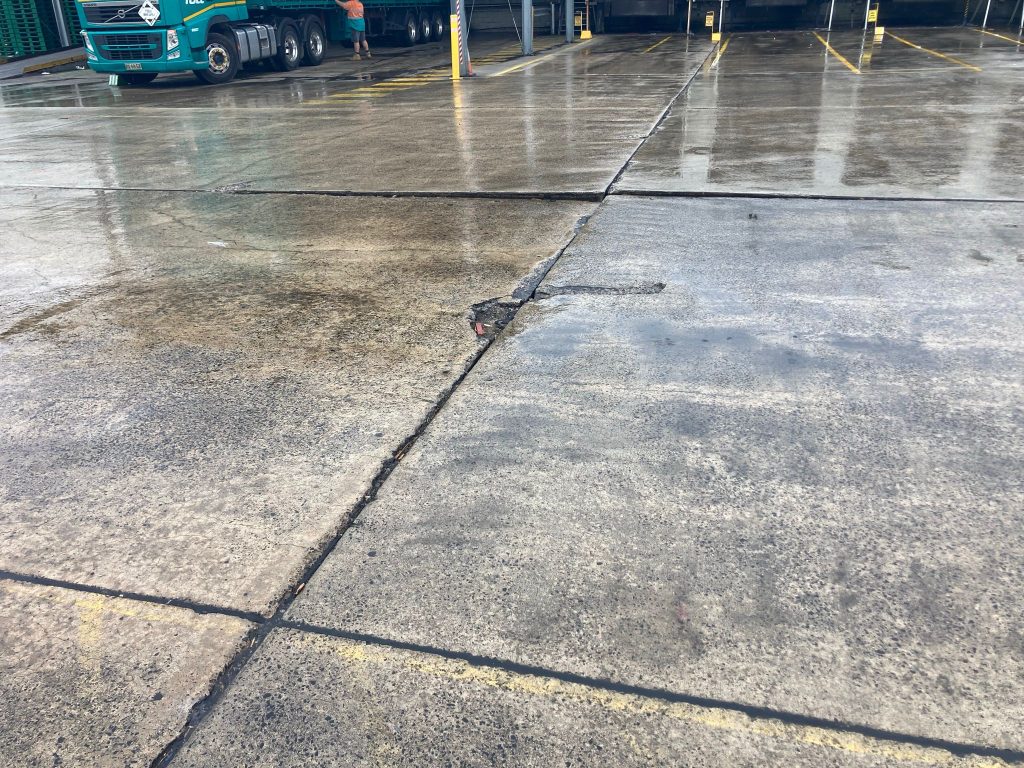
Settlement can affect one slab panel while neighbouring panels stay stable, and water pooling can be both a symptom and a cause of further deterioration. Raising a slab without correcting active erosion produces a temporary result, and surface cracks don’t reveal how large the void beneath actually is. Not every uneven surface is settlement, either; some slabs were simply poured with the wrong falls.
How Does Concrete Lifting Repair a Sunken Slab?
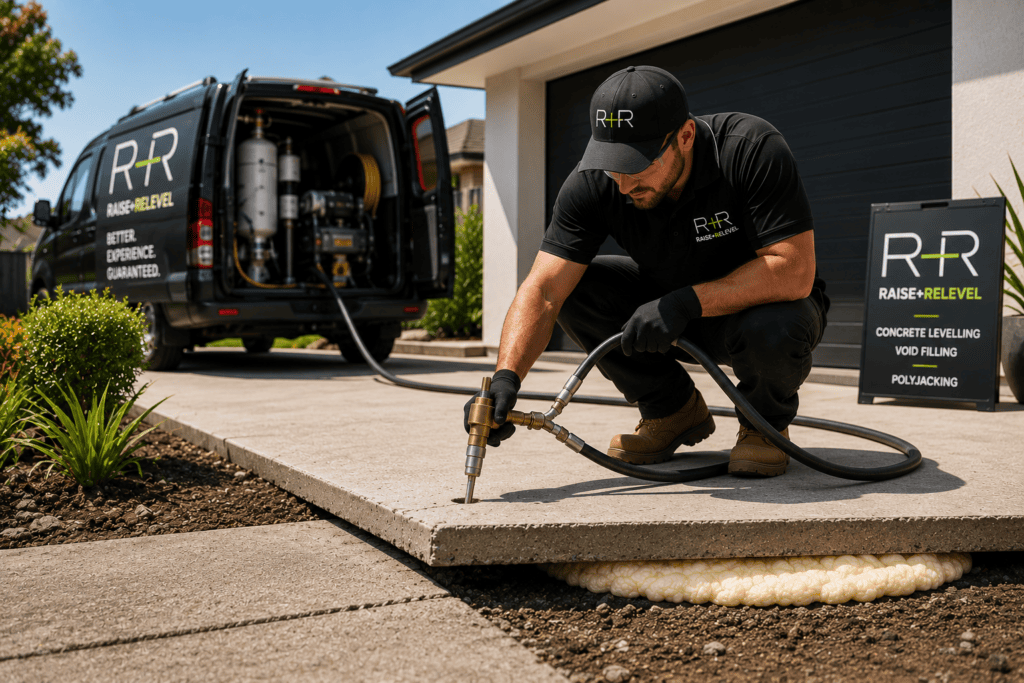
Concrete lifting raises and re-supports an existing slab by placing grout or expanding resin into voids or weak areas beneath it. This process follows standard concrete levelling guide methods, and the exact steps vary by system, site, and structural requirements.
Typical process
- Inspect the concrete and surrounding site
- Measure existing slab levels and falls
- Identify potential voids, services, and injection locations
- Drill access holes through or beside the slab
- Inject grout or expanding resin in controlled stages
- Monitor movement during lifting
- Stop once the specified level or support outcome is reached
- Seal injection holes and complete final measurements
Common lifting methods
Cementitious slab jacking: a grout mixture is pumped beneath the slab to fill voids and create lifting pressure. It’s an established method, with material weight and access-hole requirements to plan for.
Resin injection: expanding resin is injected beneath the slab to fill voids and permit controlled lifting, through smaller injection points and with a rapid reaction that needs careful monitoring.
Limitations
- Exact return to the original level may not be achievable
- Connected walls, services, steps, and adjoining slabs can restrict movement
- Injection does not repair deteriorated concrete
- Unresolved drainage or erosion can cause renewed movement
- Excessive or uncontrolled lifting may damage the slab or nearby finishes
- Load-bearing building slabs require a more detailed structural assessment than paths or driveways
Levelling and stabilisation aren’t always the same outcome, and some slabs should be stabilised without a complete lift. How much material is injected depends on conditions below the surface, and lifting sequence can matter as much as material choice. Small injection holes don’t mean the project is technically simple.
When Should You Lift Sunken Concrete?
Lifting is most appropriate when the concrete remains capable of moving as a reasonably intact unit and the support problem can be treated through injection.
Signs lifting may be suitable
- The slab is settled but largely intact
- Cracks are limited and sections haven’t fragmented
- The main issue is loss of support beneath the concrete
- Required lifting is within the repair system’s capability
- Access for injection and monitoring is available
- The underlying cause can be corrected or controlled
- Replacement would unnecessarily disturb surrounding structures or landscaping
- The existing surface finish is worth retaining
- The repair doesn’t require complete redesign of the slab
Common applications
- Driveways
- Garage slabs
- Concrete paths
- Patios and courtyards
- Pool surrounds, subject to additional service considerations
- Warehouse or workshop floors
- Selected internal slabs
- Steps or landings where geometry permits safe lifting
Decorative or matching concrete can be difficult to replace seamlessly, and lifting can preserve adjacent landscaping that replacement would disturb. Multiple slabs may need staged adjustment to keep transitions workable, and drainage falls should be checked, not just whether the surface looks level. A lift can also affect thresholds, garage doors, gates, and connected paving.
What Signs Mean Concrete Replacement Is the Better Option?
Replacement is generally preferable when the slab is no longer serviceable, or when lifting can’t correct its design, condition, or underlying problems.
Signs replacement may be necessary
- Extensive interconnected cracking
- Crumbling, spalling, or badly deteriorated concrete
- Multiple displaced or fragmented sections
- Significant reinforcement corrosion
- Inadequate slab thickness
- Incorrect reinforcement or joint design
- Major surface scaling or material failure
- A layout that needs to be redesigned
- Incorrect drainage falls that lifting can’t reliably correct
- Severe root damage
- Contaminated or unsuitable underlying material requiring excavation
- Previous lifting attempts have failed
- The required level change exceeds safe lifting tolerances
Cracks alone don’t automatically rule out lifting: their number, width, displacement, pattern, cause, and effect on slab integrity all matter. Lifting a fragmented slab can raise pieces unevenly, whereas replacement lets the sub-base and drainage design be rebuilt properly. New concrete may not visually match the surrounding older concrete, and demolition can damage nearby landscaping, walls, or utilities. Replacement doesn’t prevent future settlement unless the underlying cause is also corrected.
How Do Concrete Lifting and Replacement Compare?
Lifting commonly offers lower cost, faster completion, and less disruption, while replacement provides a completely new slab and the chance to rebuild the base.
| Comparison Factor | Concrete Lifting | Concrete Replacement |
| Primary outcome | Raises and re-supports existing concrete | Removes and rebuilds the slab |
| Existing concrete required | Must remain suitable for lifting | Existing concrete can be badly damaged |
| Demolition | Usually minimal | Required |
| Waste removal | Limited | Significant |
| Installation time | Often completed more quickly | Usually takes longer |
| Return to use | Often relatively fast; system-specific | Requires curing before normal use |
| Disruption | Generally lower | Generally higher |
| Surface appearance | Retains existing concrete | New but potentially unmatched surface |
| Base correction | Limited to injectable treatment | Base can be excavated and reconstructed |
| Best suited to | Intact settled slabs | Severely damaged or unsuitable slabs |
| Main risk | Recurrence if the cause remains active | New settlement if base preparation is inadequate |
A note on pricing
The replacement rate can look cheaper per m² but may exclude demolition, cutting, waste disposal, excavation, sub-base, reinforcement, formwork, drainage changes, finishes, access difficulties, and reinstatement. Lifting prices may include minimum project charges or extra resin where voids run deeper than expected. Publicly available Australian pricing guides aren’t current, company-confirmed figures, so specific per-m² costs aren’t quoted here. Treat any published range as a rough planning reference, and confirm actual pricing with a written, itemised quote from Raise and Relevel.
Headline per-m² prices don’t represent equivalent scopes, and a small lifting project may attract a minimum charge. Replacement becomes more competitive as concrete deterioration increases, while lifting can deliver more value when demolition would disturb valuable surrounding work.
How Does Repair Time and Disruption Compare?
A simple comparison, without promising universal completion times for either method.
Concrete lifting
Potential stages include inspection and measurement, service location, drilling and injection, controlled lifting, hole sealing, and final measurements. Many straightforward residential lifting jobs finish within a day, but complex work can take longer. Return-to-use time depends on the injection material, the slab’s purpose, and the contractor’s instructions.
Concrete replacement
Potential stages include cutting and demolition, waste removal, excavation, base preparation, formwork and reinforcement, concrete placement, finishing, curing, joint cutting and sealing, and reinstatement. New concrete needs adequate curing before it can support the expected loads, so there’s no universal timeframe for pedestrian and vehicle use.
“Completed in one day” doesn’t necessarily mean ready for every load immediately, and replacement may restrict access for several stages rather than just one. Weather can affect placement and curing, while injection work may need only small access areas. Garage, commercial, and vehicle-bearing slabs need project-specific guidance rather than a general rule.
How Do You Choose the Right Repair for Your Property?
The choice should follow diagnosis of both the concrete condition and the cause of settlement, not a guess based on how the surface looks. If a wider unlevel building repair is needed rather than a single slab, the repair options look different again.
Decision framework
- Identify the affected slab and its function
- Measure settlement and displacement
- Examine cracking and concrete deterioration
- Investigate voids and underlying support
- Check drainage, plumbing, and erosion
- Locate underground services
- Determine whether the slab is load-bearing
- Define the required final levels and drainage falls
- Compare technically suitable repair options
Which way property conditions tend to point
| Property Condition | Likely Direction |
| Intact driveway panel with a localised void | Consider lifting |
| Garage slab settled near one edge | Assess for lifting and investigate the cause |
| Concrete fragmented into several displaced pieces | Consider replacement |
| Severe spalling or reinforcement corrosion | Replacement or structural concrete repair |
| Active plumbing leak beneath slab | Repair leak before or alongside slab work |
| Incorrect falls across the original slab | Replacement may offer better control |
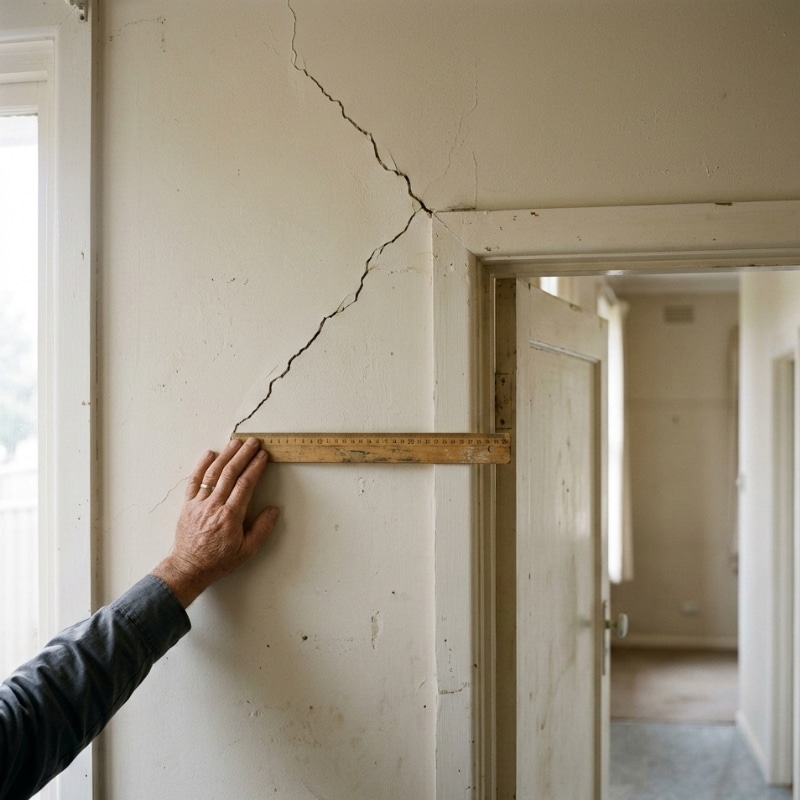
| Settlement beside a building footing | Obtain a foundation assessment |
| Uncertain condition or conflicting quotes | Seek independent professional advice |
Questions to ask contractors
- Why did the slab sink?
- Is the concrete intact enough to lift?
- Is the goal to lift, level, stabilise, or fill voids?
- What result can realistically be achieved?
- How will levels and drainage falls be monitored?
- Are pipes or services at risk?
- What site problems must be corrected first?
- What does the quote include and exclude?
- When can the area safely return to use?
- What does the warranty cover?
- What happens if the slab cannot be lifted as planned?
A note on location
Melbourne properties often deal with variable soil reactivity, seasonal moisture changes, mature trees, and restricted access in established suburbs, though not every slab shares the same soil conditions. Sydney sites vary in geology, with sloping blocks, tight access, and service congestion adding to demolition costs. Brisbane properties contend with heavy rainfall, drainage and washout, and the distinction between concrete slabs and raised homes on stumps. Separate city price ranges aren’t published here unless backed by recent, company-confirmed quote data.
The Bottom Line
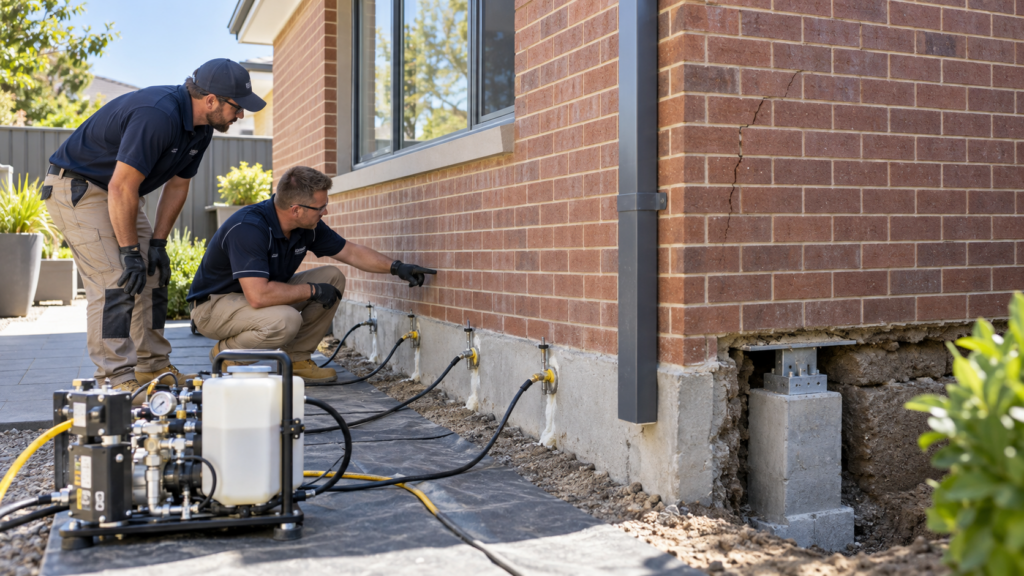
Lift concrete that remains suitable for controlled movement and re-supporting. Replace concrete that’s extensively damaged, incorrectly constructed, or incapable of functioning as a sound slab. Compare complete project costs rather than advertised per-m² rates, correct any leaks, drainage defects, erosion, or unsuitable support conditions, and get an inspection before committing to demolition or injection. In cases where the movement points to a footing rather than just the slab, underpinning foundations or resin injection underpinning may be the more appropriate comparison instead of replacement.
Request an assessment of the sunken slab, and compare lifting and replacement against the same required outcome rather than price alone. Ask for an itemised concrete slab jacking or concrete slab lifting quote, confirm whether the existing concrete can be preserved, and see our earlier guide on slab jacking cost for more on what drives the price.
Frequently Asked Questions
How long does concrete lifting last?
There’s no universal lifespan for concrete lifting or any repair method. Durability depends on the injection material, how well voids were identified, soil conditions, and whether the original cause, such as a leak or drainage problem, was also corrected. An uncorrected cause is the most common reason lifting doesn’t hold, not the lifting process itself. Ask your contractor what factors were considered for your specific site.
Is concrete lifting cheaper than slab replacement?
Usually, yes, mainly because it avoids demolition, waste disposal, and rebuilding the base. But this only holds when the slab is actually suitable for lifting; using it on severely damaged concrete just delays a more expensive replacement. Compare complete project costs, not headline per-m² rates, since quotes often cover different scopes. An itemised quote for each option is the only reliable way to compare.
Can badly cracked concrete be lifted?
Sometimes, but not always. Limited cracking with sections that haven’t fragmented can often still be lifted successfully. Extensive interconnected cracking, crumbling concrete, and multiple displaced pieces usually mean the slab can no longer act as a sound unit, and lifting a fragmented slab risks raising pieces unevenly. A proper assessment of crack width, pattern, and cause is needed to confirm suitability, not just a visual check.
How soon can you use concrete after it has been lifted?
Many straightforward residential lifting jobs are ready within hours to a day, since the process doesn’t involve pouring new concrete that needs to cure. Return-to-service time depends on the injection material used, the slab’s purpose, and your contractor’s instructions. Garage, commercial, and vehicle-bearing slabs typically need project-specific guidance rather than a general timeframe, so confirm this before work begins.
What causes a concrete slab to sink again after repair?
Recurrence usually means the underlying cause, such as an active leak, ongoing erosion, or poor drainage, was never actually corrected, only the visible settlement was treated. Lifting restores support and levels but doesn’t fix a water source or reactive soil movement on its own. A thorough diagnosis before repair, and correcting drainage or plumbing alongside the lift, matters more for long-term results than the lifting technique itself.