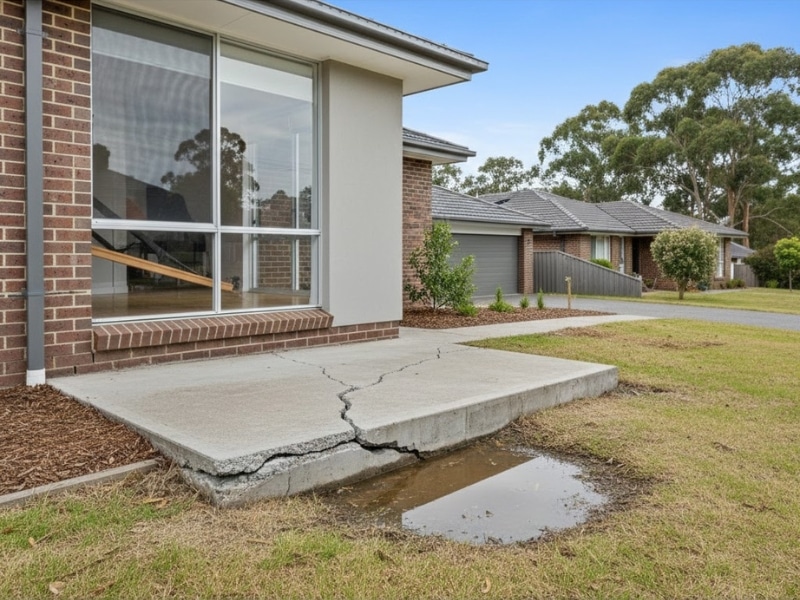
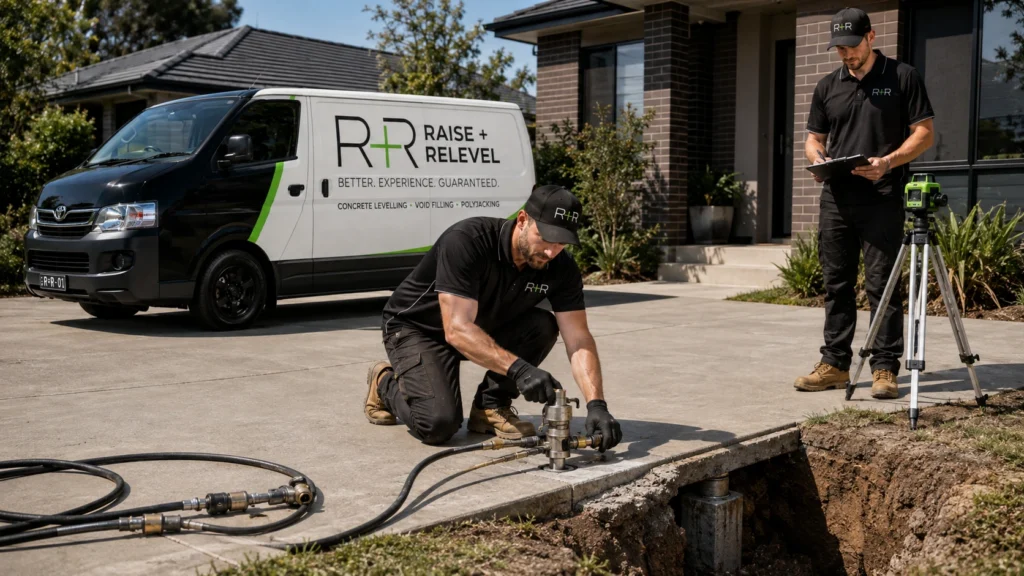
Slab jacking cost in Australia typically sits around $150–$350 per square metre for suitable resin-based lifting, though small jobs are often shaped more by contractor minimum charges than by the size of the affected area. Price also depends on settlement depth, void volume, access, service locations, and whether resin or grout is used. Slab jacking differs from underpinning, which supports a building’s foundations rather than lifting the slab itself, so an inspection is needed to confirm it can be safely lifted.
| Quick answer
For a suitable slab, slab jacking is usually the cheaper and less invasive option than underpinning or full slab replacement. Small residential jobs may start around $1,500, while larger or more complex projects can cost several thousand dollars. Minimum charges and site conditions often have more impact on cost than size alone. These are planning figures, not quotes. Structural foundation problems may require underpinning instead, so diagnosis should come before comparing prices. |
What Is the Average Slab Jacking Cost?
As a general guide, resin-based slab jacking costs approximately $150–$350 per square metre in Australia. Most residential jobs don’t scale neatly with this rate, though: small projects are frequently affected by setup costs and contractor minimum charges, which can push the effective per-square-metre cost higher.
| All prices in this guide are indicative Australian market ranges only, quoted in Australian dollars for typical residential work, and are not quotations. Costs vary according to the affected area, settlement depth, void volume, access, resin or grout requirements, structural conditions, engineering needs, city, and contractor minimum charges. Treat these as a planning starting point and confirm exact costs, including GST treatment, with a written, itemised quote. |
| Project or Pricing Measure | Indicative Cost |
|---|---|
| Resin slab lifting or void filling | $150–$350 per m² |
| Small affected area or single slab section | Approximately $1,500–$3,000 |
| Larger or more complex affected area | Approximately $3,000–$5,000+ |
| Structural or whole-home resin treatment | Commonly quoted as a project rather than per m² |
| Inspection, engineering, or soil investigation | Usually quoted separately |
Whether these figures include GST should be confirmed with your contractor and stated clearly in any quote you receive.
Example cost scenarios
Small sunken path (around 6 m²): A small path won’t necessarily cost six times the advertised per-square-metre rate. Mobilisation, equipment, labour and minimum material charges apply regardless of job size, which in many cases makes the effective rate higher on a small job.
Double garage slab (around 36 m²): Using the indicative range, a 36 m² garage would produce a simple calculated range of roughly $5,400 (at $150 per m²) to $12,600 (at $350 per m²). In practice, contractors often treat only the settled portion of the slab rather than the full floor area, so the actual quote can fall outside this simple calculation.
Localised driveway settlement: Several affected panels along a driveway may be quoted as a project rather than by total area, because injection depth, the number of voids, access and the lifting sequence typically matter more than the overall total area.
Quotes may also be based on estimated resin or grout volume rather than surface area alone, and injection is often concentrated around the affected zones rather than the whole slab. A clear quote should state whether lifting, void filling, or both are included, since a low-cost quote may only stabilise the area without fully restoring it to its original level. Because voids and settlement can’t always be fully assessed before work begins, it’s worth asking what is included in the quoted price and how any additional work may affect the final cost.
What Factors Affect the Price of Slab Jacking?
The visible size of a sunken area is only one part of the pricing picture. Slab jacking quotes typically reflect the complexity of the repair, including what’s happening beneath the surface, rather than simply the total area involved.
Main cost factors
- Total treated area and number of separate slabs or panels
- Depth and extent of settlement, and the volume of voids beneath the concrete
- Whether resin or cementitious grout is used
- Number and depth of injection points, and the lifting accuracy required
- Condition, thickness and structural role of the slab
- Access for equipment and materials, such as slopes, stairs, landscaping or confined spaces
- Nearby underground pipes and services
- Soil type and moisture conditions, including drainage or erosion issues
- Need for engineering, surveying or geotechnical input
- Location and contractor travel or mobilisation
- Surface reinstatement and cosmetic repairs after lifting
Because subsurface conditions aren’t always fully known before injection begins, a good quote should also explain how any extra material or additional injection work would be authorised and charged.
How different conditions typically affect cost
| Condition | Likely Cost Effect |
|---|---|
| Clear access and shallow, localised void | Lower |
| Small job below the contractor’s minimum scope | Higher per m² |
| Multiple disconnected repair areas | Higher |
| Deep or unpredictable voids | Higher |
| Controlled structural lifting | Higher |
| Void filling without significant lifting | Potentially lower |
| Underground services near injection points | Higher |
| Plumbing or drainage repair required | Higher |
| Large, accessible treatment area | Potentially lower per m² |
| Severely cracked slab requiring replacement | Slab jacking may not be economical |
More resin doesn’t automatically mean a better repair: accurate lifting can actually require slower, staged injections. Where water or erosion is contributing to the settlement, that cause typically needs to be addressed separately. Differences in access and scope between properties often affect price more than the city a home happens to be in. A fixed-price quote should also identify what resin or grout volume it assumes, since that estimate directly affects the final cost.
How Does Slab Jacking Cost Compare With Underpinning?
Slab jacking is generally cheaper and less disruptive than foundation underpinning methods when the problem is limited to a settled slab that remains suitable for lifting. Underpinning is more likely to be needed when load-bearing footings require deeper or stronger support, and in that situation, slab jacking usually isn’t a substitute, regardless of cost.
There are several types of underpinning, including mass concrete, screw pile, and resin-based ground improvement, and each suits different structural conditions. Weighing up resin underpinning vs concrete underpinning isn’t really a question of which is cheaper. It comes down to which method can deliver the structural outcome your property actually needs.
| Repair Method | Indicative Australian Cost | Typical Pricing Basis | Common Application |
|---|---|---|---|
| Resin slab jacking | $150–$350+ per m² or $1,500–$5,000+ per area | Area or project | Suitable settled slabs and voids |
| Structural resin injection | Approximately $5,000–$15,000+ | Whole project | Suitable ground improvement or foundation applications |
| Mass concrete underpinning | $1,000–$3,000+ per metre or underpin | Metre, pit, or underpin | Existing footings requiring deeper support |
| Screw pile underpinning | $2,000–$5,500+ per pile | Per pile | Loads requiring transfer to suitable ground |
| Restumping | $5,000–$25,000+ | Per stump or project | Raised homes with failed stumps |
| Concrete slab replacement | $75–$175+ per m² before complex demolition or structural work | Per m² | Concrete unsuitable for lifting or repair |
*Indicative pricing only. These ranges are deliberately broad, as actual costs can vary significantly depending on site conditions, location, access, engineering requirements, project size, treatment depth, materials and the extent of works required. Pricing methods also vary across the Australian market, with resin injection often priced by project, underpinning by pier or underpin, and slab replacement by square metre. As a result, headline costs are not always directly comparable. A site assessment is required to determine the most appropriate repair method and provide accurate pricing.
What each method actually delivers
- Slab jacking lifts or re-supports a suitable slab
- Structural resin injection can increase ground support in targeted zones
- Underpinning adds support to existing footings
- Restumping replaces or adjusts stump supports
- Slab replacement removes and reconstructs the concrete
Because these methods solve different problems, comparing a per-square-metre rate against a per-pier or per-metre rate can be misleading. Underpinning quotes may exclude cosmetic crack repairs, and slab replacement quotes may exclude demolition, disposal, drainage or reinforcement, so it pays to compare like-for-like scope. Some projects also need both the underlying cause addressed and structural repair carried out, rather than one or the other. The cheapest suitable method for your situation matters more than the cheapest method overall.
Is Slab Jacking Cheaper Than Foundation Piering?
For a settled slab that’s suitable for lifting, slab jacking is usually cheaper than foundation piering, mainly because it involves less excavation and structural installation.
Why piering typically costs more
- Piers must transfer building loads, sometimes to significant depths
- Structural engineering input is commonly required
- Mechanical equipment and engineered foundation connections are often needed
- Installation capacity may need to be tested or documented
- Excavation and site reinstatement add to the cost
Piers and resin injection solve different load-support problems, so the right comparison starts with matching the method to what the property actually needs, not the unit price. Screw pile depth can also be uncertain until installation begins, and restricted access may make one system preferable even at a higher unit rate. Foundation piering can still be the more cost-effective option when a footing lacks adequate support. Slab jacking shouldn’t be chosen as a lower-cost substitute based on price alone. Structural capacity, not just cost, should be compared before deciding. A small number of well-placed piers can sometimes cost less overall than widespread but unnecessary injection.
What Additional Costs Should You Consider Before Repairs?
The lifting or injection work itself is often only part of the total project budget. It’s worth factoring in the following before comparing quotes.
Potential additional costs
- Initial inspection or diagnostic testing
- Structural engineering or geotechnical investigation
- Plumbing leak detection and drainage repairs
- Service location and council or building approvals
- Surveying and level monitoring
- Concrete crack repairs and surface resurfacing or sealing
- Floor-covering removal and reinstatement, painting or plaster repairs
- Landscaping restoration and temporary access or protection
- Old concrete demolition and disposal, where relevant
- Travel charges for regional locations
- Post-repair monitoring
Quote inclusions worth confirming
- Total treated area and the number and depth of injection points
- Material or injection system used, and whether lifting is included
- Target level or lift tolerance
- Maximum included resin or grout volume, and how unexpected voids are treated
- Surface reinstatement, engineering and approvals
- Whether GST is included
- Warranty terms, exclusions, and what happens if the target result can’t be achieved
Cosmetic repairs sometimes need to wait until movement has been monitored, and homeowners may end up paying twice if an underlying plumbing or drainage cause is left unaddressed. Restoring a slab to its exact original level isn’t always safe or technically appropriate. In some cases, stabilisation is the more realistic and durable goal. Warranty exclusions in particular can materially affect the long-term value of a repair, so they’re worth reading closely. An itemised scope is generally more useful for comparison than a low headline price.
How Do You Choose the Most Cost-Effective Foundation Solution?
Cost-effectiveness isn’t about choosing the lowest quote. It means selecting the least expensive method that reliably delivers the outcome your property actually needs.
A simple decision framework
- Identify whether the affected element is a slab, footing, stump or foundation
- Determine why the movement occurred
- Establish whether the movement is still active
- Correct any plumbing, drainage or erosion problems where required
- Assess whether the existing concrete remains suitable for lifting
- Define whether the goal is levelling, stabilisation, structural support or replacement
- Compare only methods capable of delivering that outcome
- Request itemised quotes based on the same scope
- Review warranties and exclusions
- Seek independent advice if recommendations differ significantly
Which option tends to fit which situation
| Property Condition | Potentially Cost-Effective Option |
|---|---|
| Intact but locally sunken driveway | Slab jacking or resin lifting |
| Void beneath a suitable garage slab | Void filling with possible controlled lifting |
| Severely cracked or deteriorated concrete | Partial or complete replacement |
| Failed load-bearing footing | Engineered underpinning or piering |
| Raised home with deteriorated stumps | Restumping |
| Active leak or drainage problem | Repair the cause before or alongside structural work |
| Conflicting contractor recommendations | Independent structural assessment |
This framework is general and educational. It can’t determine the correct repair for an individual property. An on-site assessment is needed to confirm which option is appropriate for your home.
A note for Melbourne, Sydney and Brisbane homeowners
Conditions vary across Australia’s east coast, and this can influence which repair approach makes sense for a given property.
Melbourne: many areas have reactive soils, along with variable moisture conditions, mature vegetation and access constraints in established suburbs, though not every Melbourne property is affected by reactive clay.
Sydney: geology varies significantly across the city, and sloping blocks, restricted suburban access and excavation difficulty can add to labour or logistics costs in some locations.
Brisbane: some suburbs have raised homes that may need restumping, and heavy rainfall and drainage conditions can create different considerations for slab-on-ground versus stump-supported houses.
City-specific pricing isn’t published here. Costs should be confirmed against current, locally validated project data rather than a general guide.
The Bottom Line
Slab jacking commonly costs less than underpinning, piering or replacement when the existing slab is suitable for lifting. Per-square-metre prices are a useful starting point for planning, but minimum charges, void volume, access, settlement and the outcome you actually need will determine the final price. Underpinning shouldn’t be recommended, or ruled out, on cost alone. An inspection and an itemised quote remain the most reliable way to compare your options.
If you’re dealing with a sunken slab, uneven driveway or settled garage floor, Raise and Relevel can help with slab jacking services tailored to your property. Book a free assessment to find out whether lifting, stabilisation or structural support is the right fit. Ask for an itemised slab jacking quote, and compare it against any other repair or replacement quotes using the same scope, so you’re weighing genuinely like-for-like options.
Frequently Asked Questions
How much does slab jacking cost per square metre?
Resin-based slab jacking in Australia typically costs around $150–$350 per square metre as an indicative starting point. Small jobs are often affected by contractor minimum charges, commonly $1,500–$5,000 for a single affected area, so the per-square-metre rate isn’t always a reliable guide on its own. Larger or structural projects are usually quoted per project rather than by area. Because pricing depends on settlement depth, void volume and access, an on-site inspection is the best way to get an accurate, itemised quote for your property.
What factors can increase the cost of slab jacking?
Cost typically increases with deeper or larger voids, multiple disconnected repair areas, restricted access, and work near underground services, drains or pipes. Jobs that fall below a contractor’s minimum scope can also carry a higher effective rate. Structural or engineered lifting, additional plumbing or drainage repairs, and post-lifting surface reinstatement can all add to the total. Because these factors aren’t always visible before work begins, quotes should clearly outline what is included and how additional work may affect the final cost.
Is slab jacking cheaper than replacing a concrete slab?
In many cases, yes: slab jacking is often cheaper than full slab replacement when the existing concrete remains suitable for lifting, since it typically avoids demolition, disposal and reconstruction. However, replacement may be more suitable for severely cracked or deteriorated concrete. Replacement quotes should be compared carefully, as they may exclude demolition, drainage or reinforcement work. An inspection can confirm whether your slab is a good candidate for lifting rather than replacement.
How long does slab jacking typically last?
How long a slab jacking repair lasts depends on the cause of the original settlement, soil conditions, and whether any underlying issues, such as drainage or erosion, were addressed alongside the lifting work. Results can vary between properties, so it isn’t possible to guarantee a specific lifespan. Asking your contractor about warranty terms, exclusions and any recommended post-repair monitoring can help you understand what to expect from the repair over time.
Does home insurance cover slab jacking costs?
Coverage depends on your individual policy and the cause of the slab settlement, so it’s worth checking directly with your insurer rather than assuming either way. Some causes, such as gradual soil movement or general wear, are commonly excluded, while sudden or specific insured events may be treated differently. A written assessment of the likely cause can support a conversation with your insurer, but it isn’t a substitute for their own coverage determination.