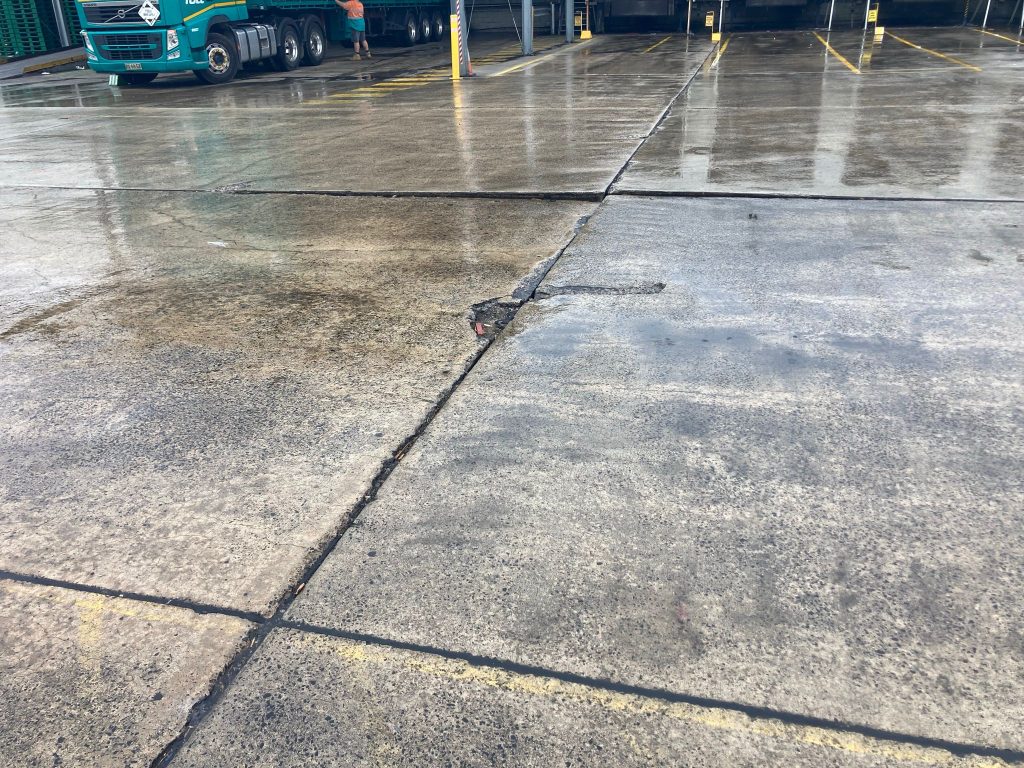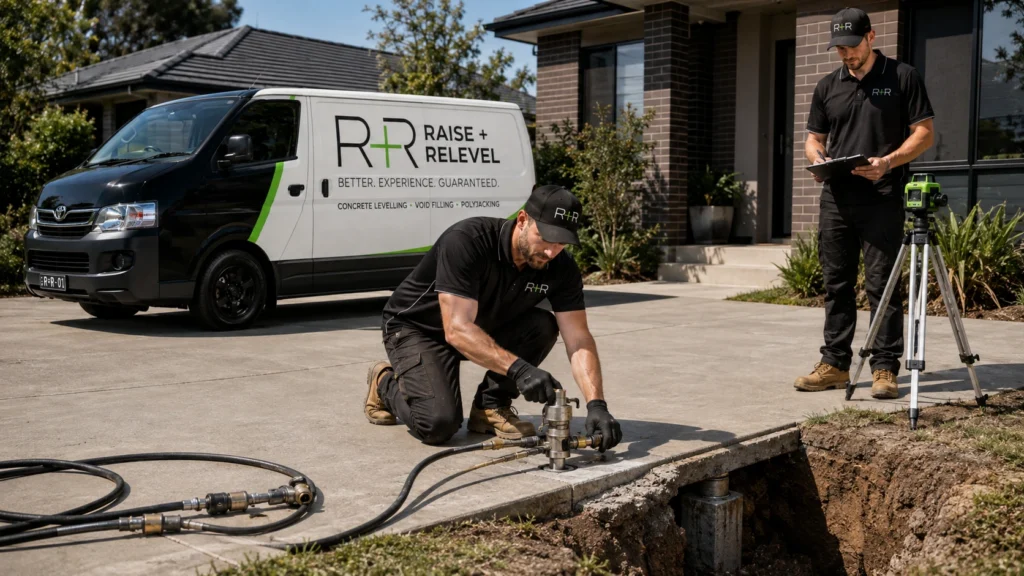
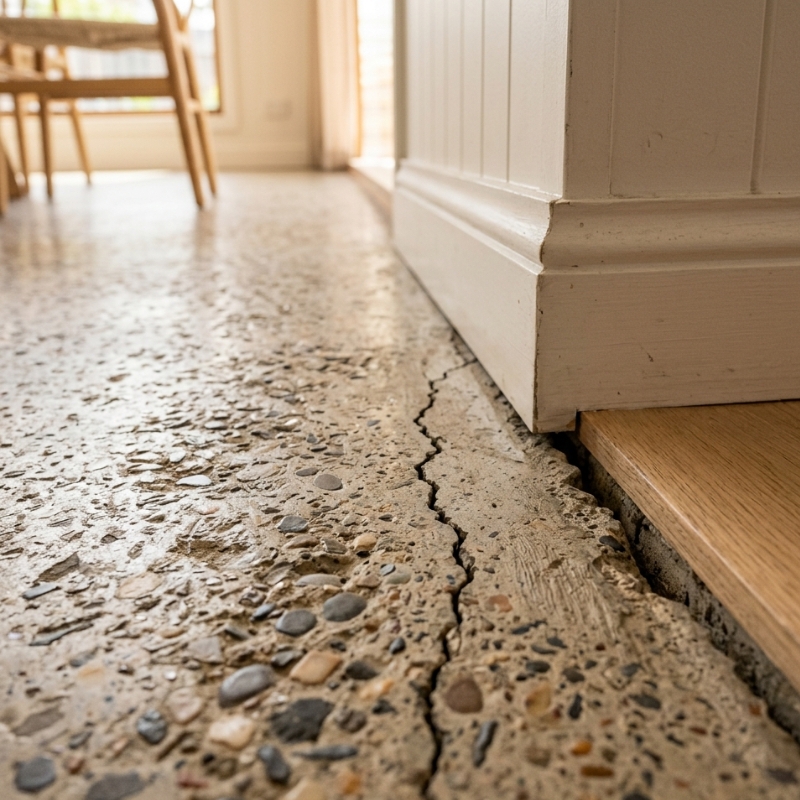
A “void” under concrete is exactly what it sounds like: a space where the slab or steps should be supported by firm ground. Concrete is strong in compression, but it’s not designed to span gaps like a bridge. When support disappears, the slab starts to flex, crack, rock, or settle.
In Australia, voids can show up under driveways, garage slabs, footpaths, patios, pool surrounds, and especially concrete steps—anywhere water, soil changes, or poor site drainage can quietly remove or rearrange material beneath the surface.
This guide walks through the most common causes of voids under concrete in Australian conditions, the early warning signs homeowners can spot, and what to do first to prevent the underlying cause from recurring.
What a “void under concrete” actually means
Under a typical slab-on-ground surface (like a driveway or pathway), the concrete relies on a compacted base and stable subgrade. If that material erodes, shrinks, washes out, or collapses, the concrete can end up partially unsupported.
Voids can be:
• Small pockets (localised “hollow spots”)
• Long channels (often linked to water flow paths)
• Broad areas of lost support (common after ongoing drainage issues)
The tricky part is that a void can exist for months before you see obvious sinking—especially if the slab is thick, reinforced, or supported at the edges.
Q&A: Is a void always an emergency?
Q: If there’s a void under my concrete, do I need to panic?
A: Not always, but you do need to take it seriously. A small void under a garden path might simply worsen over time. A void under steps, a driveway, or near the house can become a safety hazard (trip risk, rocking steps) and can lead to cracking and rapid settlement. The key is to identify the cause early—water and drainage issues rarely fix themselves.
The most common causes of voids under concrete in Australia
1) Water washout from stormwater and poor drainage
This is the big one. Water is the number-one transporter of soil fines (the smaller particles that help bind the ground together). When runoff repeatedly travels along the edge of a slab—especially during intense rainfall—it can gradually “mine” material from underneath.
Common Australian culprits include:
• Downpipes discharging too close to slabs
• Overflowing gutters dumping water beside driveways or paths
• Poor surface fall that sends runoff under steps or slabs
• Blocked stormwater lines, forcing water to escape at weak points
• Garden beds against concrete edges that trap water
You don’t need a dramatic flood for a washout to happen. Repeated smaller events—especially when the ground is already saturated—can slowly create a hidden channel beneath the slab.
Early signs that point to a washout
• Soil is scoured away at slab edges after rain
• You see sand/silt deposits where water exits
• Puddles repeatedly form in the same low spot
• The problem worsens after heavy rainfall cycles
Q&A: Why does the concrete sound hollow after rain?
Q: My slab sounds “drummy” or hollow after rain—why?
A: Saturated soils can soften and allow fine particles to move. If water has a pathway under the slab (even a small one), it can carry material away and create a gap. The slab then behaves like a thin plate over a pocket of air, which creates that hollow sound when you tap or walk on it.
2) Leaking services under or near the slab (plumbing and stormwater)
Not all water problems come from above. Leaks from below can be even more damaging because they’re often continuous.
Potential sources:
• Water supply line leaks (constant moisture)
• Sewer leaks (often subtle, may present as persistent damp areas or odours)
• Stormwater pipe separation or blockage (water escaping during rain)
• Irrigation lines (slow leaks that keep soil wet)
When water continuously moves through soil, it can:
• Erode and transport fines
• Create “piping” voids (tunnel-like cavities)
• Weaken the subgrade so it collapses under load
Early signs that point to a service leak
• Localised sinking in one area (rather than a whole slab edge)
• Damp patches during dry weather
• Unexplained increases in water use (where applicable)
• Persistent soft ground near a single spot
• Settlement close to known service routes (where the plumbing runs)
Q&A: Can a small leak really cause a void?
Q: If it’s only a small leak, can it still wash out soil?
A: Yes. A small but constant flow can transport fine particles surprisingly well over time. Think of it like a slow stream under pressure. In reactive or sandy soils, the effect can be faster than people expect.
3) Poor compaction or inadequately prepared base
Sometimes the issue isn’t that soil “left” the area—it’s that it was never properly compacted in the first place.
This can happen when:
• Fill is placed and not compacted in layers
• The base course is too thin or inconsistent
• Construction occurs during very wet conditions
• Trenches are backfilled loosely near slabs or steps
• New landscaping adds fill next to the existing concrete
Poor compaction tends to show up as gradual settlement, often within the first few years after construction—though it can appear later if water infiltrates and accelerates consolidation.
Early signs that point to compaction issues
• Settlement occurs without obvious water scouring
• The slab sinks more uniformly rather than cracking sharply
• The problem was present early and slowly worsened
• Adjacent areas with recent excavation/trenching are affected
Why Australia’s soils make this more common in some areas
4) Reactive clay soils and moisture swings
Large parts of Australia sit on reactive clay soils that shrink when dry and swell when wet. That movement can create gaps, change support conditions, and redirect water pathways.
A typical pattern:
• Dry period: clay shrinks and pulls away from edges, creating small separations
• Rain returns: water enters those gaps, softening and moving material
• Repeated cycles: differential movement increases and localised voiding can develop
This is one reason moisture management around foundations and slabs is often emphasised by building authorities and guidance documents (for example, homeowner guidance on managing moisture around foundations). An accessible reference point is the Queensland Building and Construction Commission’s homeowner guide: QBCC guide to preventing structural damage.
Early signs that point to reactive soil involvement
• Cracks and gaps that change seasonally (worse in dry spells, different after rain)
• Multiple areas of minor movement rather than one obvious washout point
• Separation between slab edges and soil that opens in hot/dry weather
• Movement near garden beds where watering patterns vary a lot
Q&A: Is reactive clay the same as a void?
Q: If I’m on reactive clay, does that automatically mean I have voids?
A: Not necessarily. Reactive clay mainly causes movement (shrink–swell). But that movement can contribute to void formation by opening gaps at edges, changing drainage behaviour, and increasing the chances of washout or loss of support in local pockets.
5) Erosion from landscaping, garden beds, and irrigation habits
Even well-intentioned landscaping can create the conditions for voids—especially when water is directed toward slabs.
Common set-ups that increase risk:
• Garden beds hard up against a slab edge (traps moisture)
• Mulch piled against concrete (holds water)
• Irrigation spraying directly onto slab joints/edges
• Planter boxes that overflow onto steps or paths
• Soil levels built up on one side, changing the surface falls
If your concrete sits lower than the surrounding soil, runoff can naturally funnel toward it and then under it.
6) Traffic loads and vibration on already-weakened support
Heavy vehicles don’t usually “create” voids from nothing, but they can accelerate settlement once support is compromised.
This is common when:
• A driveway has a small void near an edge
• A wheel path repeatedly loads the same zone
• The slab “pumps” (flexes) under load and ejects fine material
Early signs:
• Cracks forming in wheel paths
• A depression that slowly grows
• A “bounce” or flex sensation when a vehicle drives over it
Early warning signs you can catch before major sinking happens
The sound test: hollow, drummy, or changing tone
A hollow sound when tapping with a rubber mallet (or even the heel of your shoe) can indicate loss of contact beneath the slab. Compare the sound across different sections—voids often present as a noticeably different pitch.
Rocking or movement underfoot
Concrete steps are notorious for this. If a step rocks even slightly, it usually means the bearing point beneath it has changed. This is a safety issue—especially for kids, older adults, or anyone carrying items.
New cracks, or existing cracks getting wider
Cracks aren’t always disastrous, but watch for:
• Cracks that widen over time
• Cracks that form near corners or re-entrant angles
• Cracks paired with a change in level across the crack
Gaps are opening at the slab edges
Look at the slab perimeter:
• Is the soil pulling away?
• Is there a gap you can slide a finger into?
• Are ants, water, or debris moving into that gap?
Water behaviour that looks “wrong”
• Water pools along one edge repeatedly
• Downpipe discharge creates a mini-river beside the slab
• Water seems to disappear into a joint or edge gap
Q&A: How can I tell if it’s a void or just a crack?
Q: I have cracks—how do I know if there’s a void too?
A: A crack alone doesn’t confirm a void. Pair the crack with other clues: hollow sound nearby, rocking, a change in level, edge gaps, or worsening after rain. When multiple signs show up together, the likelihood of lost support is much higher.
Scenarios: what the cause is most likely to be
If it got worse after heavy rain
Most likely contributors:
• Stormwater washout
• Blocked/failed stormwater lines
• Water entering edge gaps opened by dry weather
First thing to check:
• Downpipes, gutters, surface falls, and where the water goes during a storm
If it’s localised in one spot and stays damp
Most likely contributors:
• Leaking service line
• Irrigation leak
• Localised drainage overflow
First thing to check:
• Persistent moisture during dry weather and any nearby service routes
If it’s near steps, a landing, or a path corner
Most likely contributors:
• Edge washout (water flows around corners)
• Poor compaction at the edge
• Reactive soil edge separation that lets water in
First thing to check:
• Soil level, water flow paths, and whether the step rocks
If the slab is older and the settlement is gradual
Most likely contributors:
• Slow base consolidation
• Ongoing minor drainage issues
• Repeated traffic loading over a weak spot
First thing to check:
• Whether drainage patterns changed over time (new garden, new downpipe position, new paving)
What to do first (without turning it into a DIY “fill the void” job)
You’ll get better long-term outcomes by focusing on the cause before thinking about the cavity itself.
1) Observe and document
• Photograph cracks and edges (include a coin or ruler for scale)
• Note when it worsens (after rain, after heat, after watering)
• Mark trip hazards immediately for safety
2) Control water at the surface
• Ensure downpipes discharge to appropriate drainage (not onto slab edges)
• Keep gutters maintained so overflow doesn’t dump beside slabs
• Adjust irrigation so it’s not constantly saturating one edge
• Maintain sensible falls so water drains away rather than ponding
3) Treat rocking steps and trip hazards as urgent
If steps rock or a walkway is uneven, treat it as a safety priority. Temporary measures (like restricting access) are sensible until the support issue is properly addressed.
4) Know when to involve a professional assessment
Escalate sooner if:
• Settlement is rapid or accelerating
• You suspect a service leak
• Cracks are widening, and there’s a level change
• The slab is near the house, and you’re seeing broader movement symptoms
If you’re at the “next step” stage where you want to understand options for stabilising movement and restoring support, this is where methods like slab jacking for uneven concrete may be relevant—particularly after water and drainage causes are identified.
How can the risk be reduced long-term (especially on reactive sites)
Think of it as a system: water, soil moisture, and load paths.
Practical habits that help:
• Keep moisture changes around slabs as even as possible (avoid one side constantly wet, the other side dry)
• Don’t let garden beds trap water against slab edges
• Maintain stormwater systems so water doesn’t escape where it shouldn’t
• Re-check falls and drainage after landscaping changes
• Watch for early “hollow” patches and address water flow before they grow
If a slab has already lost support, long-term success usually depends on both restoring support and controlling the cause—especially drainage. In those cases, approaches like concrete slab lifting are often discussed alongside drainage improvements, because lifting without fixing the water pathway can invite repeat settlement.
Q&A: Will fixing drainage alone stop the sinking?
Q: If I improve drainage, will the slab stop moving?
A: Better drainage often prevents further washout and reduces moisture-driven movement, which is a big win. But if there’s already a void, the slab may remain partially unsupported. That’s why many long-term solutions pair water control with restoring contact/support under the slab.
FAQ: Voids under concrete slabs and steps in Australia
How do voids form under concrete slabs?
Most voids form when soil is washed away by water (stormwater runoff, poor drainage, or leaks), when soil shrinks and pulls back in reactive clay conditions, or when the base was not compacted properly and consolidates over time.
What does it mean if my concrete sounds hollow?
A hollow or “drummy” sound often means there’s a gap under part of the slab. It doesn’t confirm severity on its own, but it’s a strong early indicator—especially if paired with rocking, cracking, or sinking.
Are voids more common after heavy rain?
They can be. Heavy rain can reveal drainage weaknesses and accelerate washout, particularly where downpipes, surface falls, or stormwater lines direct water along slab edges.
Why do concrete steps rock?
Steps often have smaller bearing areas and more exposed edges. If supporting material is lost at one corner (washout, shrinkage, poor compaction), the step can start to teeter. Rocking steps are a safety concern and should be addressed promptly.
Can reactive clay cause voids?
Reactive clay mainly causes movement (shrinkage and swelling). That movement can create edge gaps and change water pathways, which can contribute to void formation—especially when rainwater enters newly opened separations.
How serious is a void under a driveway?
It depends on size, location, and loading. Voids under wheel paths can worsen faster due to repeated loading. Even small voids can lead to cracking and settlement over time if not addressed.
How can I reduce the chance of voids returning?
Focus on water management: maintain gutters and downpipes, ensure stormwater is directed away properly, avoid creating wet zones against slab edges, and keep moisture changes as even as possible on reactive sites.
What are the common next steps once a void is confirmed?
After identifying the cause (drainage, leak, soil movement, compaction), the next step is typically restoring stable support under the slab and correcting the conditions that created the void. Where appropriate, options such as stabilising sunken slabs may be considered as part of an overall plan that includes drainage and moisture control.