Concrete levelling foam is a repair method that uses expanding polyurethane injected beneath a settled slab to lift and stabilise it without demolition. For Australian homeowners and property managers dealing with uneven concrete, it delivers results the same day at a fraction of the cost of full slab replacement. The process targets the problem directly by filling voids under the slab and expanding to restore a level surface.
Key Takeaways
- Concrete levelling foam uses expanding polyurethane injected through small drill holes to lift settled slabs back to level, with most repairs completed in a single day and the surface ready for use within 30 minutes of injection.
- Polyurethane foam is significantly lighter than traditional grout or sand-cement fill, which reduces additional load on soil that has already shown signs of movement or void formation.
- The method is suitable for a wide range of applications across residential and commercial properties, including driveways, warehouse floors, patios, pool surrounds, and public footpaths.
- A professional site inspection is the necessary first step before choosing foam levelling, because slabs with severe structural cracking or active soil erosion may need additional engineering work before or alongside lifting.
Why Is Concrete Levelling Foam Better Than Concrete Replacement?
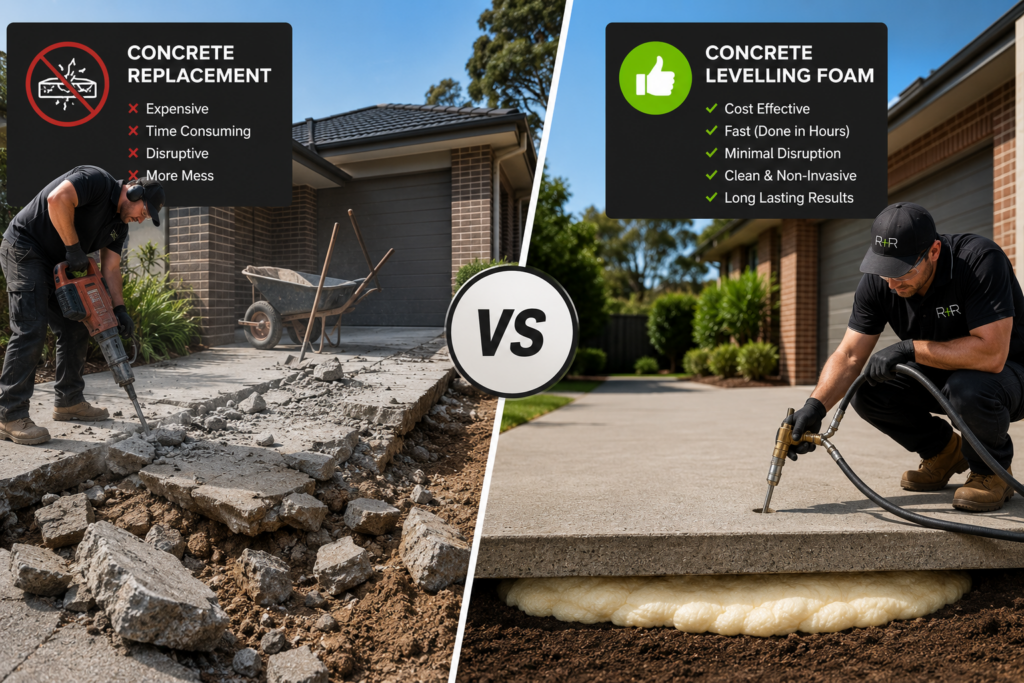
Full slab replacement is sometimes unavoidable. When a slab has shattered, corroded reinforcing steel, or deteriorated past any structural use, replacement is the right path. For the far more common scenario, where a slab is structurally intact but has settled due to soil movement or void formation, foam levelling is the more practical and cost-effective option.
Residential slabs across Australia are built to AS 2870-2011, the Australian Standard for residential slabs and footings, which classifies sites by soil reactivity. Many properties in eastern Australia sit on highly reactive clay soils, which shrink and swell with seasonal moisture changes. This soil behaviour is one of the most common drivers of slab settlement, and it is exactly the condition foam levelling is designed to address without removing the slab.
Here is how foam levelling compares to full replacement across the key decision points:
- Foam injection typically completes in a few hours, while slab replacement requires demolition, disposal, forming, pouring, and a minimum curing period, which can stretch the project over several days.
- Drill holes for foam injection measure around 16 mm in diameter, so there is no heavy machinery disturbing surrounding landscaping, garden beds, or adjacent paving.
- Replacement carries labour costs for demolition, concrete disposal, formwork, and re-pour. Foam levelling avoids most of those cost lines entirely.
- Polyurethane foam reaches working strength within 15 to 30 minutes of injection, so the surface is ready for foot traffic the same day.
- Demolition generates significant concrete rubble that must be removed from the site. Foam injection generates almost no waste.
- When properly installed, foam fills voids and bonds to the underside of the slab, providing stable, continuous support that does not wash out over time.
The environmental case for repair over replacement is also worth noting. Concrete production accounts for a meaningful share of industrial carbon emissions, and concrete slab construction and finishing processes in Australian residential builds involve significant material and energy inputs. Preserving a structurally sound slab instead of disposing of it and pouring a new one is the lower-impact option.
What Are the Benefits of Using Concrete Levelling Foam for Sunken Slabs?
Polyurethane foam has become the standard material for modern slab levelling because of its behaviour during and after injection. It expands to fill irregular voids, adheres to the underside of the slab, and sets quickly under controlled conditions. These physical properties give it clear advantages over older materials like sand-cement grout, which is heavier, slower, and cannot reach irregular void shapes beneath a slab.
Foam density and expansion rate are controllable variables that trained technicians manage in real time during injection, which enables precision lifting. This matters when a slab has settled unevenly across its surface, because different sections may require different lifts to restore a true level.
The practical benefits for Australian properties include:
- Polyurethane foam weighs a fraction of traditional grout or sand-cement mixes, which means the repaired slab does not add excessive new load to soil that has already shifted.
- Cured polyurethane does not absorb water or wash out over time, unlike sand fill, which makes it more durable beneath slabs exposed to rain, irrigation, or seasonal ground moisture changes.
- The injection process requires only small pre-drilled holes in the slab surface, so there is no trenching, excavation, or major site preparation involved.
- Technicians control foam expansion in real time, enabling accurate slab lifting when uneven settlement occurs across multiple sections.
- The same technology used for domestic driveways also applies to warehouse floors, loading docks, and pedestrian footpaths, making it a versatile solution across property types.
Load-bearing performance of polyurethane foam-filled structural components confirms the material’s capacity to carry significant loads when correctly installed. This is relevant for Australian industrial and commercial applications where slabs support forklifts, heavy plant, or high foot traffic.
One aspect that often surprises property owners is how little the finished surface changes. The drill holes are patched after injection, and exposed aggregate, brushed finishes, or patterned concrete do not need to be refinished for properties where the appearance of the existing slab matters; this is a real practical advantage.
Where Can Concrete Levelling Foam Be Used Around Residential and Commercial Properties?
Foam levelling suits any concrete surface that has settled due to soil movement, void formation, or inadequate compaction beneath the original pour. The method works equally well in residential backyards and large commercial facilities, which makes it one of the most broadly applicable concrete repair options available in Australia.
Foundation movement in Australian homes is often first noticed as uneven concrete surfaces around the property. Acting on visible settlement early stops the underlying void from growing and prevents what starts as a minor trip hazard from becoming a more expensive structural problem.
Common applications around residential and commercial properties include:
- Driveways and vehicle crossovers
- Footpaths and pedestrian walkways
- Garage floors and workshop slabs
- Patios, alfresco areas, and entertaining spaces
- Pool surrounds and coping slabs
- Warehouse and factory floors
- Commercial building entrances and loading areas
- Retail carpark slabs and travel lanes
Homeowners dealing with a sinking floor can also benefit from foam injection into internal slabs, provided the cause of the settlement has been identified first. External applications, such as driveway releveling, are among the most frequent requests because settlement is visible and poses a direct hazard to vehicles and pedestrians.
The method is especially practical where excavation would be difficult or disruptive. Slabs beneath structures, slabs adjacent to established trees or garden beds, and slabs in areas with restricted access all benefit from the minimal site footprint of the foam injection process. Concrete slab floor systems in Australian construction are widely used for both ground-bearing and suspended applications, and foam levelling is applied to both types when ground-bearing slabs have settled.
How Long Does Concrete Levelling Foam Last After Installation?
Professionally installed polyurethane foam can last decades when the site conditions support it. The foam itself does not degrade under normal load and temperature conditions common to Australian climates. The more relevant factor is whether the soil conditions that caused the original settlement have been addressed at the time of repair.
Moisture in concrete slabs is one of the primary drivers of ongoing movement in Australian conditions, particularly on properties with poor drainage or high seasonal rainfall. Foam repair that coincides with drainage correction tends to hold far longer than foam applied without addressing the source of the water.
Several factors affect the long-term performance of the repair:
- Expansive clay soils that continue to move with seasonal moisture changes can cause a lifted slab to stress over time. Soil treatment or drainage correction at the time of repair significantly improves the results.
- Correct drill-hole placement and foam volume control during installation determine how completely the voids are filled. Partial void fill can allow further settlement in the unfilled areas.
- Water pooling beneath or adjacent to a slab is a primary cause of void formation. Directing surface water away from the slab after repair reduces the rate of future movement.
- Slabs carrying heavy vehicle or equipment loads need assessment of both soil bearing capacity and foam density to confirm the repair is appropriate for the load conditions.
- Keeping expansion joints clear and maintaining surface drainage reduces the rate at which new voids form beneath the slab over time.
For properties on reactive soils, combining slab jacking with appropriate drainage management gives the repair the best chance of lasting performance. Properties where ongoing subsidence is a concern may also need a broader assessment that considers house underpinning or specialised grouting alongside the levelling work.
What Factors Should You Consider Before Choosing Concrete Levelling Foam?
Foam levelling works well under specific conditions. Not every sunken or uneven slab is a suitable candidate, and getting a professional assessment before committing to any repair method helps avoid addressing symptoms while the underlying cause persists.
The NCC 2022 Housing Provisions for footings and slabs set the minimum design requirements for residential slab construction in Australia. These standards inform how engineers and practitioners assess whether an existing slab is a candidate for lifting or requires partial or full replacement.
Before selecting foam levelling, these are the key considerations:
- Slabs that have settled more than approximately 50 mm in a single section may indicate significant void formation or soil failure. These cases need a structural assessment before any lifting begins.
- Foam levelling works on slabs that are intact or have only minor surface cracking. Slabs with deep structural cracks, spalling, or deteriorating concrete quality need crack injection and repair first, or may require replacement.
- Active soil movement from ongoing shrink-swell in reactive clay may cause the slab to continue settling after being lifted. Soil stabilisation or specialised grouting addresses this before or alongside the foam work.
- Poor drainage that has caused voids beneath the slab will continue to erode support unless it is corrected at the same time. Water leak management is sometimes required before levelling work begins.
- The long-term value of a cheaper repair depends on whether the root cause is fixed. A foam repair that needs repeating every few years because drainage was not addressed is not always the better financial decision over replacement.
- Slabs with visible cracked walls nearby or signs of differential settlement across a larger area of the property may need an engineering assessment that considers the broader site, not just the slab in isolation.
A professional site inspection uses ground-penetrating radar or physical probing to map void locations, confirm the slab’s structural condition, and determine whether foam levelling alone is sufficient. Where the assessment identifies more complex conditions, structural underpinning services may be required alongside or instead of foam injection.
The Austroads guide to pavement materials for stabilisation provides technical context on the use of grout and injection materials for pavement and slab repair in Australian civil and infrastructure applications. This guidance is relevant to commercial and infrastructure-scale concrete levelling projects.
Getting the Assessment Right Before You Repair
Concrete levelling foam delivers fast, durable results for Australian properties where a structurally sound slab has settled due to soil movement or void formation. The foam cures in under 30 minutes, carries real structural loads, and avoids the disruption, cost, and waste of full slab replacement. For properties on reactive clay soils, it addresses one of the most common concrete problems without a week of construction activity on site.
The repair holds longest when the cause of settlement is corrected at the same time as the lifting work. Drainage, soil moisture, and slab condition all affect how many years the result lasts. Getting a thorough assessment at the start is what separates a repair that lasts a decade from one that needs to be repeated in 3 years.
Contact the team at Raise and Relevel to arrange a professional site inspection and find out whether concrete levelling foam is the right solution for your property.
Frequently Asked Questions
What is concrete levelling foam?
Concrete levelling foam is an expanding polyurethane material injected beneath a sunken or uneven concrete slab through small pre-drilled holes. The foam expands to fill voids under the slab, bonds to the concrete from below, and lifts the surface back to its original level. It is a minimally invasive alternative to removing and replacing the slab entirely.
How does concrete levelling foam lift sunken concrete?
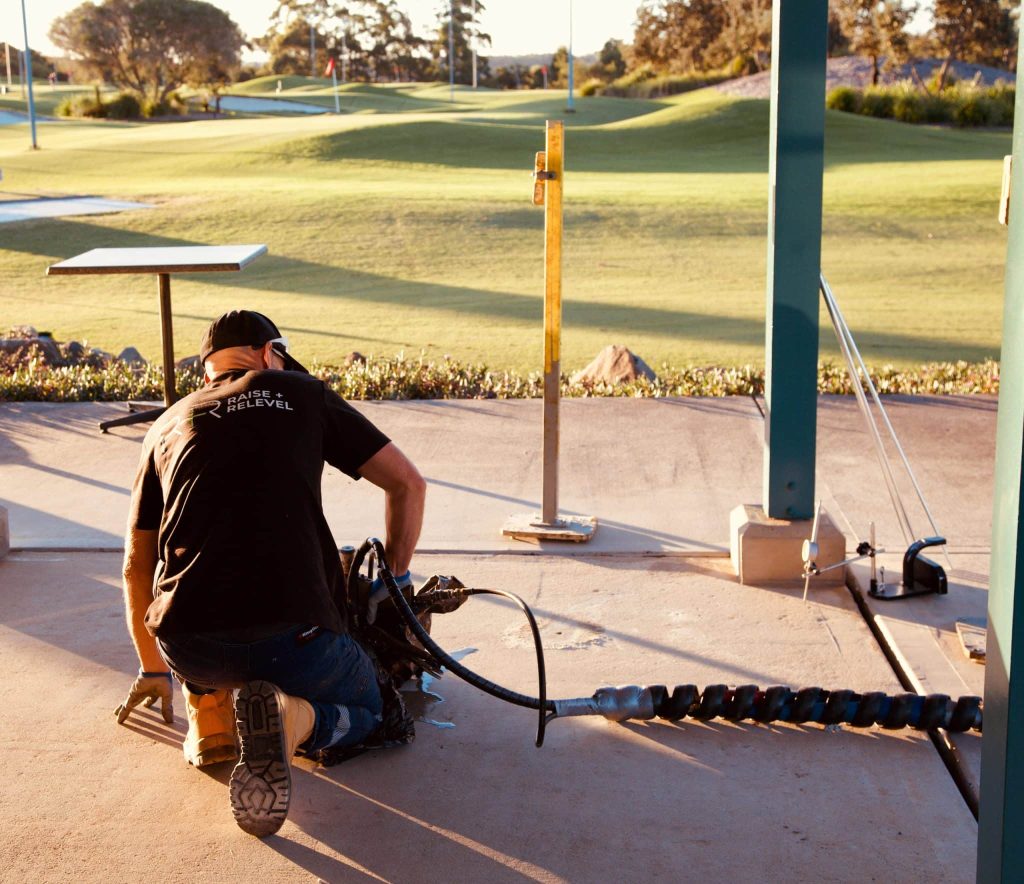
A technician drills small holes through the slab at calculated positions above the settled area. Polyurethane foam is then injected under controlled pressure, expanding to fill existing voids and pushing the slab upward from below. The technician monitors the lift in real time and stops the injection once the slab reaches the required level.
Is concrete levelling foam a permanent repair solution?
Foam levelling is a long-term repair that addresses the underlying cause of settlement at the time of installation. The foam itself is durable and water-resistant once cured and does not break down under normal load conditions. If soil movement, poor drainage, or active erosion continues beneath the slab, further settlement is possible regardless of the repair method used.
How long does concrete levelling foam take to cure?
Polyurethane foam reaches its initial set within 15 minutes of injection and full cure within 30 minutes under typical Australian conditions. In most cases, foot traffic can resume the same day. Heavy vehicle use may require a longer waiting period depending on slab thickness, foam density, and the load the slab is expected to carry.
Is concrete levelling foam more affordable than concrete replacement?
In most cases, foam levelling costs significantly less than full slab replacement. Replacement involves demolition labour, concrete disposal fees, formwork, new material, and an extended curing period before the surface is usable again. Foam injection avoids most of those costs, and the same-day turnaround reduces disruption to the property and to any businesses operating on site.
Sources
- Standards Australia. AS 2870-2011 Residential Slabs and Footings. Standards Australia AS 2870-2011 Catalogue
- Government of Western Australia, Building Commission. TG002 Moisture Content in Concrete Slabs. WA Building Commission TG002 Technical Guide (PDF)
- Government of Western Australia, Building Commission. Industry Bulletin 31: Placement, Curing and Finishing of Residential Concrete Floor Slabs. WA Building Commission Industry Bulletin 31
- Building and Plumbing Commission Victoria. Minimising Foundation Movement and Damage to Your House. BPC Victoria: Minimising Foundation Movement Guide
- University of Southern Queensland Research Repository. Polyurethane Foam: The Foaming Process and the Effect of Process Parameters on Properties. USQ Research: Polyurethane Foam Properties Study
- Western Sydney University Research. Structural Performance of Polyurethane Foam-Filled Building Components. WSU: Structural Performance of Polyurethane Foam Research
- RMIT University Learning Lab. Concrete Slab Floor Systems, General Construction. RMIT Learning Lab: Concrete Slab Floor Systems
- RMIT University Learning Lab. Concrete Slab Types and Load Classification. RMIT Learning Lab: Slab Types & Load Classification
- Training.gov.au. CPCCCO3046A Construct Residential Slabs and Footings. Training.gov.au: CPCCCO3046A Unit Guide (PDF)
- Training.gov.au. MSFFL2032 Install Floor Levelling and Repair Systems. Training.gov.au: MSFFL2032 Unit Guide (PDF)