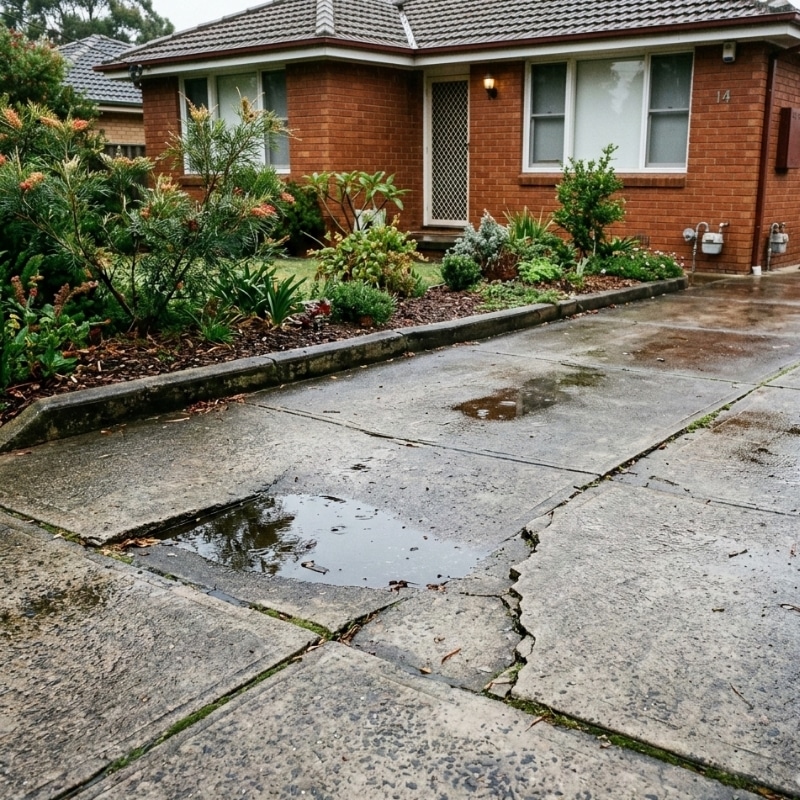
A driveway that suddenly dips, slopes, or develops an uneven “step” between slabs can be more than a cosmetic annoyance. In many Australian homes, it’s a sign that the ground under the concrete has lost support or shifted over time.
The good news is that driveway settlement often follows a pattern. If you understand the most common causes—especially soil erosion, poor compaction, and moisture changes—you can usually narrow down what’s happening underneath, spot warning signs early, and avoid repeat issues.
This guide is written for Australian conditions (including Sydney, Melbourne, Brisbane and beyond) where rainfall events, reactive soils, drainage layouts, and everyday loading can combine in ways that gradually change the support beneath concrete.
What “settlement” really means (in plain English)
Concrete doesn’t “sink” on its own. A driveway typically settles when:
- The soil or material under the slab compresses (often from poor compaction)
• The support washes away (soil erosion/voids)
• The ground expands and contracts with moisture (especially in reactive clays)
• Loads repeatedly stress weak points (edges, thin sections, poorly supported areas)
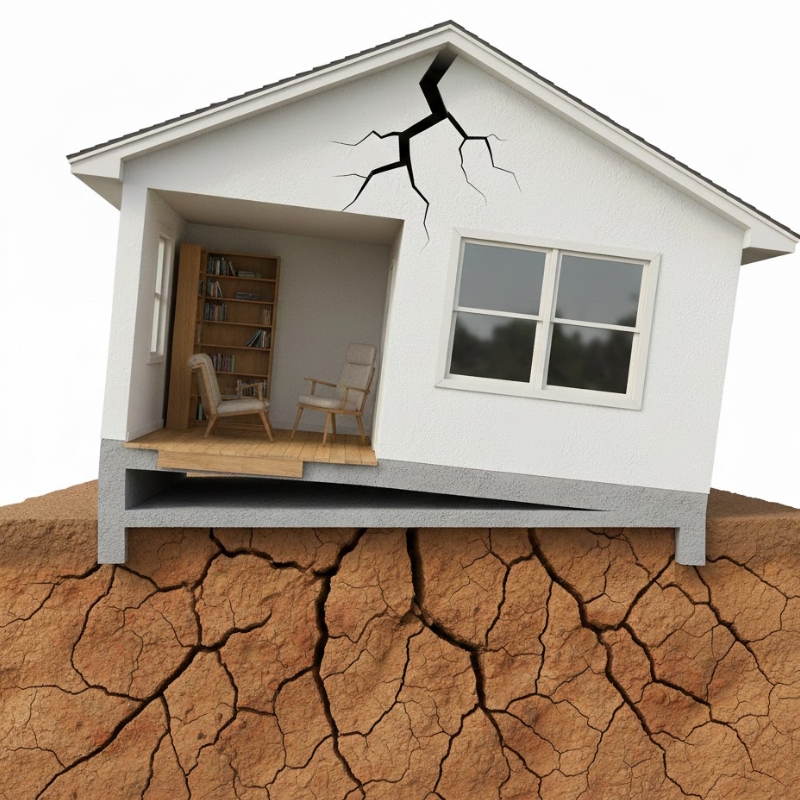
You can think of your driveway like a tabletop. The concrete is the tabletop, and the soil/sub-base is the legs. If a “leg” softens, erodes, shrinks, or was never properly built, the tabletop can tilt or drop.
Is a sinking driveway dangerous?
It can be. Uneven sections create trip hazards, can scrape car underbodies, and often cause water to pond or flow toward garages and house slabs. If the change is sudden, the dip is growing, or water is now draining toward the home, it’s worth treating as a priority rather than “something to do later”.
The top 3 causes of driveway sinking in Australia
Most driveway settlement stories fall into one (or more) of these buckets:
- Soil erosion and washout (support literally disappears)
- Poor compaction or sub-base issues (support compresses over time)
- Moisture-driven ground movement (support expands/shrinks seasonally)
Let’s break them down in practical, homeowner-friendly terms.
Cause 1: Soil erosion and washout (voids under the slab)
Soil erosion happens when water moves where it shouldn’t—under the driveway, along the edge, or through small gaps—carrying fine material away. Over time, that creates voids (empty pockets). Once there’s a void, the slab can crack, rock, or drop into the space.
Common sources of washout around driveways
- Downpipes that discharge near the driveway edge
• Stormwater overflows during heavy rain
• Incorrect falls that funnel water under joints
• Leaking taps, irrigation lines, or burst poly pipes
• Garden beds built up against the driveway edge (trapping water)
• Repeated hosing that pushes water into gaps over months/years
In Sydney and Brisbane, intense rainfall can expose weak drainage points quickly. In Melbourne, slower persistent moisture around edges can still do damage over time—especially when combined with clay soil behaviour.
How to tell if erosion is likely (simple clues)
Look for these signs:
- A dip that worsens after heavy rain
• Sand or fine soil “pumping” out from under edges or cracks
• Hollow sounds when you tap the slab with a tool handle
• A slab that feels slightly “springy” or rocks when stepped on
• Cracking that appears near corners/edges first
• New puddles forming where water didn’t previously pond
Can heavy rain make a driveway sink overnight?
Sometimes, yes—especially if there’s already a developing void or a compromised area near a drain line. A major rain event can accelerate an existing problem. If you notice a sudden change after a storm, check downpipes, overland flow paths, and whether any water is now disappearing into cracks or joints.
What to check first if you suspect a washout
Start with the “water map” around your driveway:
- Where do downpipes discharge, and where does that water go in a big downpour?
• Do you have any low spots that pond water near slab edges?
• Are there gaps where water can travel under the slab (open joints, edge separations)?
• Are there signs of soil movement near the driveway edge (small sinkholes, soft spots)?
If you can fix the water pathway early, you often prevent the void from expanding.
Cause 2: Poor compaction and sub-base problems (support compresses)
Poor compaction is one of the most common reasons driveways settle over the first few years—especially after construction, renovations, or landscaping changes.
A driveway isn’t just a concrete slab. Underneath, there should be a properly prepared base (often crushed rock) and well-compacted subgrade. If that foundation wasn’t compacted enough—or if unsuitable fill was used—the ground can compress gradually under normal use.
Where poor compaction shows up most
- Areas near the house where fill was placed after construction
• Driveway extensions added later
• Trench backfills (after plumbing, electrical, drainage works)
• Edges and corners (where compaction is often weaker)
• Areas that take repeated loading: bin routes, turning circles, parking bays
If you’ve had trenching work along or under the driveway—even years ago—settlement can appear as the backfill consolidates. This is also common around infrastructure projects where repeated heavy vehicle movement stresses ground that may not have been compacted to suit.
Visual patterns that suggest compaction settlement
- A broad, shallow depression rather than a sharp “step”
• Multiple slabs settling in the same direction
• Settlement near a patch or cut line
• Cracks that form as the slab flexes, then the section slowly drops
Why does my driveway sink in one spot only?
A localised dip often points to a localised cause: a poorly compacted patch, a trench backfill, a void from washout, or a concentrated water source (like a downpipe). The “one spot” clue is helpful—walk the perimeter and look for the nearest water or excavation history.
How to reduce future compaction-related settlement
Even without rebuilding anything, homeowners can reduce risk by:
- Keeping heavy loads off slab edges (where support is easiest to undermine)
• Redirecting water away from edges so the base stays stable
• Monitoring any patched or trenched zones for early movement
• Avoiding garden beds that trap water against the driveway sides
Compaction issues are rarely fixed by surface patching alone. If the support underneath continues to compress, the visible symptom often returns.
Cause 3: Moisture changes and reactive soils (shrink–swell movement)
Moisture-driven movement is a big deal in many parts of Australia. Some clay soils expand when wet and shrink when dry. Over seasons, that can lift sections, drop sections, and create uneven support beneath slabs.
This doesn’t always look like classic “sinking.” It can look like:
- One side drops during a dry spell
• The same area seems to change slightly over seasons
• Cracks appear, then widen and narrow with weather patterns
• Doors/gates nearby start sticking at certain times of year
For a homeowner, the key idea is simple: stable moisture around foundations and slabs matters. If one side of the driveway stays wetter than the other (say, because of irrigation or a downpipe), the soil behaviour can be uneven—leading to tilt, settlement, or differential movement.
For a deeper homeowner-friendly explanation of moisture management around footings (including how watering patterns and drainage can influence ground performance), see CSIRO’s guidance on foundation maintenance and footing performance: CSIRO foundation maintenance and footing performance.
Moisture patterns that commonly affect driveways
- Lawn sprinklers overspraying onto driveway edges daily
• Garden beds that keep one side damp
• Water pooling near the garage/house slab
• Trees drawing moisture from one side more than the other
• Long dry periods followed by sudden rain (rapid moisture swings)
Is it “normal” for concrete to move with the seasons?
Minor movement can happen, especially on reactive soils, but noticeable unevenness, trip hazards, or changes that worsen each season aren’t something to ignore. Even if moisture changes are part of the story, it’s still worth checking drainage and support conditions because moisture + poor base + washout can stack together.
Other contributors that often overlap with the “big three”
Even when erosion, compaction, and moisture changes are the main drivers, these factors frequently contribute.
Heavy loads and repeated stress (especially near edges)
Driveways often carry more than just cars: delivery vans, concrete trucks during renovations, skip bins, and council trucks. Repeated loading can accelerate settlement in already-weak areas—especially:
- Along driveway edges
• At transitions to the street/kerb
• Where the slab is thinner or unsupported
• Where the base is weaker due to poor compaction or washout
Tree roots and vegetation effects
Tree roots can heave slabs, but trees also change moisture patterns by drawing water from soil—sometimes increasing shrinkage in dry periods. The result can be uneven support and movement that appears as “sinking” in one zone.
Construction changes and landscaping
Any time the surrounding ground is altered—retaining walls, garden rebuilds, new drainage, added fill—the driveway’s support environment can change. Settlement may show up months later, once the soil consolidates or water pathways change.
A practical diagnosis guide (what to check, in order)
You don’t need specialist tools to do a first-pass assessment. The goal is to gather clues.
Step 1: Map the dip
- Is it one slab, one corner, an edge line, or a broad area?
• Is the lowest point near a downpipe, garden, or drain?
• Is water now pooling there?
Step 2: Look for water pathways
- Watch the area during rain (or run a hose briefly and observe flow)
• Check downpipes and stormwater entry points
• Look for overflow paths (water running along the driveway edge)
Step 3: Check for void signs
- Hollow sound when tapped
• Soil loss at edges
• Small sinkholes or soft soil near the slab
Step 4: Consider construction history
- Was the driveway extended?
• Were trenches cut nearby?
• Was fill added after the build?
Step 5: Consider seasonal patterns
- Does it worsen in dry spells or after long rains?
• Is one side wetter (irrigation, shade, garden beds)?
What’s the difference between driveway cracks and driveway sinking?
Cracks can happen for many reasons (shrinkage, thermal changes, minor movement), but sinking usually indicates a support issue underneath. If cracks are paired with uneven levels, rocking slabs, gaps opening at edges, or new drainage issues, the underlying support conditions should be investigated.
Why quick surface fixes often don’t last
It’s tempting to grind a high edge, fill a crack, or patch a low spot. Sometimes that helps temporarily for safety. But if the root cause is below the slab—voids from erosion, base compression, or moisture-driven movement—surface fixes don’t restore the missing support.
A more durable outcome usually comes from two parts:
- Addressing the cause (water control, drainage, moisture stability)
• Addressing the symptom (bringing levels back into safe alignment)
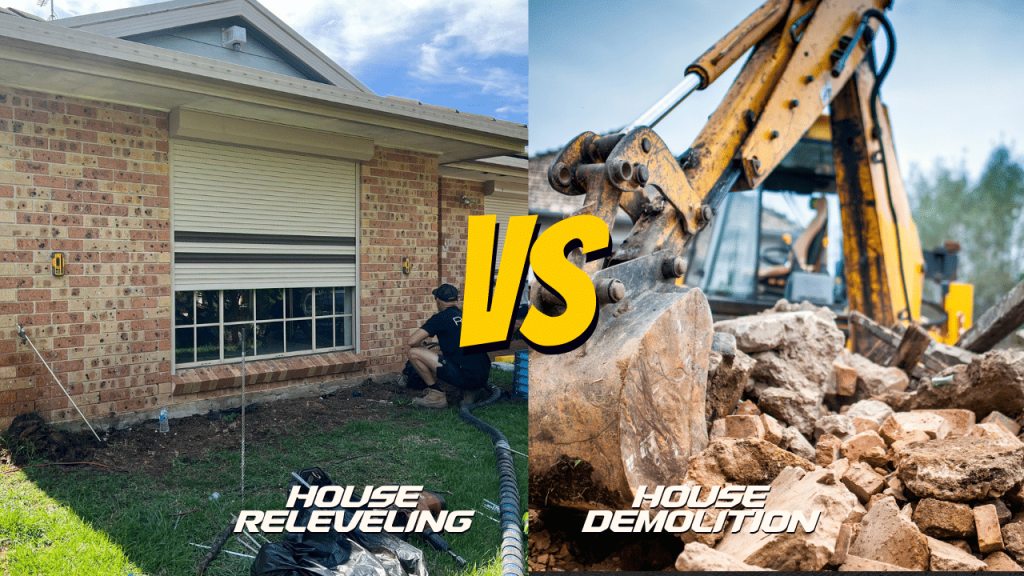
If the slab is mostly intact and the issue is underneath, the next step is usually to understand the driveway releveling process and whether it suits the way your driveway has settled.
Moisture management tips that help in many Australian yards
Because moisture changes are so often involved, these habits can reduce risk even if settlement has already started:
- Ensure downpipes discharge into proper stormwater, not onto the driveway edge
• Avoid daily overspray from sprinklers onto slab edges
• Keep garden beds slightly lower than driveway edges where practical (so water drains away)
• Make sure surface water runs away from the house and garage slab
• Fix leaks quickly—small leaks become big soil problems over time
If I fix drainage, will the driveway “come back up”?
Fixing drainage can stop the problem getting worse, but it usually doesn’t reverse settlement on its own. If a void exists or the base has compressed, the slab typically stays where it is until it’s properly re-supported and levelled.
When settlement is urgent (and when it can be monitored)
Not every dip is an emergency, but some situations deserve prompt attention.
More urgent scenarios
- Rapid change over weeks (not months/years)
• Water now draining toward the garage or house
• A slab corner that rocks when stepped on
• Sudden cracking paired with a level change
• A depression that creates frequent ponding (slippery algae zones can form)
• Trip hazards on main pedestrian routes
Monitor-but-don’t-ignore scenarios
- Minor level differences that aren’t changing
• Hairline cracks without noticeable movement
• Slight ponding that appears only in very heavy rain (still worth improving drainage)
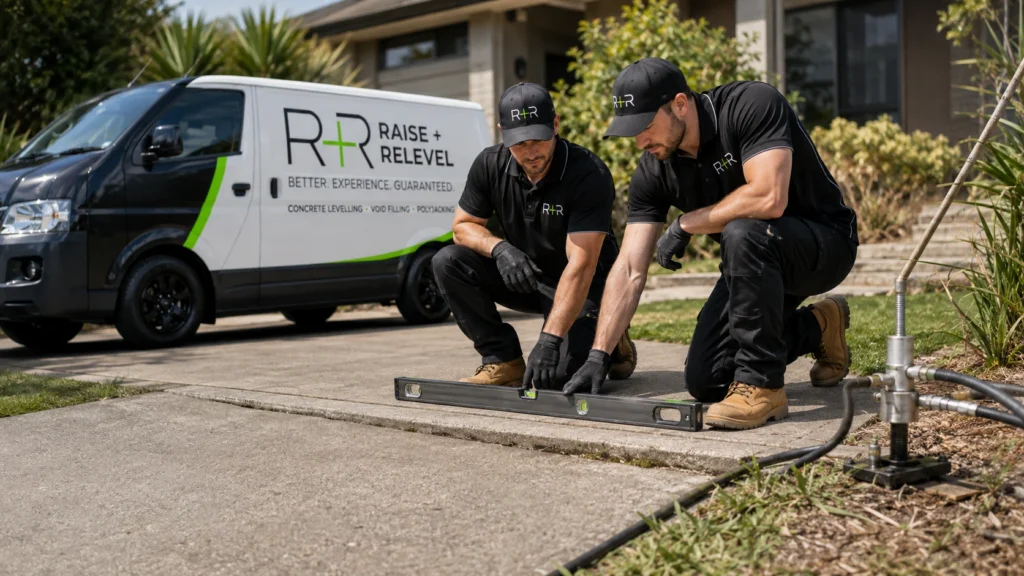
If you’re unsure, document it: take photos, measure the dip with a straightedge, and re-check after major weather events.
What “releveling” generally means (without getting salesy)
“Releveling” is a broad term people use when they want the driveway surface even again. The best approach depends on what’s actually happening underneath.
At a high level, durable outcomes usually involve:
- Restoring support under the slab (so it’s not bridging a void)
• Bringing the slab back toward a safe, functional level
• Controlling the cause (water and moisture patterns)
Once you’ve identified whether erosion, poor compaction, or moisture movement is the likely cause, it’s easier to make sense of how driveway releveling works and what it’s designed to correct.
Is replacement always necessary?
Not always. Replacement can be appropriate when slabs are badly deteriorated, broken into many pieces, or the drainage design needs a complete rework. But if the slab is largely intact and the issue is support underneath, addressing the support and levels can often be a more targeted solution. The right answer depends on the condition, cause, and the broader site drainage picture.
Preventing repeat settlement: match the fix to the cause
If a settlement happened from a washout, but the water source remains, the risk of recurrence stays high. If a settlement happened from poor compaction, but heavy loading continues on a weak edge, the risk stays high. If the settlement is moisture-driven and one side remains far wetter than the other, the risk stays high.
A practical prevention mindset is:
- Water control first
• Support integrity second
• Surface safety and drainage flow last (ponding, trip hazards, transitions)
Where one section has dropped, but the surrounding concrete is still in reasonable condition, homeowners often start by learning about driveway releveling for sunken concrete so they can compare it against patching or full replacement.
FAQs about sinking driveways (Australia)
Why is my driveway sinking near the garage?
This is often linked to drainage or moisture patterns. Water can concentrate near the garage if falls are wrong, downpipes discharge nearby, or stormwater overflows during heavy rain. It can also be linked to fill placed after construction that slowly consolidates if compaction wasn’t ideal.
Why is my driveway sinking in the middle?
Middle settlement may point to a localised weak base, a void developing under that section, or a historical trench/backfill area. Check whether any plumbing or stormwater lines run underneath, and look for signs of water disappearing into cracks or joints.
Can I just fill the low spot with a patching compound?
You can sometimes patch for short-term safety, but it won’t replace missing support underneath. If the cause is erosion, poor compaction, or moisture-driven movement, the patch often cracks or sinks again.
How do I know if there’s a void under my driveway?
Common clues include hollow sounds when tapped, small sinkholes near edges, soil washing out of joints, rocking slabs, and dips that worsen after rain. A professional assessment can confirm the extent and location.
Do reactive clay soils cause sinking or lifting?
They can contribute to both. Reactive clays shrink as they dry and swell when wet. If moisture isn’t consistent around the slab, movement can be uneven—causing tilt, dips, or apparent “sinking” at one side.