Uneven concrete is one of the most overlooked safety hazards on Australian properties. Why is concrete levelling important? Because sunken, cracked, or shifted slabs create real injury risks every day, in homes, workplaces, and public spaces. Levelling restores stable surfaces, prevents accidents, and protects structural integrity across residential and commercial buildings. It also helps property owners stay on the right side of Australian safety standards, preventing small problems from growing into expensive ones.
Key Takeaways
- Uneven concrete surfaces are a leading cause of trip-and-fall injuries in Australian homes, workplaces, and public spaces, and most of these incidents are preventable.
- Concrete levelling restores load-bearing balance across displaced slabs and stops further cracking, sinking, and structural stress from spreading to connected building elements.
- Australian workplace safety legislation and building standards require property owners to promptly identify and address known surface hazards.
- Addressing uneven concrete early costs significantly less than the repairs, liability claims, or full slab replacement that follow if the problem is left to worsen.
How Uneven Concrete Puts People at Risk
Concrete doesn’t fail overnight. Subsidence, soil erosion, and changes in moisture gradually shift slabs out of position over months and years. By the time a surface looks noticeably uneven, the risk to people using it is already real. Sinking floors and displaced slabs around driveways, footpaths, and building entries are responsible for a large share of trip-related injuries across Australia.
Falls on the same level account for a significant proportion of serious workers’ compensation claims in Australia. Outside workplaces, the risk is just as present in residential settings. Driveways, garden paths, and outdoor entertaining areas develop level changes that catch people off guard, particularly in low-light conditions.
What Counts as a Trip Hazard on Concrete
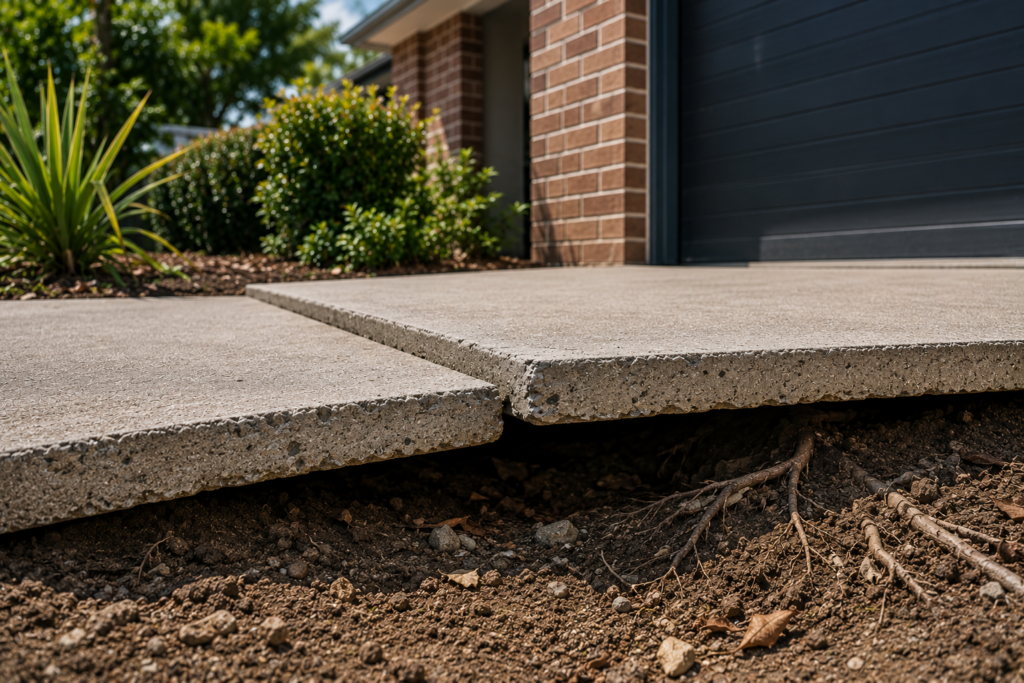
Any vertical change in level that exceeds 3mm on a concrete surface is generally classified as a trip hazard. That is a very small gap. Slab edges that lift by even a few millimetres create conditions that cause falls, particularly for older Australians, children, and people using mobility aids.
The hazards posed by uneven concrete go beyond falls. These are the most common risks:
- Raised slab edges cause trip-and-fall accidents, especially at building entry points and in poor lighting.
- Wheelchair users and people with mobility aids lose safe, continuous access across displaced or cracked surfaces.
- Vehicles and equipment sustain damage when crossing sharp level changes in driveways and hardstand areas.
- Water pools in low points where slab movement has disrupted surface drainage, further weakening the subbase over time.
- Connected building elements experience increased structural stress when loads are unevenly distributed across the foundation system.
Each of these issues compounds without intervention. A 5mm edge becomes a 15mm edge. A drainage problem keeps eroding the subbase, making the eventual repair far more extensive.
Why Concrete Levelling Directly Prevents Injuries
Concrete levelling brings displaced slabs back to their correct position and removes the surface irregularities that cause falls. The result is a continuous, stable walking surface that eliminates the conditions leading to injury.
Slips, trips, and falls consistently rank among the top sources of serious injury claims in Australia’s national workplace health and safety statistics. WorkSafe Victoria identifies slip and trip hazards as preventable risks that property owners and employers have a clear duty to manage. SafeWork SA confirms that most such incidents involve identifiable surface conditions that could have been corrected before anyone got hurt.
Reducing Liability for Property Owners
Property owners carry a duty of care under Australian law to keep surfaces in a safe condition. When uneven concrete causes injury, the owner’s liability exposure is real. Courts and insurers look at whether the hazard was known, how long it had been present, and whether reasonable action was taken.
Trip-and-fall injury claims in Australia frequently involve surface conditions that were identifiable and preventable well before the incident. Levelling uneven concrete is a documentable action that shows a property owner has addressed a known hazard. The cost of professional levelling is far lower than that of a personal injury claim.
High-Traffic Areas Need Priority Attention
Not all uneven concrete carries the same level of risk. Areas with heavy foot traffic need priority assessment. These include building entry points, walkways between car parks and doors, loading zones, and communal pathways in residential complexes.
For residential properties, driveway releveling is one of the most common safety interventions because vehicle and foot traffic together accelerate slab movement over time.
How Concrete Levelling Supports Structural Stability
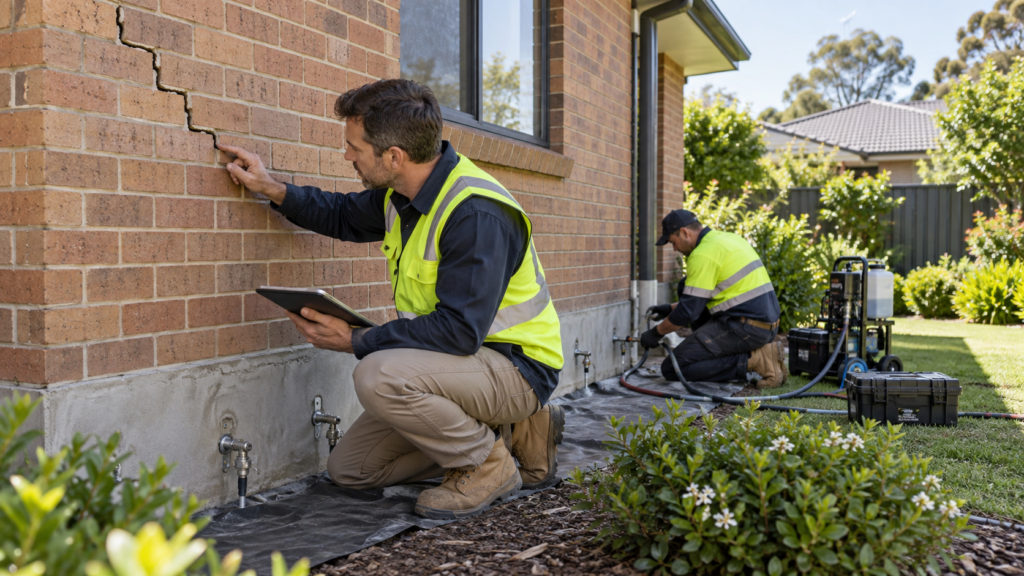
Concrete slabs don’t move in isolation. When one slab shifts, it alters how loads are transferred through the foundation system below. Unlevel buildings develop cracked walls, sticking doors, and jammed windows as a direct result of slab movement that was not corrected early enough.
Slab jacking restores the original position of displaced concrete by filling the void beneath the slab and levelling it. This re-establishes load-bearing balance across the entire foundation system. The structural benefits include the following:
- Load distribution is restored across the slab and its supporting substrate, removing concentrated stress points.
- Further cracking and surface spalling are prevented once the slab regains proper support.
- Adjacent footings and building elements receive consistent support, reducing the risk of secondary damage.
- Connected structures, including walls, columns, and stairs, experience less stress as a result.
- The service life of the concrete surface is significantly longer than that of a slab that remains displaced and unsupported.
Environmental surface conditions and injury severity are closely linked in Australian safety research, with findings pointing clearly to surface conditions as a controllable risk factor. Restoring even, stable surfaces reduces both the frequency of incidents and the severity of those that occur.
For buildings experiencing active subsidence, levelling alone may not be sufficient in the long term. Underpinning addresses the root cause by stabilising the foundation, which then supports lasting levelling outcomes.
Concrete Levelling and Australian Building Standards
Australian construction and safety regulations set clear expectations around surface conditions in buildings and public infrastructure. Minimum standards for surface continuity, slip resistance, and accessibility apply to both new and existing structures under the National Construction Code.
These standards apply beyond large commercial projects. Residential properties, particularly those undergoing renovation or preparing for sale, must meet minimum surface condition requirements. Local councils also maintain standards for footpaths and shared areas, where concrete crack injection and repair are commonly used to restore compliance.
How does concrete leveling work, and what are the standards? Concrete levelling is a repair method used to restore sunken or uneven concrete slabs without full replacement. The process involves injecting specialised materials beneath the slab to fill voids and raise the surface back to its intended level. While there is no single Australian Standard dedicated exclusively to concrete levelling, the repaired surface must comply with applicable NCC requirements and accessibility standards, particularly those relating to safe, stable, and slip-resistant walking surfaces. Proper concrete levelling helps property owners and councils maintain compliance, r
Workplace Safety Obligations
For commercial and industrial properties, obligations go further. Managing risk in concrete construction environments is a core responsibility under SafeWork Australia’s guidance, covering active work sites and maintained structures where workers conduct inspections or ongoing operations.
On-site concrete work safety identifies surface condition as a frontline concern for any team working on or around concrete. Uneven surfaces increase the risk of worker falls, equipment instability, and dropped loads simultaneously.
For industrial sites and large infrastructure projects, structural repair solutions address both safety compliance and long-term slab performance.
Infrastructure, Public Spaces, and Accessibility
Public infrastructure in Australia undergoes regular inspection against surface and accessibility standards. Roads, footpaths, public buildings, and transport facilities must maintain surfaces that meet both safety and accessibility requirements for people with disabilities. Transportation and infrastructure concrete repair covers the levelling and grouting work that keeps these assets safe and compliant for ongoing public use.
Civil construction projects incorporate concrete levelling as a standard quality step before handover to councils, government agencies, or end users. Public and government sector asset managers rely on regular concrete condition assessments to stay ahead of compliance requirements.
The Long-Term Cost of Leaving Uneven Concrete Unaddressed
Delaying concrete levelling rarely saves money. Surface problems do not resolve on their own. Subbase erosion continues, slab edges shift further apart, and the scope of repair work grows substantially the longer it goes unaddressed.
A surface that needed minor treatment early can require full slab replacement if left too long. Void filling and sinkhole remediation become necessary when the subbase beneath a slab erodes to the point where the concrete loses all support. That is a significantly larger and more disruptive job than early-stage levelling would ever have been.
Most slip, trip, and fall incidents occur on predictable surfaces that have been developing for some time. Proactive concrete maintenance is genuinely preventive, not just reactive repair.
Proactive levelling is also considerably less disruptive to daily operations than emergency repair work. For commercial operators and residential owners alike, addressing the problem on your own schedule costs less and causes less disruption than responding to an incident or a compliance notice.
For anyone noticing early warning signs, such as cracked walls or jammed doors and windows, getting a professional assessment early gives you the most options and the lowest repair cost.
Frequently Asked Questions
Why is concrete levelling important for structural safety?
Concrete levelling restores the load-bearing capacity of displaced slabs, preventing further cracking, sinking, and stress on connected building elements. When slabs shift, the foundation’s ability to distribute weight evenly is compromised. Levelling corrects that imbalance before it causes wider structural damage. Buildings with stable, level concrete slabs are far less likely to develop cracked walls, sticking doors, or jammed windows over time. The earlier the intervention, the simpler and less costly the repair tends to be.
Why is concrete levelling important under Australian building standards?
Australian building standards set minimum requirements for surface continuity, slip resistance, and accessibility. Uneven concrete can breach these requirements, creating compliance issues for property owners and managers. This applies to residential properties, commercial buildings, and public infrastructure alike. The Australian Building Codes Board and Safe Work Australia both address surface conditions as part of broader structural and workplace safety frameworks. Staying compliant through regular maintenance protects you from enforcement action and insurance complications down the line.
Why is concrete levelling important for long-term property safety?
Surface problems in concrete tend to worsen over time without intervention. A small raised edge or minor slope change gradually becomes a more significant hazard as the subbase continues to shift beneath it. Addressing levelling issues early stops that progression and protects both the people using the surface and the structural elements connected to it. Properties with well-maintained concrete also carry lower liability risk and tend to hold their value better than those with visible surface deterioration.
What happens if concrete levelling is not done in homes?
Unaddressed concrete movement in homes typically leads to a series of problems. It starts with uneven surfaces around driveways, pathways, or internal slabs. Over time, this leads to cracking in connected walls, jammed doors and windows, and drainage problems around the building perimeter. In more advanced cases, ongoing subsidence beneath the slab causes it to lose support entirely, requiring far more extensive and costly repair work than early-stage levelling would have needed.
Why is concrete levelling important in construction site safety?
On active construction sites, uneven concrete surfaces pose several hazards. Workers face trip risks, equipment becomes unstable on uneven ground, and loads are harder to move safely across broken surfaces. SafeWork Australia’s guidance on construction environments identifies surface condition as a frontline safety control. Maintaining level, stable concrete surfaces reduces the likelihood of incidents and supports safe, efficient workflows for every worker on site.
Sources
- Safe Work Australia — Slips, Trips and Falls
- Safe Footpaths Australia — What is a Trip Hazard
- SafeWork NSW — Slips, Trips and Falls on the Same Level
- SafeWork SA — Slips, Trips and Falls
- WorkSafe Victoria — Slips, Trips and Falls
- WA Health Alliance — Key WHS Statistics 2025
- Taylor and Scott Lawyers — Alarming Statistics About Slips, Trips and Falls
- Monash University MUARC — Research Report 281
- Runnymede Safety — Concrete Work Safety Toolbox Talk
- Safe Work Australia — Managing Risk in Construction Concrete Pumping
- Acclaimed Workforce — Slips, Trips and Falls Are Not as Random as You May Think
- Australian Building Codes Board — National Construction Code