How does concrete levelling work? Technicians drill small holes into the settled slab. They then inject resin, foam, or grout into the voids below.
The material fills the voids and carefully raises the concrete to the required level.
This process restores support and alignment. It may also avoid the need to remove and replace the entire slab.
Key Takeaways
- Sunken concrete slabs can be lifted and stabilised by injecting material into the voids beneath them, which restores surface alignment without tearing out and replacing the slab.
- Australia’s reactive clay soils and variable weather conditions make concrete settlement a common problem, and the right repair method depends on soil type, slab condition, and load requirements.
- A professional levelling job follows a strict sequence from site assessment through to sealing, and skipping any step reduces the repair’s longevity.
- Catching settlement early through a professional inspection keeps repair costs low and prevents minor ground movement from turning into major structural damage.
Why Does Concrete Sink in Australian Construction?
Concrete does not sink without a reason. Identifying the cause matters as much as fixing the surface, because levelling a slab without addressing the cause can lead to the same problem returning within a few years.
Several site-specific factors are common across Australian properties.
Soil behaviour is the primary driver. Australia has high concentrations of reactive clay soils, classified under Australian Standard AS 2870 into site classifications ranging from slightly reactive to extremely reactive.
These soils shrink during dry periods and swell when wet, creating ongoing movement beneath slabs. Residential slabs not designed to match the site classification are especially prone to differential settlement.
Other contributing factors include the following:
- Poor subgrade compaction during construction: fill that is not properly compacted continues to compress under load, creating voids beneath the slab over time.
- Water erosion and poor drainage: water flowing beneath a slab washes away fine particles, creating hollow spaces that allow sections to drop.
- Tree root activity: roots extract moisture from the surrounding soil, causing localised shrinkage and uneven ground support directly beneath slabs.
- Sustained load pressure: heavy vehicle traffic or point loads stress slabs in areas where the ground support is already marginal.
- Subgrade wetting and drying cycles: seasonal moisture fluctuations are particularly severe in inland and semi-arid parts of Australia, compounding movement in reactive soils.
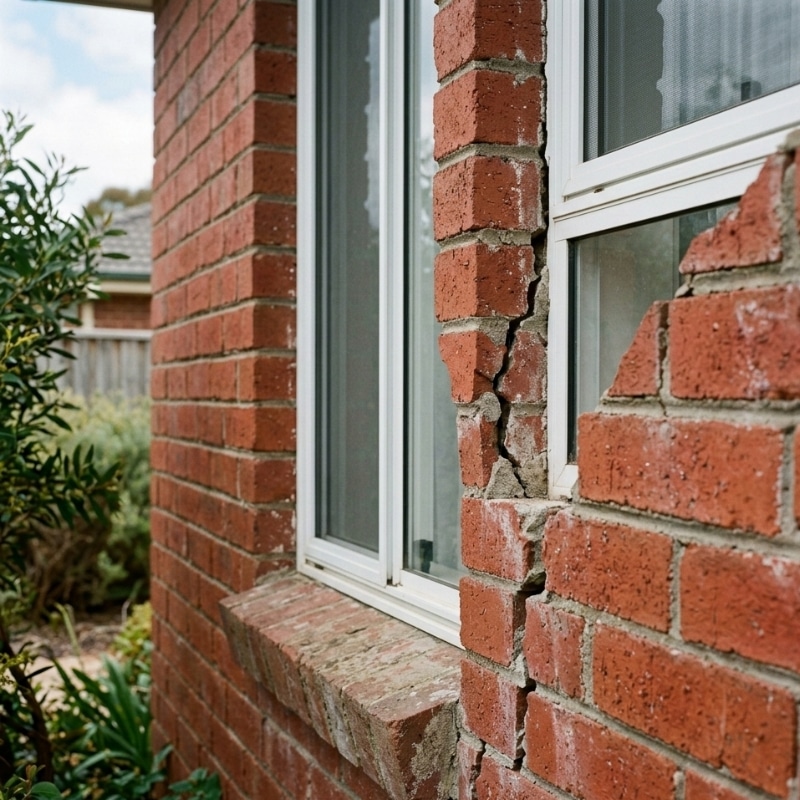
When these forces go unchecked, slabs shift, crack, and create hazards. Sinking floors, cracked walls, and jammed doors and windows are all early warning signs that ground movement is already underway.
How Does Concrete Levelling Work to Restore Structural Stability?
Concrete levelling restores support beneath a settled slab by filling underground voids and carefully raising the concrete.
Depending on the site, technicians may use polyurethane resin, cementitious grout, or another engineered material to stabilise the slab and correct the affected surface.
The principle behind the process is straightforward. A void beneath a slab removes the support that keeps the concrete in position.
Injecting a material that fills that void and expands or hardens beneath the slab pushes it back up.
Construction professionals have used the basic mechanics of slabjacking for decades, and engineering practice has long established the method as reliable.
How Levelling Compares to Full Replacement
Before choosing between repair and replacement, property owners often ask, “How does concrete levelling work compared with installing a new slab?”
Levelling fills the voids beneath structurally suitable concrete, while replacement involves removing the existing slab and pouring a new one.
The Western Australia Building Commission technical note on residential concrete floor slabs outlines curing and placement standards for both new pours and reinstated surfaces. Levelling completed by professionals aligns with these requirements.
For unlevel buildings or subsidence issues, levelling is often the correct first-line repair before any deeper structural intervention. It stabilises the slab so that further assessment can proceed from a stable base.
Methods Used for Concrete Levelling in Modern Construction
Since contractors can use several repair methods, clients may wonder, “How does concrete levelling work with resin, grout, or mudjacking?” The most suitable method depends on the slab type, soil conditions, expected load, and severity of settlement.
Mudjacking
Mudjacking pumps a mixture of water, soil, and cement beneath the slab through drilled ports. The slurry fills the void space, and the pressure lifts the slab. It is a well-established repair technique with a long history in construction, particularly suited to large commercial and civil slabs.
The main limitation is weight. The slurry adds considerable mass beneath the slab, which can be problematic on sites with weak or moisture-sensitive subgrades.
Polyurethane Foam Injection
Polyurethane foam injection, also called polyjacking, works by pushing a two-part expanding foam through small holes drilled into the slab. The foam expands quickly, fills the void below, and raises the slab back to its correct level.
Compared with traditional mudjacking slurry, polyurethane resin is lightweight and can allow technicians to control the lift in small increments. Its expansion and curing properties depend on the product, temperature, site conditions, and manufacturer specifications.
Raise and Relevel’s resin injection services apply this method across residential and industrial sites where accuracy and minimal downtime matter most.
Grout-Based Levelling Systems
Cementitious grout mixes are suitable for heavier slabs, infrastructure pavements, and large-scale civil projects where high compressive strength is a priority.
Slab stabilisation using grout-based systems is standard practice in pavement engineering and transport infrastructure. Raise and Relevel’s specialised grouting services address these more demanding structural applications.
Self-Levelling Concrete
Self-levelling concrete is a fluid cementitious mix poured across a surface to correct minor irregularities. It flows into low spots without mechanical intervention and suits interior floors with small-scale unevenness.
It is not designed for significant structural settlement and is more of a finishing layer than a structural repair method.
Step-by-Step Process of Concrete Levelling Explained
The process follows a clear sequence, regardless of the material used.
These stages answer a common client question: “How does concrete levelling work from the first inspection to the final surface check?” Care at each stage affects the quality of the repair.
The standard process covers these stages:
- Site inspection and slab assessment: a qualified technician assesses the slab, maps settlement patterns, and determines injection point locations. Void detection may involve probing, ground-penetrating radar, or visual inspection of surrounding indicators.
- Drilling injection points: Technicians drill small holes at calculated points across the slab. The size and spacing of the holes depend on the selected injection system, slab condition, and location of the underground voids.
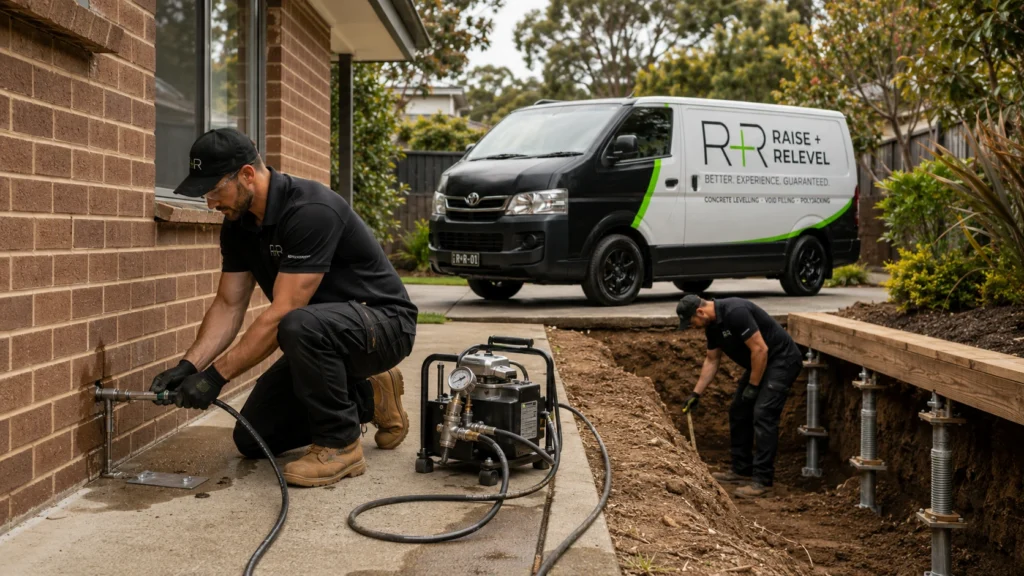
- Injecting levelling material: the technician delivers foam or slurry through the injection ports into the void beneath the slab. The technician monitors flow rate and pressure continuously to control the lift.
- Raising the slab to the correct height: as material fills the void, the slab rises. Technicians use precision levelling instruments to monitor elevation in real time and stop injection at the target height.
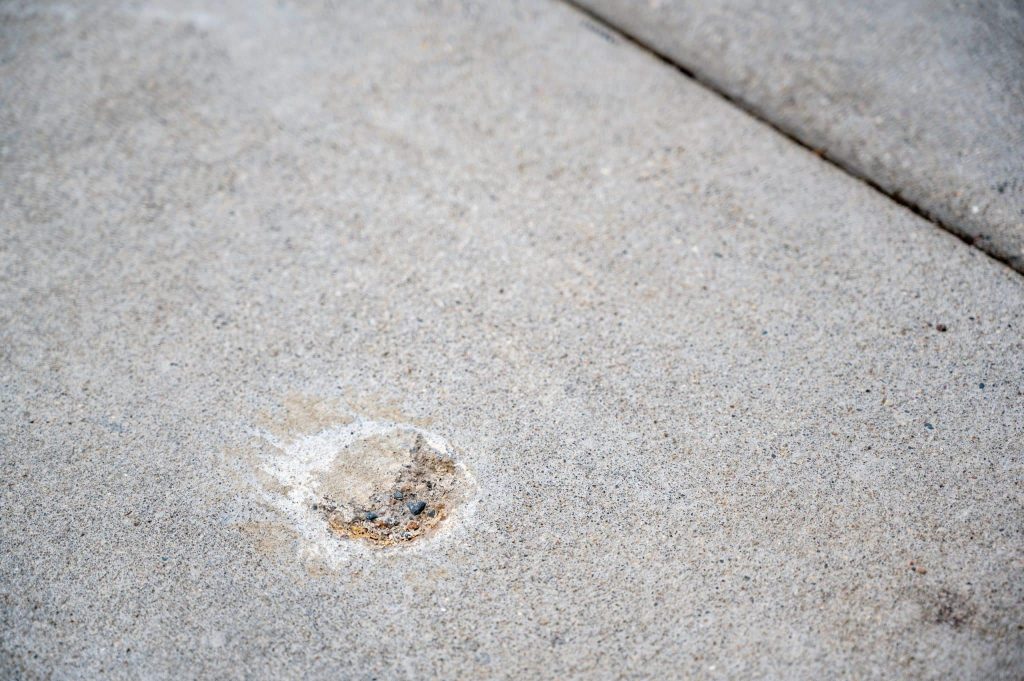
- Sealing holes and finishing the surface, technicians patch the injection holes with a suitable repair material. They then check the finished surface to confirm that it meets the required level and the applicable project tolerances.
A technical, ergonomic, and safety assessment of concrete levelling techniques, published in the public domain through engineering research, confirms that operator skill and equipment calibration are the most significant variables in determining lift accuracy.
Professional assessment and controlled installation are important because incorrect injection pressure, poor material placement, or failure to address the cause of settlement may reduce the effectiveness of the repair.
Tools and Materials Used in Concrete Levelling Work
Professional levelling requires specialised equipment. The tools technicians use directly affect how accurately and efficiently they can lift the slab, and how well the repair holds over time.
Here is a summary of the core equipment involved in a standard concrete levelling job.
- Injection pumps and hoses: high-pressure pumps deliver material through injection ports at controlled flow rates. Foam systems use two-component mixing guns that combine resin and catalyst at the point of delivery to activate the expansion reaction.
- Polyurethane foam or cement slurry: foam is the preferred material for most residential and light commercial projects. Cement slurry or grout is suitable for heavier infrastructure applications with higher compressive strength requirements.
- Core drilling equipment: rotary hammer drills or core drills create the injection holes without fracturing the surrounding slab. Hole size and spacing are calculated based on the slab dimensions and void pattern.
- Levelling and measuring tools: digital levels, laser levels, and string lines allow technicians to monitor elevation changes in real time throughout the lift.
- Safety gear and site protection materials: all workers operate in accordance with Australian workplace health and safety requirements. Foam chemicals require appropriate PPE, and injection areas are secured to prevent bystander access during the lift.
Advanced equipment removes the guesswork from the process.
Digital monitoring tools give technicians precise control over how much each section of the slab rises, which reduces the risk of over-lifting or cracking adjacent areas.
Benefits of Concrete Levelling in Construction Projects
Concrete levelling competes strongly with full slab replacement across a wide range of project types. Both residential and civil construction practices consistently demonstrate the advantages.
Here is why levelling is often the preferred approach.
- Cost-effective repair: levelling costs significantly less than demolition and repour. On large commercial or industrial slabs, the savings are substantial.
- Faster completion and reduced downtime, the concrete levelling may take less time than demolition and slab replacement. Actual completion and reopening times depend on the size of the area, repair material, site access, load requirements, and product curing specifications.
- Minimal disruption to surrounding structures: the repair area stays contained. Adjacent structures, landscaping, utilities, and site access are subject to minimal interference throughout the process.
- Improved structural safety and surface stability: a levelled slab restores correct load distribution and eliminates trip hazards, reducing liability for property owners and site operators.
- Extended lifespan of concrete structures: filling voids and restoring subgrade support removes the ongoing settlement pressure that leads to further cracking and progressive damage.
These benefits apply across residential, industrial, civil construction, and public sector projects. For heritage-listed sites, polyurethane foam injection is particularly valuable because it is non-invasive and does not damage the original building fabric.
Void filling and sinkhole repair work on the same core principles, and Raise and Relevel handles these applications across multiple industries.
For structurally suitable slabs affected mainly by settlement, levelling may require less demolition, labour, material, and site downtime than full replacement.
A professional assessment is still required to determine the most appropriate and cost-effective option.
When to Call a Professional Concrete Levelling Service in Australia
Jammed doors and windows, cracked walls, and sinking floors are all indicators worth investigating promptly. For projects requiring deeper structural intervention, underpinning services address the foundation level when levelling alone is insufficient.
For sites affected by water-leak management issues alongside ground movement, combining both services provides a more comprehensive repair.
Raise and Relevel works across residential, industrial, transport infrastructure, and public sector projects. Their team assesses each site individually and selects the method best suited to the slab condition, subgrade type, and load requirements.
Visiting the concrete levelling services page gives a full picture of available solutions across Australia.
Uneven concrete gets worse the longer it sits. If you notice sunken slabs, cracked surfaces, or shifting ground around your property, get a professional assessment before the damage spreads.
Contact Raise and Relevel to book an inspection and find out which concrete levelling solution suits your site.
Frequently Asked Questions
What safety precautions should you take during concrete levelling?
Workers should wear appropriate safety equipment for the materials and site conditions. This may include gloves, eye protection, protective clothing, and respiratory equipment.
Technicians should inspect pumps, hoses, and mixing equipment before starting work. They should also keep other people away from the injection area. Polyurethane products must be handled in accordance with the product safety data sheet.
Before hiring a contractor, check that the business holds the licences, qualifications, and insurance required for the project.
When should concrete levelling be used instead of other methods?
Concrete levelling may be suitable for a slab that has settled due to soil movement, erosion, or voids beneath the slab. The slab must still be strong enough to withstand the lifting process.
A replacement may be necessary when the slab has deep cracks, severe damage, or chemical contamination. A professional inspection can confirm which option is suitable.
Levelling may also support other structural work, such as underpinning, by creating a more stable surface.
What are the limitations of concrete levelling in construction?
Concrete levelling cannot repair every damaged slab. It may not suit concrete that is too thin, badly cracked, or severely deteriorated.
The process will also provide only a temporary result if the cause of settlement remains. For example, contractors must first address leaking pipes, poor drainage, or ongoing soil erosion.
Large industrial slabs may require stronger equipment and specialist materials. Limited site access can also affect where technicians place the injection points.
How does concrete levelling work in large-scale commercial projects?
Large commercial projects follow the same basic process as residential concrete levelling. However, contractors use larger pumps and higher-capacity injection systems.
The team may divide the slab into several sections. This allows them to raise each area in a controlled way. Survey tools help technicians monitor the slab at several reference points.
The project engineer may also require testing or further checks before the site returns to normal use.
How does concrete levelling work for repairing damaged concrete slabs?
Concrete levelling lifts and supports a slab that has settled. Crack injection treats suitable cracks in the concrete surface. Contractors may use both methods when a slab has minor cracking and ground movement.
Technicians first inject material beneath the slab to restore support. They may then seal suitable cracks with polyurethane or epoxy material.
For more complex damage involving both significant settlement and structural cracking across the full slab depth, a full structural repair assessment determines whether levelling, underpinning, or a combination of both services provides the correct scope of work for the site.
Sources
- The Constructor: What is Mudjacking in Construction? — https://theconstructor.org/concrete/mudjacking-construction/567067/
- The Constructor: What is Polyjacking in Construction? — https://theconstructor.org/concrete/what-is-polyjacking-in-construction/567242/
- The Constructor: Self-Levelling Concrete — https://theconstructor.org/concrete/self-levelling-concrete-slc-properties-benefits/25657/
- FP2.org: Slab Stabilisation and Jacking — https://fp2.org/slab-stabilization-jacking/
- CDC Stacks: Concrete Levelling Techniques Ergonomic Assessment — https://stacks.cdc.gov/view/cdc/197448
- Housing Industry Association: Residential Slabs and Footings — https://hia.com.au/resources-and-advice/building-it-right/australian-standards/articles/residential-slabs-and-footings
- American Concrete Institute: Slabjacking Technical Guide — https://www.concrete.org/portals/0/files/pdf/rap-11.pdf