Subsidence Explained: What It Is and How It Affects Your Home’s Value
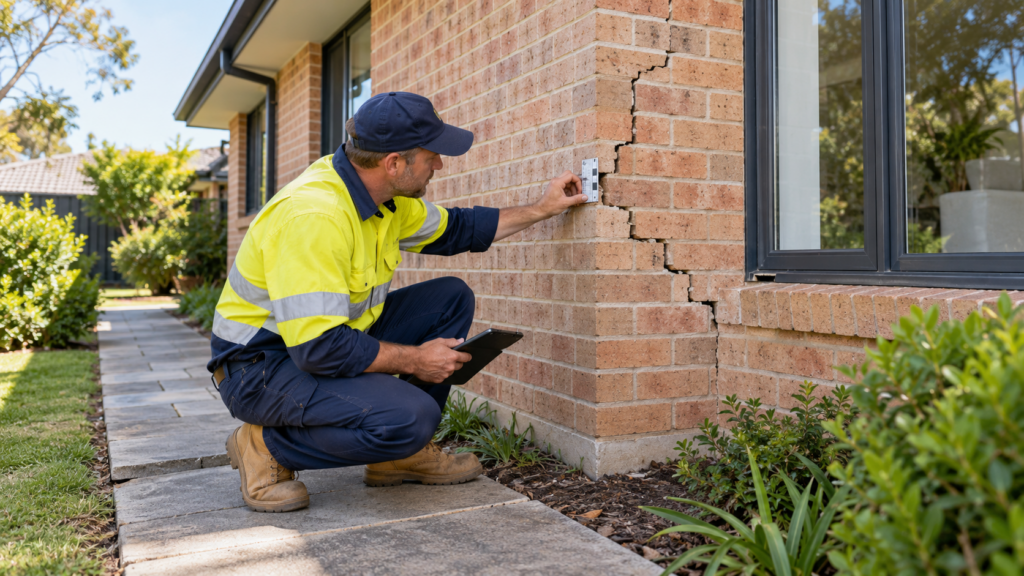
A crack appears above a doorway, a door starts catching on its frame, and suddenly, you are reading about foundations at eleven at night. So what is subsidence, and how worried should you be? Subsidence occurs when the ground or foundation beneath part of a building settles. That leaves the structure unevenly supported, and uneven support is what produces cracks, distorted door and window openings, and floors that no longer feel flat underfoot.
Take a breath before you assume the worst. Small cracks appear in Australian homes for plenty of reasons, including material shrinkage, drying plaster and the normal movement of a building through its first few years and through the seasons. One visible sign proves very little on its own.
Definition: Subsidence is the downward movement of the ground or foundation supporting a building, which can cause part of the structure to move or settle unevenly.
Only an investigation can tell you whether the movement is still active, what caused it and whether structural repair is needed at all. This guide covers how to tell the difference, and then the part most articles skip: what subsidence actually means for your home’s value, your insurance and your sale.
In This Guide
What Is Subsidence and What Causes It?
Subsidence is a loss or downward movement of support beneath part of a building. It can follow changes in soil moisture, water escaping where it should not, poor drainage, nearby works, or site conditions that were never quite right to begin with. The building itself has not changed. The ground holding it up has.
Subsidence Compared With Related Terms
These words get swapped around in conversation, in inspection reports and in insurance policies, and the differences matter.
| Term | What It Means | Key Point |
|---|---|---|
| Subsidence | Ground or foundation moves downward | Often localised or uneven |
| Settlement | Ground compresses under building loads | May occur after construction, and can be even or uneven |
| Differential settlement | Different parts settle by different amounts | Uneven movement |
| Heave | Ground or foundation moves upward | Upward or lifting movement |
| Erosion | Soil is removed by moving water or another process | Loss of support |
| Landslip or slope movement | A soil mass moves down a slope | Horizontal and vertical movement |
| Shrinkage cracking | Building material dries and contracts | Usually within finishes or materials |
| Structural cracking | Cracking related to stress or movement | Requires professional interpretation |
| Restumping or reblocking | Replacing or resetting stumps under a suspended timber floor | Not a movement type. A repair, and a different one from underpinning |
A label is not a diagnosis. Two reports can describe the same house using different words, so what matters is that a professional identifies the actual movement, its direction, and its pattern rather than resorting to a general term.
What Usually Causes It
Soil moisture sits behind a large share of Australian cases. CSIRO’s guide to foundation maintenance and footing performance explains that “all clays react to the presence of water by slowly absorbing it, making the soil increase in volume,” then shrink again as they dry. On plumbing, the same document is blunt: “Even a minuscule leak can be enough to saturate a clay foundation.” On vegetation, it notes that “roots in the vicinity of footings will absorb much of the moisture in the foundation soil, causing shrinkage or subsidence.”
Homes on reactive clay move with the seasons by design, which is why AS 2870, the Australian Standard for residential slabs and footings, classifies sites by soil reactivity and sets footing requirements to suit. It is referenced in both volumes of the National Construction Code.
Beyond moisture, the usual suspects are poorly compacted or variable fill, erosion, water escaping from plumbing or stormwater, nearby excavation or construction, slope instability, added loads from renovations, and inadequate or deteriorated footings. Our subsidence page sets out the full taxonomy of causes, and there is more detail on how water leaks can lead to foundation movement if a plumbing issue is on your list of suspects. If your suburb is known for clay, the background on reactive clay and moisture movement is worth reading first.
Every one of those causes is plausible. None is proven until the evidence points there. Naming a cause too early is how homeowners end up removing a healthy tree, only to watch the crack grow.
What It Means When a House Is Subsiding
A subsiding house is one in which the ground or foundation beneath part of it has settled. That description says nothing about severity, cause or the repair required. When people ask whether their house is subsiding, what they usually want to know is which part is moving, by how much, and whether it is still happening.
Three points worth holding onto. The movement may affect one small area or a broader section of the building. It may be recent, seasonal, progressive or purely historical. And cracks often stay visible long after movement has stopped, so a wide crack is not proof of an active problem. A house can be perfectly stable while carrying damage from something that happened a decade ago.
What Are the Warning Signs of Subsidence?
Possible signs include cracks that change over time, doors and windows that suddenly stick, sloping floors and separation around openings. All of these can also be caused by factors other than foundation movement, which is why they need professional interpretation rather than a search engine diagnosis.
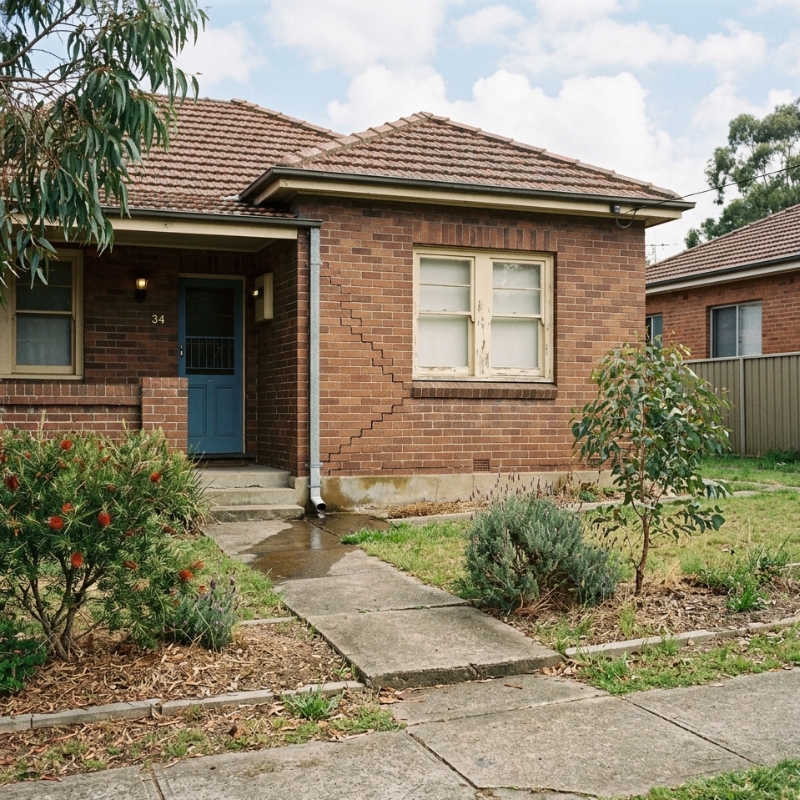
The signs that most often matter are cracks that widen or lengthen over weeks or months, stepped cracks following masonry joints, diagonal cracks running from the corners of doors or windows, cracking that returns after cosmetic repair, doors or windows that suddenly begin to stick, noticeably sloping floors, and separation between an extension and the original house. A fuller list of common signs of subsidence in homes is worth a read if you are trying to work out whether the pattern in your house adds up, and pages on cracked walls, sinking floors and doors and windows that jam explain what each symptom can point to.
What matters more than the list is what each observation should prompt you to do.
What Each Observation May Mean
| Observation | Possible Issue | Recommended Response |
|---|---|---|
| Fine, stable plaster crack | May be cosmetic or historical | Record and monitor |
| Crack that changes over time | May indicate ongoing movement | Arrange a professional assessment |
| Stepped masonry crack | May relate to differential movement | Obtain structural advice |
| Door suddenly sticking | May indicate frame movement | Check several possible causes |
| Uneven floor | May result from foundation or floor-support issues | Arrange a level assessment |
| Wall separating from ceiling | May indicate movement or framing issues | Inspect professionally |
| Water pooling beside the house | May affect soil moisture | Correct drainage after suitable advice |
| Sudden movement after excavation | May require urgent assessment | Contact an engineer promptly |
| Bulging or unstable wall | Potential safety concern | Keep clear and seek urgent professional advice |
| Damaged gas, water or electrical service | Immediate safety issue | Contact the relevant emergency or licensed service |
Sorting a cosmetic crack from a structural one takes more than a photo, and the difference between a crack and a structural issue is usually about how the crack behaves rather than how wide it is today.
When Is Foundation Movement Urgent?
Most foundation movement is not an emergency. Some of it is. Seek prompt professional advice, or emergency services where relevant, if:
- Movement appears sudden rather than gradual.
- A wall is leaning, bulging or unstable.
- Floors or walls have visibly shifted.
- A door needed for exit will not open.
- Cracks are developing rapidly.
- A retaining wall is failing.
- Movement follows excavation on your property or next door.
- Water is actively eroding soil around the building.
- Gas, electrical, water or sewer services may be damaged.
- Materials could fall, or a partial collapse looks possible.
Ignore any rule of thumb that ties urgency to a single crack width. A narrow crack that appeared overnight can matter far more than a wide one that has not changed in fifteen years.
How to Monitor a Crack Safely
While you wait for an assessment, you can gather useful evidence without touching the structure:
- Photograph the crack and include the date.
- Place a ruler or tape measure beside it for scale.
- Write down exactly where it is, inside and out.
- Note any change in nearby doors and windows.
- Record recent plumbing work, heavy rain, drought or excavation.
- Leave it unfilled before the first assessment if it is still changing.
- Do not build homemade structural gauges or attempt your own repairs.
- Arrange professional monitoring where the movement is uncertain.
Dated photographs are a helpful background. They are not a substitute for calibrated monitoring or a professional diagnosis, and no engineer will design a repair from a phone camera alone.
How Is Subsidence Diagnosed?
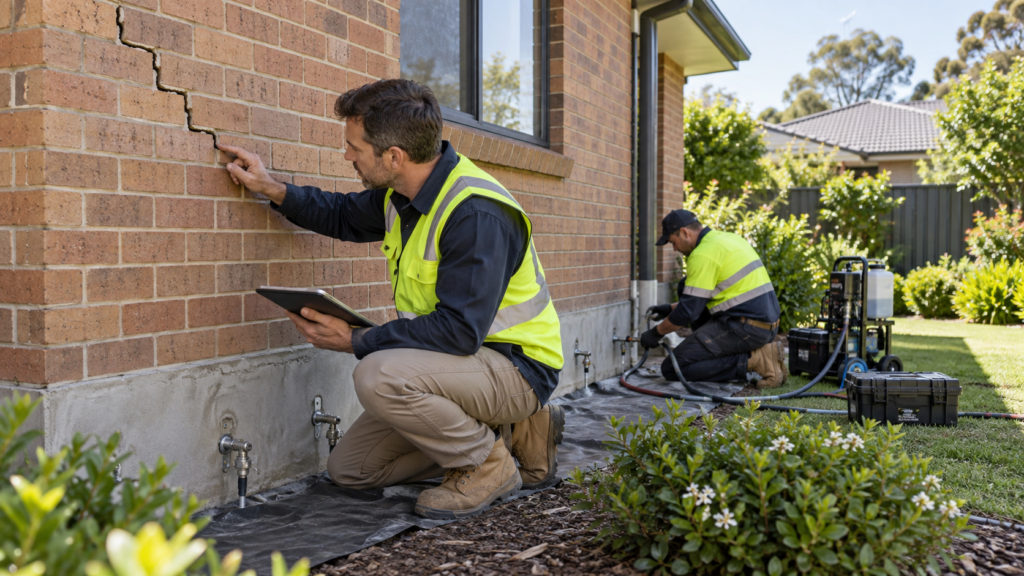
Diagnosis combines a building inspection, accurate level measurements, the property’s history, and investigation of soil, water and nearby site conditions. No single crack confirms subsidence, and no single visit always settles the question. In sequence, a thorough investigation reviews the property’s history, inspects cracking inside and out, records floor or foundation levels, checks drainage and plumbing, assesses trees, retaining walls and nearby excavation, reviews or obtains soil data, monitors movement where the timing is uncertain, and only then names a likely cause and recommends a response.
A practical explanation of how an unlevel building is diagnosed covers the measurement stage in detail, including floor-level surveys, moisture profiling and crack monitoring.
Who Does What
| Professional | Role |
|---|---|
| Structural engineer | Assesses structural movement and designs repairs |
| Geotechnical engineer | Investigates soil, fill, groundwater and slope conditions |
| Building inspector | Records building defects and visible conditions |
| Licensed plumber | Tests water, sewer and stormwater systems |
| Registered surveyor | Provides accurate levels or site information |
| Arborist | Assesses relevant trees and root conditions |
| Foundation contractor | Prices and installs the designed repair |
| Property valuer | Assesses property-specific value implications |
| Insurance assessor | Reviews a claim under the relevant policy |
For a complex structural problem, the contractor who will do the repair should not be your only source of diagnosis. An independent engineering opinion protects you and gives any future buyer something credible to rely on. You can check an engineer’s standing on the publicly searchable National Engineering Register maintained by Engineers Australia.
Dig out whatever documents you can find before the first visit. Original plans and engineering drawings, soil reports from construction or purchase, previous inspection reports, plumbing and drainage repair history, renovation and extension records, details of nearby construction, tree planting or removal history, and any dated crack photographs all shorten the investigation and reduce what has to be tested from scratch.
Is the Movement Active, Seasonal or Historical?
| Movement Type | What It Means | Typical Next Step |
|---|---|---|
| Active | Movement continues or has recently changed | Investigate the cause and design a response |
| Seasonal | Movement varies with moisture or weather cycles | Longer monitoring and moisture assessment |
| Historical | Movement occurred previously and appears stable | Confirm stability before cosmetic repair |
| Uncertain | Evidence is insufficient | Monitor and complete further investigation |
This is the single most useful distinction in the whole subject, and the one most often skipped. Where a house moves with the seasons, a single inspection in February tells you very little about what happens in August. Be wary of any report that sounds definitive when the evidence calls for monitoring over both wetter and drier periods.
How Can Subsidence Affect Your Home’s Value?
Subsidence can affect buyer confidence, finance, insurance and sale negotiations. How much it affects the value depends on the property, and no single percentage gives an honest answer. A documented, repaired and stable house sits in a very different position from one with an unexplained crack and no reports.
The impact tends to depend on the severity of the movement, whether the cause has been identified, whether movement is still active, the scope and cost of repairs required, the quality of the engineering documentation, whether structural repairs have been completed, any outstanding cosmetic damage, warranty cover, insurance implications for the next owner, lender requirements, local demand, disclosure obligations in your state or territory, and evidence from comparable sales.
What a Buyer Sees, and What Helps
| Situation | Buyer Concern | What Helps |
|---|---|---|
| Suspected movement, not yet investigated | Unknown structural and repair risk | Independent inspection and engineering report |
| Cause identified but unrepaired | Cost and timing of the required work | Repair design and detailed quotations |
| Repair underway | Quality, approvals and completion risk | Contract, engineering inspections and progress records |
| Repair completed and documented | Long-term performance and recurrence | Completion reports, warranties and monitoring records |
| Historic stable cracking | Whether movement remains active | Monitoring records and professional assessment |
| Cosmetic damage after structural repair | Appearance and finishing cost | Repair scope and evidence of structural completion |
An unresolved problem can make a property harder to sell because buyers price in uncertainty conservatively, and their inspectors are paid to be cautious. A professionally investigated and documented repair does not automatically raise the price; it replaces uncertainty with facts. Underpinning does not restore value on its own, and any agent or contractor who says otherwise is guessing. For property-specific advice, a certified practising valuer through the Australian Property Institute is the right person to ask, not a repair contractor.
What Happens When a Valuer or Lender Sees It
This is where uncertainty costs real money, and it is worth understanding before you list.
A valuer inspecting the property will note visible structural defects and may qualify the valuation, recommend a structural report, or value the property on the assumption that identified work is completed. A lender relying on that valuation sets its own policy, and policies differ between lenders, so nobody can tell you in advance how a particular bank will respond. What is reasonably predictable is its shape: an identified, priced, and documented problem gives a lender something to condition an approval on, while an unexplained one gives it a reason to wait for more information.
The practical consequence is that documentation is not just reassurance for a buyer. It is what allows a valuation and a financial approval to proceed on facts rather than on cautious assumptions. That is the same reason an independent engineering report is worth more to a sale than a contractor’s quote alone.
Buying a House With Disclosed Subsidence
If a vendor discloses past movement or repaired subsidence, the documented repair is what turns a risk into a known quantity. Ask for:
- The original structural and, if one exists, geotechnical report
- The engineered repair design, including drawing revision numbers
- Evidence of who carried out the work, with licence details
- Engineering inspection records and any completion certificate
- Council or certifier documentation, where approvals applied
- Product and workmanship warranties, and whether they transfer to you
- Any post-repair monitoring records
- Evidence that the contributing cause, such as drainage or plumbing, was also fixed
That last point is the one buyers most often miss. A structural repair that left the leaking stormwater line in place has treated the symptom and not the cause. There is further reading on buying or selling a house with subsidence, covering how the conversation usually goes with agents and buyers.
Selling a House With Subsidence
A house affected by subsidence can still be sold. What you must disclose, and how, varies by state or territory, by the contract of sale and by what you and your agent actually know, so get property-specific legal advice rather than following a general rule from the internet.
A sensible approach: obtain a current structural assessment; understand the repair scope, whether or not you carry it out; collect all relevant documents; get legal advice on your disclosure obligations; avoid giving buyers assurances you cannot support; allow reasonable inspections; and use a qualified valuer for advice on value.
Documents to Keep After a Repair
Keep these together in one file, because when a buyer’s solicitor asks, having the whole set ready does more for the negotiation than any amount of reassurance:
- Structural and geotechnical reports
- Drainage and plumbing reports
- Approved drawings and council or certifier documents
- Contractor licence and insurance details
- Contract, specifications and approved variations
- Progress photographs and inspection reports
- Completion certificates
- Product and workmanship warranties
- Level and monitoring records
- Invoices and cosmetic repair records
What Can You Do to Repair and Prevent Subsidence?
The right response depends entirely on the cause. Repairs may involve drainage or plumbing work, foundation stabilisation, underpinning, re-levelling, or a combination of these. Fixing the symptom without fixing the cause is how homeowners end up paying twice.
Address the underlying cause first. Depending on the investigation, that may mean repairing leaking water, sewer, or stormwater pipes; connecting downpipes to a lawful discharge point; improving surface drainage and falls; managing erosion; repairing retaining walls; or reviewing the influence of nearby vegetation. Where escaping water is part of the picture, the explanation of how water leaks cause foundation movement sets out the mechanism, and our water-stopping and leak management service handles the sealing work itself.
Do not remove a tree on a hunch. Tree removal can change soil moisture enough to cause heave in reactive clay, and many councils protect significant trees. Get arboricultural, engineering and council advice before anything comes down.
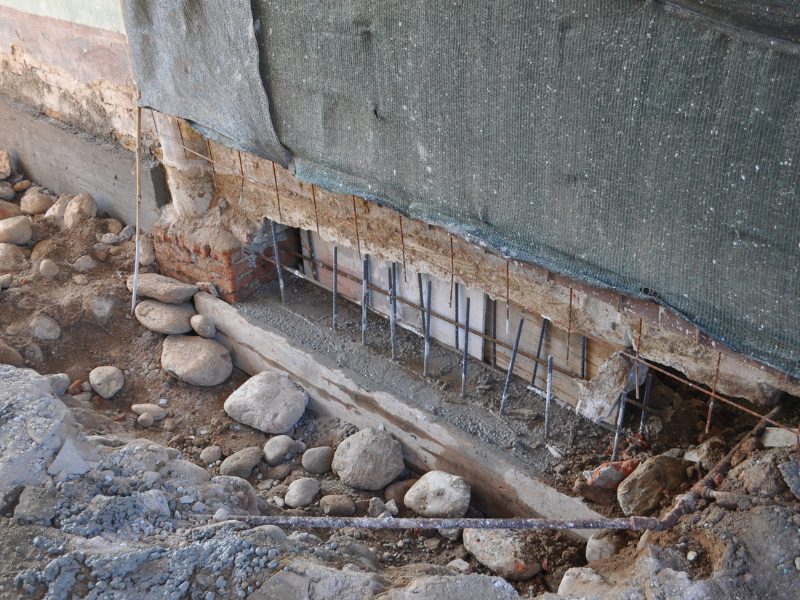
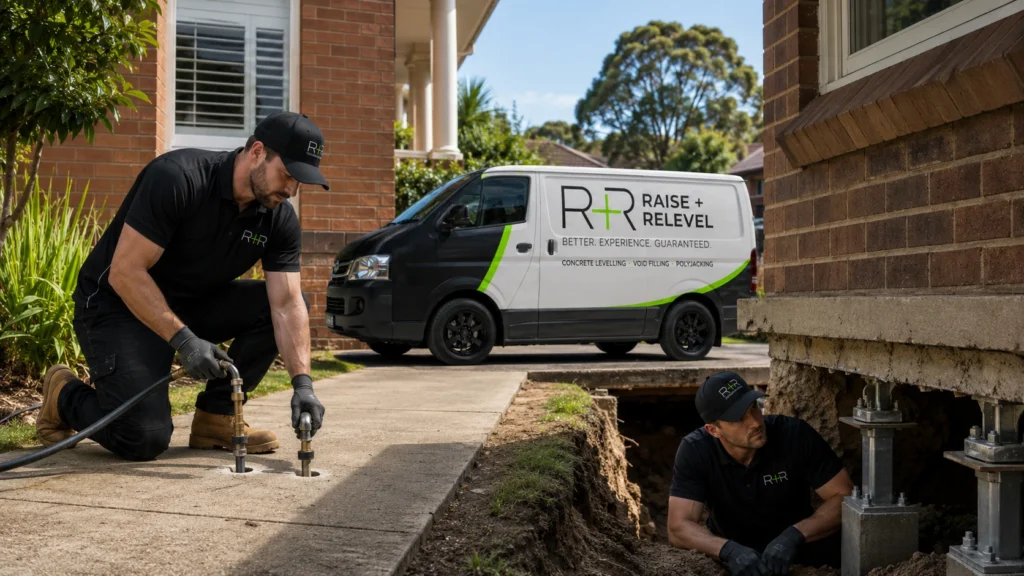
At a high level, the repair options include mass concrete underpinning, beam-and-base underpinning, bored piers, steel or screw piles, mini-piles or micropiles, resin or ground injection, grouting, floor re-levelling, local footing reconstruction, and drainage or soil management work. No single contractor offers all of them, so ask whoever quotes you which they perform themselves and why they have recommended the one they have. Underpinning suits some problems but not others, while resin injection and void filling address different conditions. Our comparison of underpinning, re-levelling and slab lifting sets out where each one fits, with indicative Australian costs and timeframes.
| Repair Option | What It Does | Main Consideration |
|---|---|---|
| Plumbing repair | Stops water escaping into or beneath the site | Does not automatically repair structural damage |
| Drainage improvement | Controls water around foundations | Must be designed for the site |
| Underpinning | Adds support beneath an existing foundation | Not required for every movement problem |
| Pier or pile system | Transfers loads to deeper suitable material | Requires engineering and suitable access |
| Resin injection | Treats selected void or ground conditions | Not suitable for every structure or soil |
| Re-levelling | Raises part of the structure towards an agreed level | Lifting can affect finishes and services |
| Crack repair | Restores masonry or finishes | Should follow structural assessment |
| Monitoring | Establishes whether movement continues | Does not repair an active cause |
On prevention, no amount of maintenance eliminates ground movement, particularly on reactive clay. Consistency is the goal rather than perfection: keep gutters and downpipes working, direct water to a lawful discharge point, stop water pooling beside foundations, repair leaks promptly, maintain falls away from the building, watch for erosion after heavy rain, and get advice before major excavation or before planting or removing large trees. Avoid heavy watering on one side of the house and none on the other, because it is the unevenness rather than the volume that moves reactive clay. CSIRO’s homeowner guide is the sensible reference here, and our guide to protecting a house from ground subsidence covers the practical measures in more detail.
Licensing and Approvals
Check licensing before you sign anything. It is the easiest thing to verify and the most expensive thing to get wrong.
In New South Wales, underpinning and piering is a recognised category of trade work, and a contractor licence is required to carry out, advertise or contract for residential building work valued at more than $5,000 in labour and materials, including GST. Other states and territories run their own schemes with their own categories and thresholds, so confirm your property’s location, rather than assuming the NSW rule applies.
| Where your property is | Regulator | Check a licence |
|---|---|---|
| New South Wales | NSW Government, Fair Trading | Categories of licensed building and trade work |
| Victoria | Building and Plumbing Commission, formerly the Victorian Building Authority | Find and check a practitioner |
| Queensland | Queensland Building and Construction Commission | QBCC registers, including the licensee register |
| Australian Capital Territory | Access Canberra | Building and construction public registers |
Verify the licence number, not just the logo on the quote. The Victorian regulator puts it well: do not rely only on advertising, business cards, quotes or what someone tells you. Our own licence numbers are NSW 377694C, VIC CDB-U 73507, QLD 15300551 and ACT 20211579. Check them, and check anyone else’s.
How Much Does Subsidence Repair Cost?
It depends almost entirely on the cause, because “subsidence repair” covers everything from redirecting a downpipe to underpinning half a house. Two properties with identical cracks can attract very different quotes once the ground beneath them has been investigated. Correcting drainage or repairing a leaking pipe generally costs far less than installing piers along a wall.
For indicative Australian figures by method, our comparison of underpinning, re-levelling and slab lifting sets out costs and timeframes for each. Treat any national average you find elsewhere carefully, because most come from contractors quoting their own region and method, and none of them has seen your site.
Whatever the method, ask every quotation to state clearly whether prices include GST, whether pricing is per support or per project, and whether engineering, excavation and spoil removal, drainage work, re-levelling and cosmetic repair are included or excluded. The main cost drivers are the cause and extent of movement, the number of affected areas, the foundation type, the repair method, the depth of suitable supporting material, soil and groundwater conditions, building size and construction, site access, existing services, temporary support, engineering, approvals, monitoring and reinstatement.
All prices are indicative until someone has been on site. A reliable quote follows an investigation and a defined scope of repair, not an estimate based on photographs of a crack. The most useful thing you can do is get one engineering scope prepared, then have two or three contractors price against that same design, so you are comparing like with like.
Insurance Considerations
Building insurance policies differ, and so do outcomes. Some policies respond to damage caused by a defined insured event, while damage that develops gradually is treated differently.
Rather than assume either way, check how your own policy handles four things in particular: gradual or progressive movement, pre-existing soil and site conditions, maintenance, and defective design or construction. Those are the clauses that usually decide a subsidence claim, and they sit in the product disclosure statement. ASIC’s Moneysmart guidance on choosing home insurance explains that exclusions are set out in the PDS, which is the document that governs your policy.
If you think you may need to claim:
- Read your current product disclosure statement rather than a summary.
- Check how the policy defines subsidence, landslip, erosion and insured events.
- Review the exclusions covering gradual damage and defective work.
- Record the date you first noticed the damage.
- Photograph the damage before making temporary repairs.
- Take reasonable steps to prevent further immediate damage.
- Contact your insurer before authorising non-emergency work.
- Ask whether an assessor will attend the property.
- Confirm whether reports or quotations are required, and who pays for them.
- Keep receipts and all correspondence.
- Do not assume your claim will be treated the same way as a neighbour’s.
- Get independent advice if the claim is disputed.
Moneysmart’s guide to making a home insurance claim explains the process in more detail. Insurers subscribing to the Insurance Council of Australia’s General Insurance Code of Practice must respond to a claim within 10 business days, provide progress updates at least every 20 business days, and make a decision within four months of receiving the claim, except in limited circumstances. If a claim is denied, they must give written reasons and tell you how to complain. If you ask for copies of the reports used to assess your claim, they must send them within 10 business days.
No one can tell you in advance whether your claim will be accepted. What you can do is document everything early, keep your insurer informed, and know what the Code entitles you to ask for.
The Takeaway
So, what is subsidence in practical terms? It is a downward movement of the ground beneath part of your house, and its effect on your home’s value depends far more on what you can prove than on what the crack looks like. An unexplained problem worries buyers, lenders and insurers. An investigation, repair, and documentation give everybody something solid to work with. The order that protects you is always the same: investigate, diagnose, repair the cause, then repair the damage.
If cracking seems to be progressing, if doors have started sticking, or if several warning signs have appeared together, arrange a foundation assessment before you commit to any repair method or price. Specialists in subsidence repair and levelling can inspect the property, determine the cause of the movement, and explain whether monitoring, drainage work, underpinning, or another response is appropriate for your home.
Book a Foundation Assessment
We first inspect, measure levels, and work out what is driving the movement. You get the diagnosis before anyone quotes a repair.
Frequently Asked Questions
What is the difference between subsidence and settlement?
Subsidence generally describes downward movement caused by changing or lost ground support, while settlement usually describes soil compressing under the weight of the building. Settlement is common in the first years after construction and is often expected. That does not make it harmless, because uneven or continuing settlement can still damage a structure. The labels matter less than the evidence, so a professional assessment should identify what is actually moving, in which direction, and whether it is still happening.
Can a house with subsidence be sold?
Yes. Houses with suspected, active, or repaired subsidence are sold regularly in Australia, though the issue can affect building inspections, finance approval, insurance, and negotiations. Get a current structural assessment, keep all repair documents together, and obtain legal advice on your disclosure obligations, which vary by state and contract. Nobody can promise a particular sale price or a universal percentage reduction, so treat any such figure with caution.
Does building insurance cover subsidence damage?
It depends on the policy, the cause and the exclusions that apply. Some policies respond to damage caused by a specified insured event, while damage that develops gradually is treated differently. The four clauses that usually decide the question are gradual movement, pre-existing soil conditions, maintenance, and defective design or construction, and they sit in your product disclosure statement. Read the PDS for your own policy rather than relying on general advice or a neighbour’s experience, and contact your insurer before authorising non-emergency repairs, because work carried out first can complicate a claim.
How much does it cost to repair subsidence?
It varies enormously with the cause, the affected area, the foundation type, site access and the repair method chosen. Correcting drainage or repairing a leaking pipe generally costs far less than installing piers or underpinning a long section of wall. Because published averages rarely match real sites, the useful step is an investigation and a defined repair scope, followed by two or three quotes priced against the same engineering design, so you are comparing like with like.
When should you arrange a foundation inspection?
Arrange one when cracks are changing, doors or windows suddenly stick, floors become uneven, or parts of the building visibly separate, particularly where several signs appear together. Seek urgent advice if movement is rapid, a wall looks unstable, or gas, water, sewer or electrical services may be damaged. A single fine crack that has not changed in years does not, on its own, indicate subsidence, though photographing it and keeping an eye on it costs nothing.