
The cost of fixing cracked walls in Australia depends on the type of crack, the wall material and whether the damage is cosmetic or structural. Minor plaster cracks may be repaired for a few hundred dollars, while cracks associated with foundation subsidence can require more extensive investigation, ground improvement or underpinning.
As an indication, a published Australian plaster-repair cost guide lists many smaller plaster repairs between $150 and $900 per job, excluding painting. Structural wall crack repairs cannot be priced reliably from crack width alone, because the source of movement and the required repair method can differ considerably.
Before repairing cracked walls, homeowners should understand the cause of the damage and whether the building is still moving. This guide explains common crack types, structural warning signs, repair options, cost factors and when professional assessment is recommended.
Why Do Walls Crack in Australian Homes?
Cracked walls occur when building materials experience stress, movement or deterioration. Some cracks develop within the plaster or paint finish, while others form because the underlying foundations or structural elements have moved.
The main causes vary according to the home’s age, construction, ground conditions and exposure to moisture.
Reactive Clay Soil Movement
Reactive clay soils expand when they absorb moisture and shrink when they dry.
This behaviour can affect the foundations supporting Australian homes, particularly when moisture conditions differ across the site.
For example, one side of a house may experience wetter ground because of damaged drainage, while another side remains relatively dry. The resulting difference in soil movement can stress the foundations and cause cracking.
Common symptoms may include diagonal cracks around windows, stepped cracks in external brickwork and gaps between walls and ceilings.
Foundation Subsidence and Uneven Settlement
Foundation subsidence occurs when the ground supporting a structure settles or sinks.
Settlement may result from poorly compacted fill, soil erosion, changing ground conditions or a loss of support beneath footings.
When different parts of a home move by different amounts, walls and openings may become distorted.
This is known as differential movement and can contribute to cracked walls, sloping floors and doors that no longer operate smoothly.
Learn more about the causes and available treatment options on Raise & Relevel’s subsidence repair page.
Poor Drainage and Plumbing Leaks
Water can affect soil strength, stability and volume.
Leaking underground pipes, blocked gutters, and damaged stormwater systems may create excess moisture around foundations. Depending on the soil type, this can contribute to swelling, softening, erosion or settlement.
The reverse can also happen. In reactive clay soils, prolonged drying can cause shrinkage and uneven foundation movement.
For a more detailed explanation, read how water leaks cause subsidence and foundation movement.
Ageing Stumps, Piers and Structural Supports
Timber stumps, brick piers or other subfloor support systems support some older Australian homes.
If these supports deteriorate, settle or lose adequate ground support, the building may move unevenly.
Homeowners may notice cracked internal walls, sloping floors or gaps around doors and windows.
Material Shrinkage and Temperature Changes
Not every wall crack is caused by foundation damage.
Plaster, render, paint and other materials can develop cracks as they dry, cure or respond to temperature changes.
These cracks may be cosmetic, particularly when they remain stable and do not appear alongside other signs of movement.
Types of Wall Cracks and What They May Mean
The appearance of a crack can help identify potential causes, but no single crack pattern confirms structural damage.
A reliable assessment considers crack width, location, direction, progression, building materials and the condition of surrounding structural elements.
| Type of Wall Crack | Appearance | Possible Causes | Recommended Response |
| Hairline crack | Very fine line in plaster or paint | Shrinkage or minor movement | Monitor for changes |
| Vertical crack | Runs up or down the wall | Material movement, settlement or local stress | Assess width and progression |
| Diagonal crack | Angled line, often near openings | Differential movement or stress concentration | Inspect accompanying symptoms |
| Horizontal crack | Runs across a wall | Material defects, corrosion, structural stress or movement | Seek assessment if significant or progressing |
| Stepped crack | Follows brick mortar joints | Masonry movement or differential settlement | Consider a professional assessment |
| Widening crack | The gap increases over time | Possible ongoing movement | Arrange for further investigation |
| Bulging or separating wall | Visible deformation or separation | Potential structural instability | Seek urgent professional advice |
Hairline Cracks in Plaster Walls
Hairline cracks are usually fine cracks affecting the surface of a wall.
They commonly develop around plaster joints, ceiling junctions and areas where different materials meet.
Many stable hairline cracks can be repaired using appropriate preparation, joint treatment, filler and repainting.
However, repeated or progressive cracking should be investigated before further cosmetic work.
Vertical Cracks in Walls
Vertical cracks may appear in plasterboard, render, brickwork or masonry.
They can develop due to shrinkage, differential movement, or stress within the wall.
A fine, stable vertical crack is not necessarily a major structural concern. However, a crack that widens, extends through masonry, or appears alongside other signs of movement requires closer investigation.
Diagonal Cracks Around Doors and Windows
Diagonal cracks often form near corners of doors and windows because these openings create areas where stress can concentrate.
They may be associated with differential foundation settlement or other structural movement.
Particular attention is warranted when several diagonal cracks appear together, doors begin sticking, or the gaps continue to widen.
Horizontal Cracks in Brick and Masonry Walls
Horizontal cracks can have several causes, including movement, deterioration of masonry components or corrosion of embedded metal.
A horizontal crack that extends over a substantial distance, appears alongside wall bowing, or widens, should be assessed promptly.
Stepped Cracks in Brickwork
Stepped cracks follow the mortar joints between bricks, creating a staircase-like pattern.
They can develop when masonry is affected by differential settlement or other structural movement.
The pattern provides a useful clue, but the underlying cause still needs to be established.
When Should You Worry About Cracks in Walls?
Wall cracks become more concerning when they widen, recur after repairs or appear alongside other signs of building movement.
Victoria’s Building and Plumbing Commission provides the following general guidance for foundation-related wall cracking:
| Crack Width | General Guidance |
| Less than 1 mm | Often associated with normal foundation movement |
| 1–5 mm | Monitor during different weather conditions over approximately 12 months |
| More than 5 mm | Considered significant in the regulator’s guidance and warrants further investigation |
These measurements are useful screening indicators, not a substitute for professional assessment. A narrow, rapidly growing crack may require attention even when it is below 5 mm.
Other warning signs include:
- Cracks that continue to grow in length or width.
- Doors and windows are suddenly becoming difficult to close.
- Uneven or sloping floors.
- Separation between walls and ceilings.
- Multiple cracks are forming in related areas.
- Cracks that repeatedly return after repairs.
- External walls are visibly leaning or bulging.
If a wall appears unstable, keep clear of the affected area and seek urgent professional advice.
For additional indicators, see 10 signs your home may need foundation repair.
How to Monitor Cracks in Walls
Where there is no immediate safety concern, homeowners can document cracks to help identify whether movement is continuing.
Record the location of each crack, photograph it with a ruler for scale and note the date. Repeat photographs from the same position and record any related changes, such as sticking doors or gaps around skirting boards.
A crack-monitoring gauge may be appropriate where recommended by a professional.
Avoid repeatedly filling a crack before its cause has been assessed if structural movement is suspected.
How Much Does It Cost to Repair Cracked Walls?
Wall crack repair costs vary significantly across Australia because cosmetic and structural repairs involve different work.
For minor plaster damage, the cost may be relatively modest. Where cracks are caused by ongoing foundation movement, the work may involve engineering assessment, drainage repairs, soil stabilisation, and structural repairs before cosmetic finishing.
Indicative Wall Crack Repair Costs in Australia
| Repair Method | Typical Application | Cost Guidance |
| Plaster crack filling and patching | Stable cosmetic cracks | A 2026 Australian cost guide indicates approximately 150–900 for many plaster repair jobs, excluding painting |
| Plasterboard joint repair | Cracks at joins or internal corners | Depends on preparation, reinforcement, wall area and painting |
| Render and mortar repairs | Stable external surface or joint damage | Requires a quotation based on material, access and extent |
| Brick stitching | Selected structural masonry cracks | Requires assessment and a project-specific quotation |
| Resin injection | Suitable foundation settlement or void-related problems | Site-specific quotation based on soil and treatment scope |
| Underpinning | Foundations requiring additional support | Site-specific quotation based on engineering design and structural work |
| Restumping or pier replacement | Deteriorated building supports | Depends on the support, access and construction conditions |
The plaster repair figures are indicative published market guidance, not a Raise & Relevel quotation. Structural foundation repair costs cannot be reliably established without a site-specific scope of work.
What Factors Affect the Cost of Wall Crack Repairs?
- Cosmetic versus structural damage
A stable crack in plaster usually requires surface preparation and finishing. Structural movement can require foundation or masonry repairs before the crack is filled.
- Crack location and extent
One small crack in an accessible wall is generally easier to repair than multiple cracks spanning internal and external masonry.
- Wall material
Plasterboard, brickwork, concrete and render require different repair materials, preparation methods and artistry.
- The underlying cause
A plumbing leak, poor drainage, subsidence or deteriorated support system may require separate corrective work.
- Engineering and investigation
Where movement is suspected, an engineer may recommend measurements, a site investigation or a specific structural repair design.
- Site accessibility
Restricted subfloor access, difficult excavation conditions and obstacles around exterior foundations can affect labour and equipment requirements.
- Finishing and associated repairs
Repainting, replastering, repointing, drainage improvements and reinstating disturbed areas may be separate items in a quotation.
Why Can Structural Wall Crack Repairs Cost More?
Structural repairs address the underlying problem instead of merely concealing the visible damage.
For example, a crack caused by ongoing foundation settlement may require stabilisation beneath the affected footing before the wall is repaired.
The work could involve soil improvement, resin injection or underpinning, depending on the assessment.
For this reason, the most useful question is not simply how much it costs to fill a crack, but what repair is necessary to address the cause.
How Are Cracked Walls Repaired?
The right repair method depends on the cause, materials and structural condition of the building.
Cosmetic Plaster Repairs
Stable, non-structural plaster cracks can often be repaired using suitable fillers, jointing compounds, reinforcing tape and repainting.
Preparation may involve removing loose material, treating the crack, allowing the compound to dry and restoring the wall finish.
Cosmetic repairs should not be used as a substitute for structural repairs when foundations are still moving.
Brick Stitching and Masonry Repairs
Brick stitching uses reinforcement installed across selected masonry cracks to help restore continuity or strengthen affected areas.
Mortar repointing or replacement of damaged bricks may also be appropriate.
The selected method must suit the masonry construction and the reason for the crack’s development.
Polyurethane Resin Injection
Polyurethane resin injection may be suitable where weak ground, underground voids, or certain settlement conditions contribute to movement.
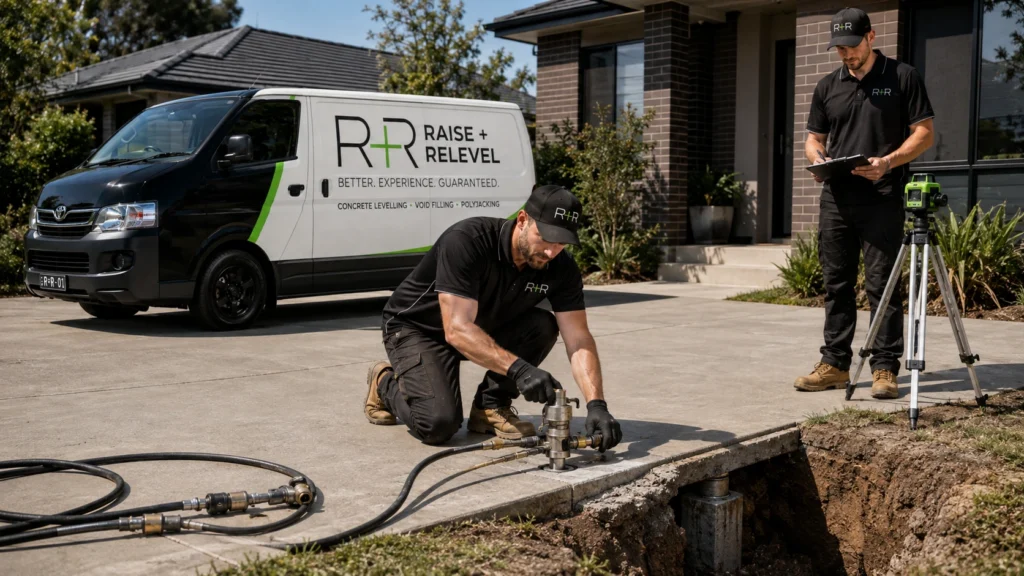
The process involves injecting an expanding structural resin into targeted areas beneath a slab or foundation.
Depending on the ground conditions and design, resin injection may improve support or assist with controlled re-levelling.
It is not suitable for every structural problem, and it does not automatically replace conventional underpinning.
Underpinning and Foundation Stabilisation
Underpinning involves providing additional or improved support to existing foundations.
Different underpinning systems may involve concrete, piles, piers or other engineered supports.
The selection depends on the building, soil conditions, foundation loads and cause of movement.
Raise & Relevel’s slab jacking versus underpinning guide explains the differences between the two commonly discussed repair approaches.
Repairing Deteriorated Stumps or Piers
Some older homes may require repairs or replacement of damaged subfloor supports.
The work could involve restumping, pier repairs, floor re-levelling or associated structural modifications.
A qualified professional should assess the condition of the supports before selecting a repair method.
Should Foundation Problems Be Repaired Before Wall Cracks?
Where ongoing foundation movement causes cracking, the underlying movement generally needs to be addressed before permanent cosmetic repairs are completed.
Otherwise, the crack may reopen even after careful filling and repainting.
Not every crack requires foundation work. Diagnosis determines whether surface repair alone is appropriate.
How to Prevent Further Wall Cracking
Although some building movement is unavoidable, good maintenance can reduce avoidable moisture changes and prevent certain defects from worsening.
Maintain Gutters, Downpipes and Drainage
Keep gutters clear, repair disconnected downpipes, and investigate water pooling near foundations.
Effective stormwater management helps reduce unnecessary changes in soil moisture.
Fix Plumbing Leaks Promptly
Underground pipe leaks may alter soil conditions beneath or beside foundations.
Arrange plumbing investigation when unexplained water usage, persistent wet areas or other leak indicators appear.
Manage Trees and Soil Moisture
Trees and vegetation can influence soil moisture, particularly near reactive clay foundations.
Avoid drastic changes to vegetation or watering practices without considering the potential effects on the ground.
Seek professional advice where large trees are close to affected footings.
Monitor Existing Cracks
Photograph cracks and record any changes.
If cracking worsens, reappears after repair or occurs alongside other movement symptoms, seek appropriate professional advice.
Address Foundation Movement Before Repainting
Repeated cosmetic repairs can conceal ongoing movement without fixing the cause.
Where foundation damage is suspected, identify the source and arrange a suitable assessment before completing extensive finishing work.
Frequently Asked Questions About Cracked Walls
How much does it cost to fix a crack in a wall in Australia?
Costs depend on the wall material, crack size and underlying cause. The 2026 guidance places many smaller plaster repairs in the hundreds of dollars, while structural repairs require site-specific quotations. Foundation stabilisation, engineering, and masonry work can substantially increase the overall cost.
How do I know if a wall crack is structural?
A structural problem is more likely to require investigation when cracks are widening, recur after repairs or accompany uneven floors, sticking doors or visible wall movement. The direction and width of a crack provide clues, but a qualified assessment is needed to establish its cause.
Can cracked walls be repaired without underpinning?
Yes. Many cracks are cosmetic and can be repaired without foundation work. Some masonry defects require local reinforcement, while certain settlement problems may be suitable for ground improvement. Underpinning is only one possible method and should be selected when the structural conditions justify it.
Will wall cracks come back after repair?
They can return if the cause of movement remains unresolved. Cosmetic filling does not prevent a foundation from moving. Where cracking is caused by subsidence or other structural movement, the underlying problem may need to be addressed before completing wall repairs.
Should I repair a crack in a wall myself or hire a professional?
Minor, stable cosmetic cracks may be suitable for straightforward DIY repairs if the wall is otherwise sound. Professional advice is recommended when cracking is progressive, affects masonry, or occurs with other signs of structural movement. Do not attempt structural foundation repairs without suitable expertise.
Get Professional Advice About Cracked Walls
If you’re concerned that cracked walls may be caused by foundation movement, identifying the underlying issue is the first step towards a suitable repair.
Raise & Relevel provides ground improvement, subsidence and foundation stabilisation services for Australian properties experiencing structural movement.
Explore our cracked-wall repair services, or contact Raise & Relevel to discuss your property and available assessment options.
Conclusion
Cracked walls can result from relatively minor material changes or more significant foundation movement. Repair costs depend on the cause, the extent of damage, and the required method.
Stable cosmetic cracks may be straightforward to repair, but cracks that widen or appear with other structural warning signs deserve further investigation.
Addressing the underlying cause before repairing the visible damage helps homeowners choose an appropriate solution and avoid repeated, unnecessary work.