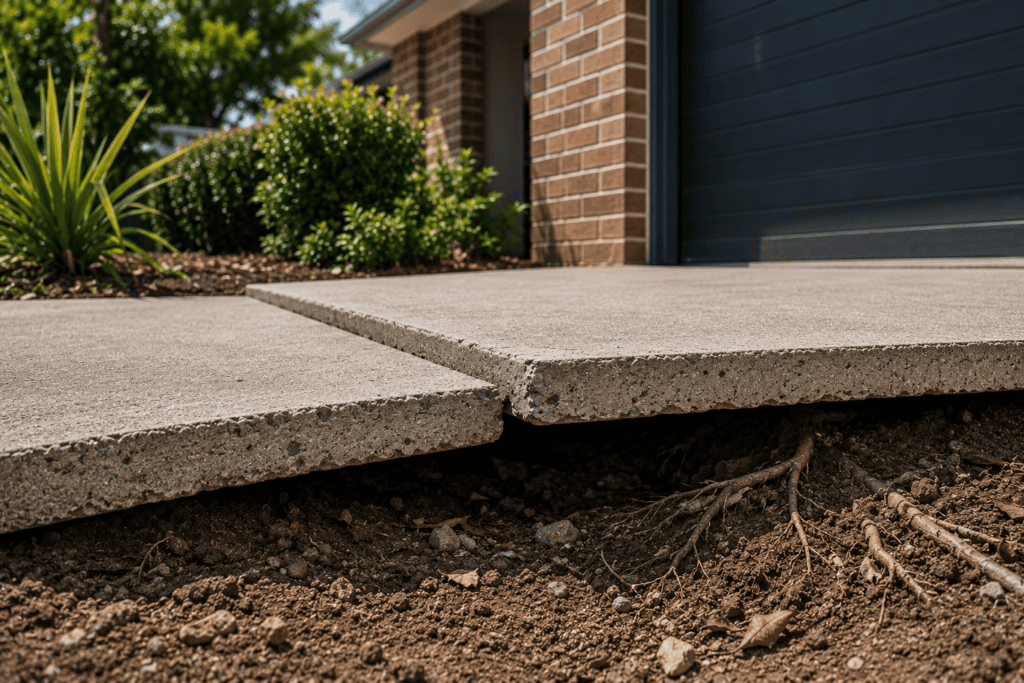
Concrete slabs sink over time because the ground beneath them shifts, erodes, or loses density. The slab itself is rarely the problem. Soil movement, moisture changes, poor drainage, and natural settlement are the real forces at work. Understanding what drives this process helps property owners catch problems early and avoid costly structural repairs later.
Key Takeaways
- Concrete slabs sink primarily because the supporting soil beneath them loses density and stability over time, not because the concrete structure itself fails first.
- Reactive clay soils found across many Australian regions shrink during dry conditions and swell during wet periods, creating repeated ground movement that gradually weakens slab support.
- Poor drainage and leaking pipes speed up slab sinking by eroding soil beneath the concrete, washing away ground support, and forming hidden underground voids.
- Visible warning signs such as uneven floors, sticking doors, and surface cracks give property owners a window to act before settlement causes serious structural damage.
What Causes Concrete Slabs to Sink Over Time?
Most people assume a sinking slab means faulty concrete. In most cases, the concrete is fine. The ground underneath it is the source of the problem. Foundation maintenance research confirms that slab settlement typically results from changes in soil rather than from failure of the concrete structure itself.
Several factors reduce the soil’s ability to support the slab. These can develop slowly over years or accelerate after a single weather event.
The most common causes include:
- Natural soil compaction occurs as soil particles compress under the weight of the slab over time, reducing both density and load-bearing capacity.
- Erosion beneath the slab happens when water movement carries soil particles away, leaving gaps or voids that remove support from below.
- Poor site preparation means inadequately compacted fill soil continues to settle long after construction finishes, sometimes for years.
- Decomposing organic material, such as buried tree roots, timber offcuts, or organic fill, breaks down over time, leaving hollow spaces beneath the concrete.
- Underground void formation occurs when water flows persistently beneath slabs, gradually hollowing out significant areas of supporting ground.
- Seasonal soil shifts driven by temperature and moisture cycles cause the ground to expand and contract repeatedly throughout the year.
Post-construction settlement is one of the most common causes of footing distress, particularly where fill consolidation or reactive clay shrinkage affects the founding depth. Even a well-built slab on poorly prepared ground will eventually reflect what is happening below it.
How Does Soil Movement Cause Concrete Slabs to Sink?
Soil movement is the most widespread cause of slab settlement across Australia. The country’s geology creates conditions where soil behaves unpredictably beneath buildings, particularly in areas with high clay content.
Reactive Clay and Shrink-Swell Cycles
Reactive clay soils expand when they absorb moisture and contract sharply when they dry out. This shrink-swell behaviour is classified under Australian Standard AS 2870, which rates site reactivity from Class A (stable) through to Class E and H1/H2 (highly reactive). Areas in Melbourne’s west, parts of Queensland, and much of South Australia sit in reactive soil zones.
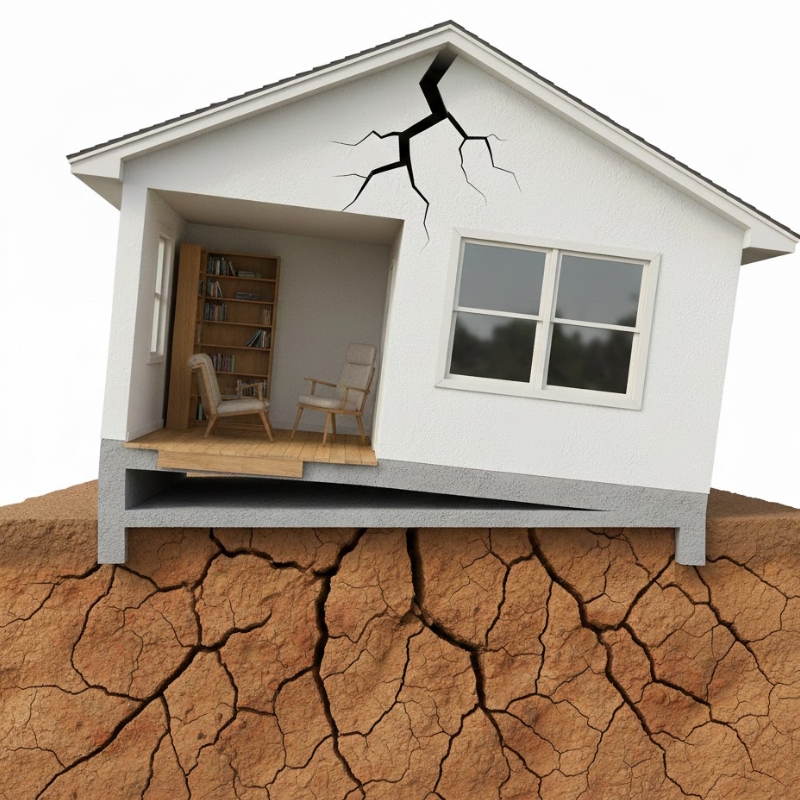
Heaving in wet periods and subsidence in dry periods in reactive clay create differential movement that most slabs cannot evenly absorb. During wet periods, reactive clay pushes slabs upward. During dry periods, the same clay shrinks away from the slab base. Repeated cycles gradually weaken the soil’s ability to provide consistent support. This is why slabs rarely sink uniformly. One side drops while another stays level, producing the tell-tale slope that signals a problem.
Slab sinking in hot or dry conditions is a key indicator of reactive clay activity pulling the slab base away. The slab itself is not failing. The ground beneath it is contracting, undermining its support.
Fill Soil and Settlement Under Load
Properties built on fill soil face a separate but equally serious risk. Wet soils compact more readily and lose structural integrity faster than well-drained soils, which means fill that was not adequately compacted before construction can continue settling for years under load. Very loose granular soils compress progressively under sustained load, sometimes long after the building above them is fully occupied and in use.
Weather-Driven Ground Movement
Australia’s climate adds another layer of complexity. Weather-driven ground movement beneath concrete slabs has intensified across multiple states in recent years, prompting structural engineers to call for updates to building codes to better account for moisture shifts in soil driven by La Niña cycles. The problem is not isolated to older buildings. New slabs on reactive ground face the same risks when site conditions are not carefully managed.
Can Poor Drainage Cause Concrete Slabs to Sink?
Drainage is one of the most underestimated factors in slab stability. Water that pools around a foundation does not just sit there. It actively breaks down the ground beneath the concrete over time.
Stormwater drainage deficiencies link directly to slab distress in residential properties, with slabs built over ground with abnormal moisture showing significantly higher rates of movement and damage. Small drainage problems compound quickly when left unaddressed.
Common drainage problems that lead to slab sinking include:
- Surface water pooling near foundations can saturate the soil and reduce its load-bearing capacity over time.
- Broken stormwater or sewer pipes saturate localised soil zones and carry fine particles away from beneath the slab.
- Leaking irrigation systems introduce slow, steady moisture that progressively softens soil across a wide area.
- Poor surface grading directs water toward the building instead of away from it, concentrating moisture at the foundation.
- Blocked downpipes or overflowing gutters discharge water directly at the foundation level during every rain event.
- Soil erosion beneath outdoor slabs on pathways, driveways, and patios creates voids that grow larger with every wet season.
Thousands of residential slabs built on soils with understated reactivity ratings began moving within years of construction when drainage deficiencies combined with incorrect founding depths. The resulting damage affected both the structure and the habitability across the entire suburb.
Water follows the path of least resistance, and beneath a slab, that path often runs straight through supporting soil. The sinking floors and cracked walls that owners notice indoors frequently trace back to something as fixable as a misaligned downpipe or a garden bed sitting too close to the foundation perimeter.
What Are the Warning Signs That a Concrete Slab Is Sinking?
Slabs rarely sink overnight. Settlement happens gradually, and early warning signs give property owners time to act before the damage escalates. Knowing what to look for makes a genuine difference to repair costs and outcomes.
Visible indicators that a slab may be sinking include:
- Uneven or sloping floors inside the building that were not present when the property was new.
- Cracks running across the surface of concrete slabs, internal walls, or external pathways.
- New cracks appearing at wall corners, particularly diagonal cracks that grow wider over time.
- Doors and windows that stick, jam, or no longer close flush with their frames.
- Gaps forming between walls and floor coverings, or between skirting boards and the floor surface.
- Outdoor steps or concrete slabs are noticeably lower than before.
- Trip hazards appear on driveways, pathways, or around building entry points.
Cracking patterns and floor sloping on reactive clay in Melbourne’s west reveal the type of movement involved. Diagonal cracks at wall corners typically indicate differential settlement, while more uniform floor cracking can point to broader compressive settlement across the slab base.
The signs of slab movement guide covers what different crack types and floor patterns suggest about the movement happening below.
Cosmetic surface cracks from concrete shrinkage during curing are common and usually stable. Cracks that widen over time, appear alongside door or window movement, or track diagonally through wall corners are more likely to indicate active subsidence and warrant professional assessment.
How Can Property Owners Reduce the Risk of Slab Sinking?
Some ground movement is unavoidable, particularly in areas with reactive clay or fill soil. Consistent property maintenance can significantly slow settlement and prevent minor issues from becoming serious structural problems.
Practical steps property owners can take include:
- Keep surface drainage directed away from the building at all times and check that grading has not shifted after heavy rain.
- Repair plumbing leaks promptly, including irrigation lines, stormwater connections, and any underground pipes running near the foundation.
- Avoid planting large trees or shrubs close to the foundation, since root systems draw moisture unevenly from the soil and accelerate shrink-swell cycles.
- Maintain consistent soil moisture levels around the building perimeter during dry seasons to reduce reactive clay contraction beneath the slab.
- Schedule periodic professional inspections when the property sits in a known reactive soil zone or on fill ground.
- Address visible erosion around outdoor concrete slabs before voids develop beneath them, creating structural risk.
Correct site classification under AS 2870 and ongoing maintenance both play direct roles in long-term slab performance. The standard identifies site reactivity classes that inform the design and management of slabs and footings throughout the life of a building.
Managing moisture around slabs on expansive soils reduces the likelihood of differential movement. When moisture conditions stay relatively consistent around the slab perimeter, reactive soils have far less opportunity to pull unevenly away from the slab base.
How Professionals Repair Sinking Concrete Slabs
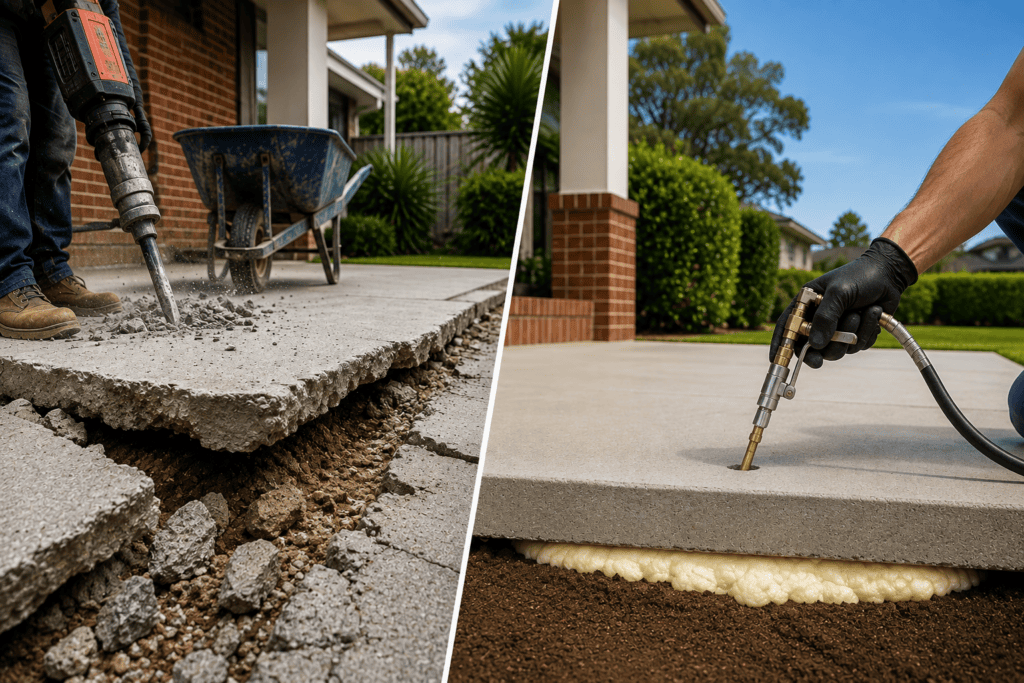
When settlement has already occurred, professional repair is often more effective and far less disruptive than full slab replacement. Modern concrete levelling services restore the slab to its original position by addressing the ground conditions beneath it rather than removing the slab entirely.
| Problem | Repair Approach |
| Uneven slab surfaces | Concrete levelling |
| Voids beneath slabs | Void filling and sinkhole correction |
| Localised settlement | Slab jacking |
| Soil instability beneath footings | Specialised grouting |
| Cracked surfaces with active water ingress | Crack injection and repair |
| Foundation movement from subsidence | Foundation underpinning |
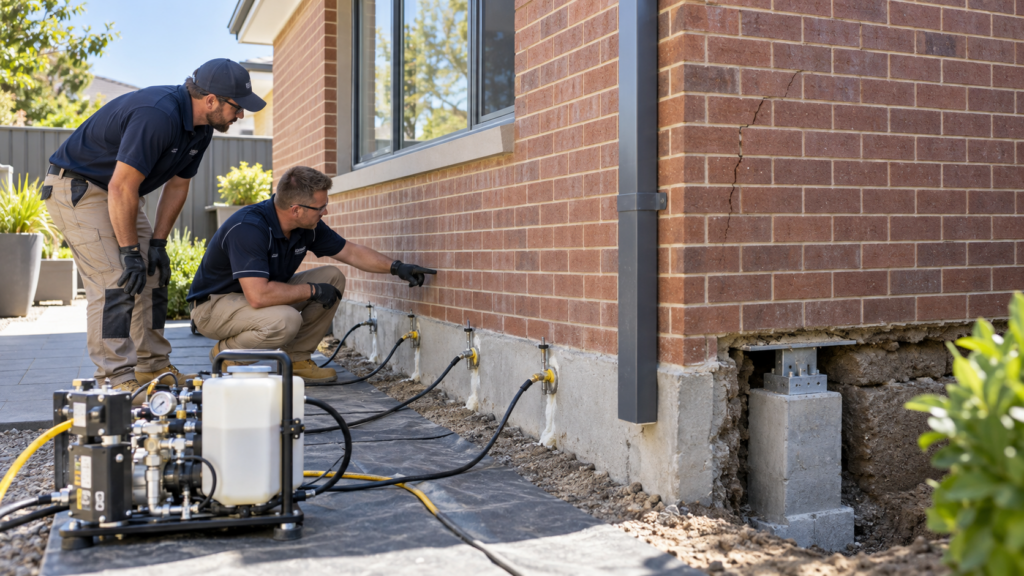
Resin injection stabilises soil beneath slabs and fills voids without excavation, making it well-suited to residential and commercial applications where disruption needs to be kept to a minimum.
A professional evaluation determines which approach best fits the specific situation. A slab that has dropped due to a localised void requires a different treatment than one sitting on broadly reactive clay with seasonal movement. Getting the diagnosis right before committing to a repair method saves both time and money in the long run.
For residential properties showing early signs of movement, the residential services page outlines the full range of available solutions.
Conclusion
Concrete slabs sink because the ground beneath them changes. Soil compaction, reactive clay behaviour, drainage failures, and erosion all reduce support over time. The process is usually gradual, which means early detection gives property owners real options before the damage becomes extensive.
Regular drainage maintenance, consistent soil moisture management, and prompt attention to early warning signs all help protect a slab’s long-term stability. When movement has already occurred, solutions like slab jacking, void filling, and specialised grouting restore the slab without requiring full replacement.
Contact Raise and Relevel for a professional assessment if you have noticed uneven floors, sticking doors, or new cracks appearing at your property.
Sources
- CSIRO — Foundation Maintenance and Footing Performance: CSIRO: Foundation Maintenance and Footing Performance (PDF)
- Queensland Government — Soil Compaction: Queensland Government Soil Compaction Guide
- Geomechanics Society of Australia — Shallow Replacement of Expansive or Swelling Soils: Australian Geomechanics Society Technical Paper
- MFS Engineering — Footing Settlement Impact on Homes: MFS Engineering: Footing Settlement & Foundation Impact
- Yahoo News Australia — Alarming Underground Phenomenon Sparks Call to Overhaul Australia’s Housing Designs: Yahoo News: Australian Housing Foundation Design Coverage
- Sourceable — Inadequate Soil Reports: Melbourne’s Big Secret?: Sourceable: Melbourne Soil Testing & Reports Investigation
- Building Inspections Melbourne Metro — Reactive Clay Soils in Melbourne’s West: Building Inspections Melbourne Metro: Reactive Clay Soils Guide
- Effective Consultancy — 3 Most Dangerous Risks of Reactive Clay Soil: Effective Consultancy: Risks of Reactive Clay Soil
- AZTA Engineering — Reactive Soil Damage: AZTA Engineering: Reactive Soil Damage & Structural Movement
- Victorian Building Authority — Research Findings on Slab Heave: VBA: Research Findings on Slab Heave (PDF)
- HIA — Residential Slabs and Footings Construction Requirements (AS 2870): HIA: Residential Slabs & Footings Requirements (AS 2870)
Frequently Asked Questions
Why do concrete slabs sink over time naturally?
Concrete slabs sink because the supporting soil beneath them changes over time. Natural compaction, moisture shifts, erosion, and reactive clay shrinkage all gradually reduce ground support. The slab responds to what the soil beneath it does, which is why settlement typically develops over months or years rather than suddenly.
How long does it take for a concrete slab to start sinking?
The timeline varies depending on soil type, construction quality, drainage performance, and climate. Some slabs on stable, well-compacted ground remain level for decades. Others on reactive clay or fill soil may show movement within a few years of construction, particularly after drought conditions or heavy rain events that shift soil moisture levels significantly.
What are the signs of a sinking concrete slab?
Common signs include sloping or uneven floors, cracks in walls and concrete surfaces, doors and windows that stick or jam, visible gaps between walls and floor coverings, and outdoor slabs or pathways that sit lower than they previously did. These symptoms often appear gradually and worsen over time if the underlying cause is not addressed.
Can water damage cause concrete slabs to sink?
Yes, water is one of the most common contributors to slab settlement. It erodes supporting soil, creates underground voids, and softens clay soils, reducing their load-bearing capacity. Broken pipes, poor drainage, and excessive irrigation near foundations all introduce moisture that progressively removes ground support from beneath the slab.
How can a sinking concrete slab be repaired?
Repair options depend on the cause and severity of the settlement. Slab jacking lifts settled sections by filling the void beneath them. Void filling addresses hollow spaces before they cause further movement. Specialised grouting stabilises unstable soil beneath footings. A professional inspection is the most reliable way to identify which approach suits the specific situation and prevents further settlement. For large-scale infrastructure examples, read our case study on road slab restoration and relevelling, which highlights how expansive sunken slabs can be brought back to grade quickly and reliably.