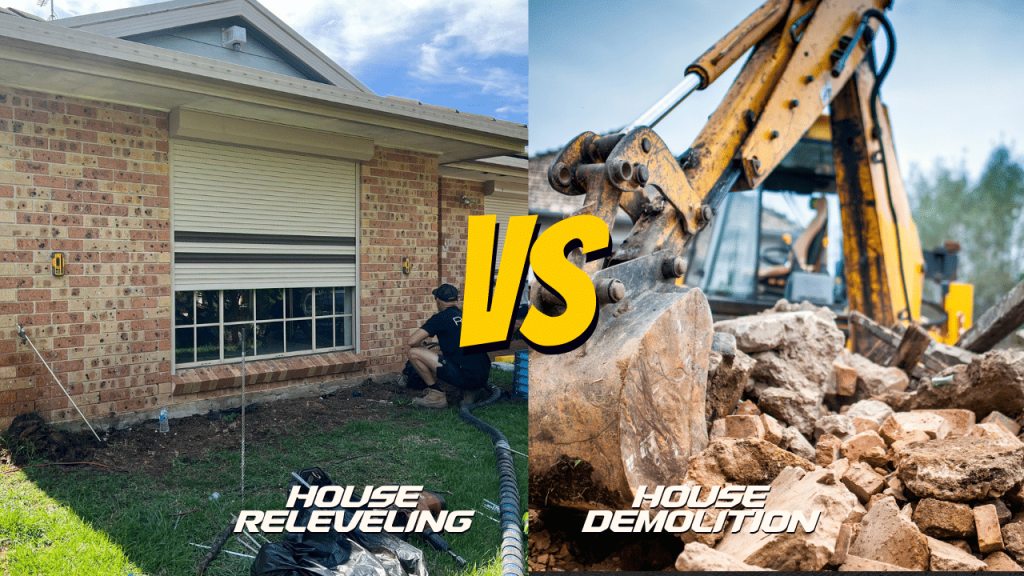
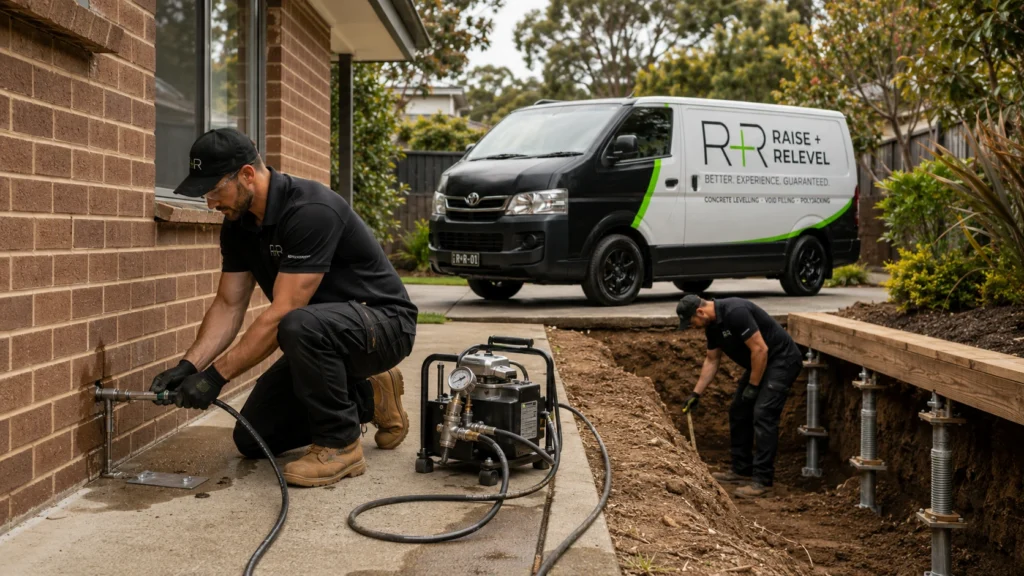
Resin injection underpinning is generally faster and less invasive, while traditional underpinning is often necessary where existing footings need substantial structural support. Resin isn’t a universal substitute for underpinning, and similar-looking cracks can have different causes. Soil, drainage, footings and movement patterns all need proper assessment, since the cheapest method can become the most expensive one if it treats the wrong problem.
| Quick answer
Choose resin injection when investigation shows that suitable ground improvement, void filling, or controlled lifting can address the problem. Choose traditional underpinning when foundations require deeper, stronger, or specifically engineered structural support. Consider screw pile underpinning when loads must be transferred to suitable bearing material at depth and the system suits the site. Don’t choose solely by price or installation speed. The repair needs to match the cause of movement and the structural element affected. |
How Does Resin Injection Stabilise a Foundation?
Resin injection involves placing an expanding material into selected areas beneath a slab or foundation. The resin fills voids, compacts or improves the surrounding ground, and may exert controlled lifting pressure where appropriate.
Typical process
- Inspect and measure the affected structure
- Identify likely voids, weak zones, or settlement patterns
- Establish injection locations and target depths
- Drill relatively small access holes
- Inject resin in controlled stages
- Monitor movement and lift during installation
- Stop when the specified result or pressure response is reached
- Seal injection points and complete post-work measurements
This isn’t a standard process for every resin system. Materials, equipment, injection patterns, monitoring methods and design requirements vary between products and applications.
Potential applications
- Suitable sunken concrete slabs
- Voids beneath floors, driveways, or paths
- Localised settlement
- Ground with inadequate support that can be improved by injection
- Projects where access or excavation is difficult
- Controlled lifting within an appropriate engineering tolerance
- Situations where minimal disruption is a priority
Limitations
- Resin cannot repair every footing defect
- It may not provide the required load path for severe structural problems
- Deep or ongoing ground instability may require another system
- Unresolved leaks, erosion, or drainage problems can continue affecting the site
- Lifting may damage brittle finishes or connected services if poorly controlled
Not every structure should be returned to its original level. Void filling, ground improvement, lifting, and underpinning are distinct outcomes, so it’s worth confirming exactly which one a quote is promising. The resin’s expansion needs to be monitored rather than assumed to be beneficial, and existing pipes or underground services can affect where injection is planned. Surface levelling doesn’t necessarily prove that the foundation has been stabilised, and resin volume alone doesn’t demonstrate repair quality or structural capacity. If you’re weighing whether resin injection underpinning suits your situation, a site-specific assessment is the only reliable way to confirm it.
When Is Traditional Underpinning the Better Choice?
Traditional underpinning is usually considered when existing footings require direct structural support, or when loads need to be transferred to stronger ground. This article focuses specifically on resin injection versus traditional underpinning for structural support; for the related question of slab jacking vs underpinning, see our earlier comparison, since slab jacking and underpinning solve different problems.
Situations that may require underpinning
- Inadequate footing depth or size
- Deteriorated or damaged foundations
- Significant differential settlement
- Weak or unsuitable ground beneath load-bearing footings
- Erosion or loss of footing support
- Structural modifications that increase loads
- Nearby excavation affecting foundation stability
- Movement that cannot be addressed through ground improvement alone
- A need to establish a deeper or more reliable load path
Types of underpinning
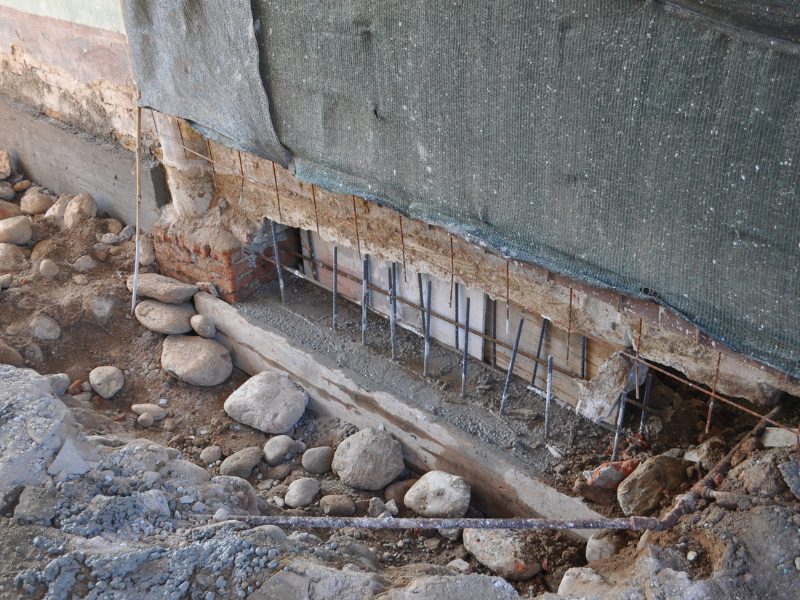
Mass concrete underpinning: sections are excavated beneath existing footings and filled with concrete in a controlled sequence. It’s an established method, though it involves excavation, access requirements, and potential disruption.
Beam-and-base underpinning: reinforced beams distribute loads to new bases or supports. It’s an engineered option suited to particular structures and site conditions.
Screw pile underpinning: steel helical piles are advanced into the ground and connected to the foundation using an engineered bracket or support system. It offers advantages for restricted access and useful depth capability, though performance depends on installation monitoring, corrosion considerations, and the soil involved.
Micropiles or other piled systems: other engineered piling systems may be appropriate where loads need to reach suitable bearing material at greater depth.
“Traditional underpinning” covers several distinct methods rather than one standard repair, and the work needs to be sequenced carefully to maintain support throughout installation. Deeper isn’t automatically better: the support needs to reach appropriate bearing conditions, not just greater depth. Stabilisation doesn’t guarantee that all cracks will close, and underpinning is sometimes combined with drainage, plumbing, or ground-remediation work to address the underlying cause. If footings need direct structural support, our underpinning foundations cover mass concrete, beam-and-base, and screw pile methods.
How Do Resin Injection and Underpinning Compare?
Resin injection, whether used for concrete slab lifting or broader ground improvement, often wins on speed and limited disruption, while underpinning generally offers more direct structural support where existing footings are inadequate.
| Comparison Factor | Resin Injection | Concrete Underpinning | Screw Pile Underpinning |
| Primary function | Void filling, ground improvement, re-supporting, or controlled lifting | Extend or strengthen footing support | Transfer loads to suitable material at depth |
| Excavation | Usually limited | Commonly substantial | Often limited, but access is still required |
| Installation time | Often shorter | Usually longer | Project-dependent |
| Disruption | Generally lower | Generally higher | Often lower than mass concrete |
| Structural connection | System- and application-dependent | Directly supports existing footing | Engineered pile and bracket connection |
| Lifting capability | May provide controlled lifting | Possible in some designs | Possible in some systems |
| Best suited to | Suitable settlement and ground conditions | Footings requiring additional bearing support | Sites requiring deeper load transfer |
| Main limitation | Not suitable for every structural failure | Excavation, curing, access, and disruption | Soil suitability, access, design, and corrosion exposure |
| Cost tendency | Often lower for suitable projects | Often higher | Varies considerably |
| Design basis | Site and application specific | Structural and geotechnical requirements | Structural and geotechnical requirements |
Speed, price, and disruption are secondary considerations after technical suitability has been established.
How Do Cost, Installation Time, and Disruption Compare?
Resin injection, covered in our concrete levelling guide, is often cheaper and faster than traditional concrete underpinning, mainly because it usually involves less excavation and reinstatement. Actual pricing depends heavily on the site, so treat any national price range with caution.
Cost drivers
- Size of the affected area
- Number and depth of injection or support points
- Extent of settlement
- Required lifting
- Soil and groundwater conditions
- Building weight and construction
- Site access
- Resin volume or underpinning depth
- Need for engineering or geotechnical work
- Excavation and spoil removal
- Plumbing and drainage repairs
- Reinstatement of floors, walls, paving, or landscaping
Installation and disruption
- Drilling versus excavation
- Equipment access
- Noise and vibration
- Cure or return-to-service time
- Occupant access during work
- Damage to landscaping or finishes
- Need to expose existing footings
- Post-repair cosmetic work
Quote checklist
- Diagnosis and investigation
- Engineering design where required
- Exact repair areas
- Number and depth of support points
- Lift tolerances
- Drainage or plumbing work
- Monitoring and completion measurements
- Surface reinstatement
- Permit or inspection costs
- Warranty scope and exclusions
Quotes for different methods don’t always cover the same outcome, and a cheaper quote may cover levelling without long-term stabilisation. Resin quantities can be difficult to predict before injection begins, and underpinning costs tend to rise when deeper or weaker ground is encountered. Comparing price per injection point or per underpin in isolation can also be misleading if the scope isn’t identical.
Which Foundation Repair Method Lasts Longer?
Neither method has a universally longer lifespan. Durability depends on correct diagnosis, design, materials, workmanship, soil behaviour, drainage, structural loading, and whether the cause of movement has actually been controlled.
Resin injection durability factors
- Resin formulation and intended structural use
- Injection depth and pattern
- Soil compatibility
- Groundwater and chemical exposure
- Whether voids and weak zones were properly identified
- Continuing erosion or moisture changes
- Quality of installation and monitoring
Traditional underpinning durability factors
- Footing and support design
- Concrete quality
- Pile or pier capacity
- Corrosion protection
- Founding material
- Load transfer and connection details
- Excavation sequence
- Ongoing soil or drainage conditions
To be clear about what durability actually means here: resin injection isn’t permanent in every soil type, underpinning doesn’t eliminate all future movement, and neither method reliably outlasts the other in every case. A long warranty isn’t proof of technical suitability, and closed cracks don’t necessarily mean the underlying problem has been resolved.
Warranty length and expected service life aren’t the same thing, and some soil movement can continue outside the treated area even after a successful repair. Repairs are best assessed against performance criteria rather than appearance alone, and cosmetic crack repair sometimes needs to wait until stability has been monitored. Long-term drainage and moisture management can matter as much as the system that was installed.
How Do You Choose the Right Underpinning Solution?
The process should begin with diagnosis, not with selecting a product.
Diagnostic framework
- Review the property and movement history
- Inspect cracks, floors, openings, footings, and drainage
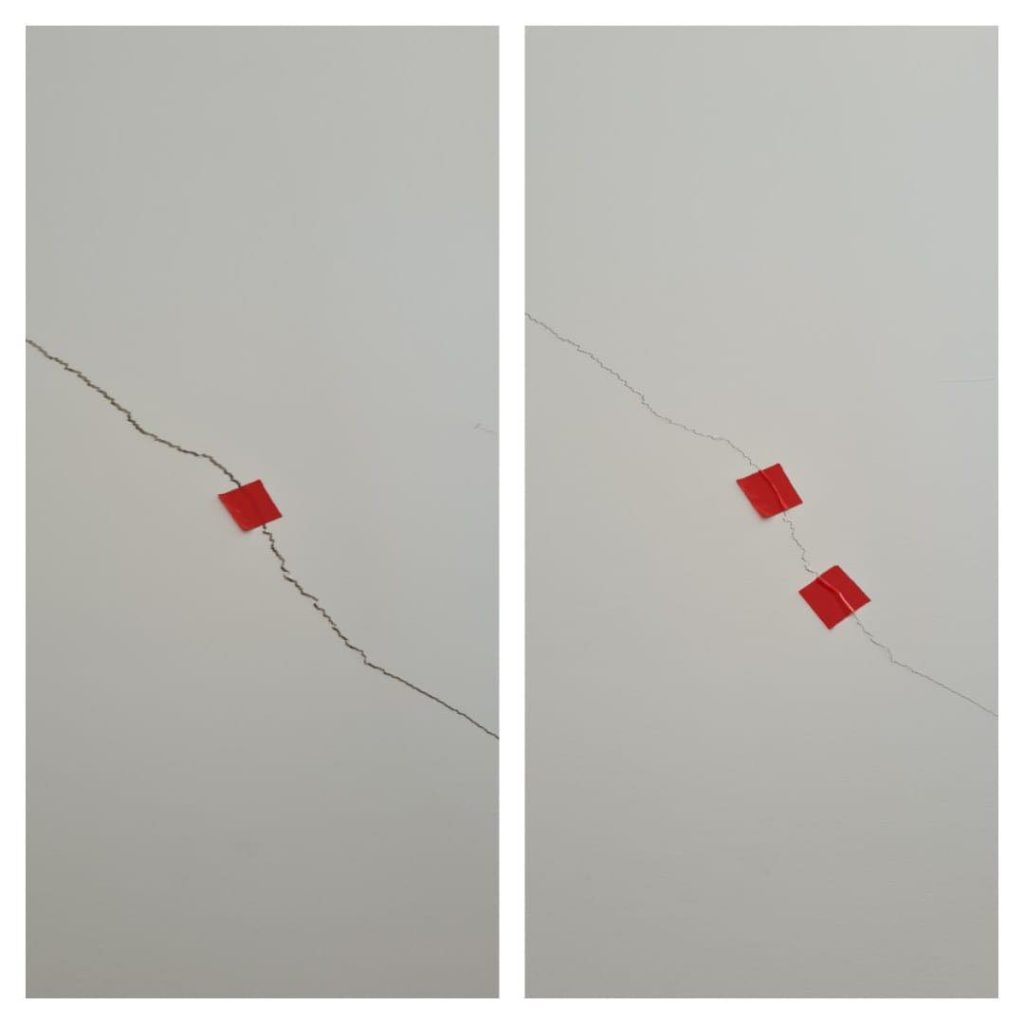
- Measure floor levels and displacement
- Investigate plumbing leaks and abnormal moisture
- Review available soil and building records
- Determine whether movement is active or historic
- Identify whether the affected element is structural
- Assess soil conditions and foundation loads
- Compare technically suitable repair options
- Specify installation controls and post-repair monitoring
Which method may be considered
| Diagnosed Condition | Method That May Be Considered |
| Void beneath an otherwise suitable slab | Resin injection or grout-based slab jacking |
| Suitable localised ground weakness | Resin ground improvement, subject to assessment |
| Inadequate load-bearing footing | Concrete, beam, pile, or other engineered underpinning |
| Need to transfer loads to deeper bearing material | Screw piles, micropiles, or another engineered system |
| Active plumbing or drainage problem | Repair the source before or alongside structural work |
| Severely damaged concrete | Replacement or structural repair may be required |
| Uncertain or conflicting diagnosis | Independent structural and possibly geotechnical assessment |
This matrix is educational and isn’t a substitute for property-specific advice. For slabs that just need lifting rather than full underpinning, our concrete slab jacking may be the simpler, less invasive option.
Questions to ask the repair provider
- What is causing the movement?
- What evidence supports that diagnosis?
- Is the affected slab or footing load-bearing?
- Is movement active, seasonal, or historic?
- Why is this method suitable for the soil and structure?
- What alternatives were considered?
- Will the work lift, stabilise, strengthen, or only fill voids?
- Who is responsible for design and supervision?
- How will movement be measured during installation?
- What happens if the expected result cannot be achieved?
- What does the warranty cover and exclude?
- Are approvals or independent inspections required?
A company that specialises in one system may not assess every alternative fairly, so independent advice can help when recommendations conflict. Soil testing alone may not identify the cause of existing movement, and structural and geotechnical assessments actually answer different questions. A good repair design should define acceptable movement and lifting tolerances upfront, not leave them open-ended. The National Construction Code‘s footing and slab provisions are a useful reference for how bearing capacity and site classification are meant to be assessed.
The Bottom Line
Choose resin injection when site investigation shows that controlled ground improvement, void filling, or slab re-supporting is appropriate. Choose concrete underpinning when existing footings need direct, deeper support and excavation is feasible. Choose screw pile underpinning when loads need to be transferred to suitable material at depth and the site supports that approach. Don’t select a method based only on cost, speed, or disruption. The right solution follows a proper diagnosis of the cause, the soil conditions, the affected building element, and the structural outcome required, which is exactly what our foundation and subsidence repair team can help confirm for your property.
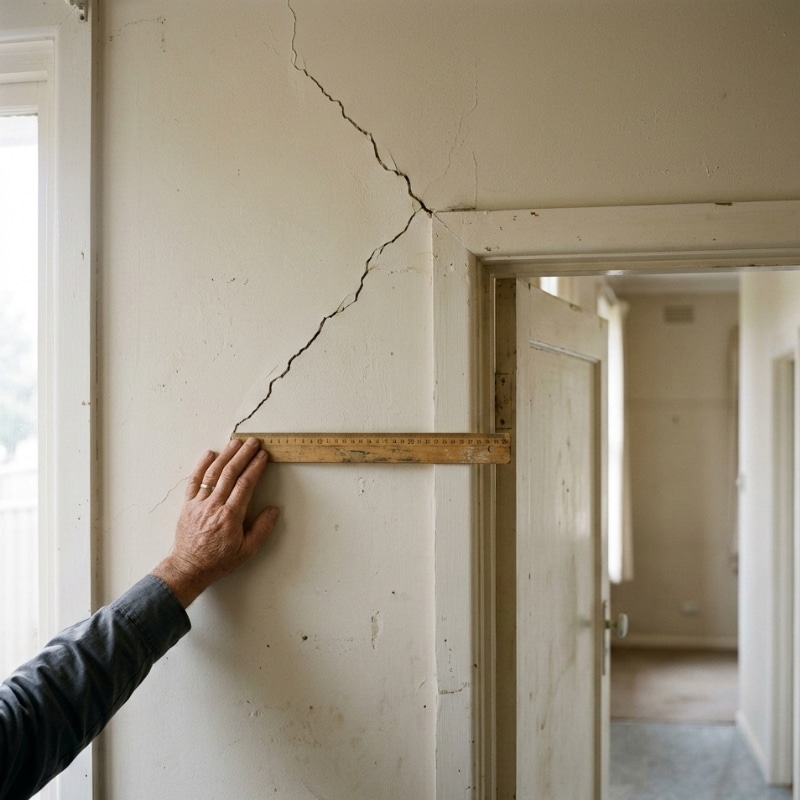
If you’ve noticed cracked walls, sinking floors, or doors and windows that no longer sit right, book a foundation and subsidence assessment before committing to a repair. Ask for a written diagnosis before approving any work, and compare resin injection and underpinning options against the same defined outcome. For significant, progressive, or disputed damage, an independent structural opinion is worth seeking out. Raise and Relevel covers the full range, from resin injection to engineered underpinning.
Frequently Asked Questions
What is resin injection underpinning?
Resin injection underpinning involves injecting an expanding structural resin beneath a slab or foundation to fill voids, compact weak ground, and improve bearing capacity. Depending on the application, it may be used for ground improvement, void filling, slab lifting, or re-supporting settled concrete. It isn’t automatically the same as traditional pier or pile underpinning, since it typically works through the surrounding ground or beneath a slab rather than directly extending the footing itself. Suitability depends on the cause of movement, soil conditions, and the structural outcome required, which is why a proper assessment matters.
Is resin injection cheaper than traditional underpinning?
Resin injection is often cheaper than traditional concrete underpinning for suitable projects, mainly because it typically involves less excavation and reinstatement. However, actual costs depend on the affected area, soil conditions, required lifting, and site access, so national price ranges aren’t reliable. A cheaper quote may also cover a different outcome, such as levelling without long-term stabilisation, so comparing quotes on price alone can be misleading. The most cost-effective method is the one that matches your property’s actual structural needs, confirmed through a proper site assessment.
How long does resin injection underpinning last?
There’s no universal lifespan for resin injection or any foundation repair method. Durability depends on the resin formulation, injection depth and pattern, soil compatibility, groundwater conditions, and whether the voids and weak zones were correctly identified and treated. Ongoing erosion, ground movement outside the treated area, or unresolved drainage problems can all affect long-term performance. A warranty reflects the provider’s commitment, not a guaranteed service life, so ask what durability factors were considered in your specific repair design.
Can resin injection repair severely damaged foundations?
Resin injection isn’t suitable for every structural failure. It can be effective for void filling, ground improvement, and controlled lifting where the existing structure remains sound, but it may not provide the load path needed for severely damaged or inadequate footings. Deep or ongoing ground instability, major structural cracking, or foundations that need substantial reinforcement typically call for traditional underpinning or another engineered system instead. A structural assessment is the only reliable way to confirm whether resin injection is appropriate for your specific damage.
How do I know which underpinning method my property needs?
The right method depends on a proper diagnosis, not a guess based on symptoms alone. This involves reviewing your property’s movement history, inspecting cracks and drainage, measuring floor levels, and identifying whether the affected element is structural. From there, a suitable repair option, such as resin injection, concrete underpinning, or screw piles, can be matched to the cause and required outcome. If recommendations from different providers conflict, an independent structural or geotechnical assessment can help clarify the right path forward.