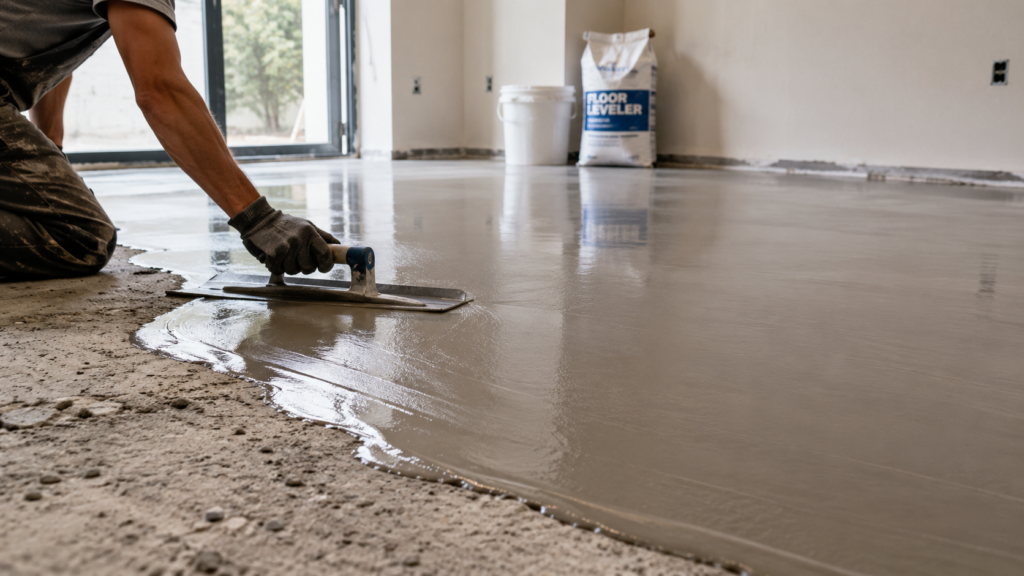
Choosing the right floor leveller for concrete slab work comes down to three things: the condition of your slab, how deep the uneven areas are, and what type of flooring goes on top. A level concrete surface is the foundation for any successful floor installation. Without it, tiles crack, vinyl lifts, and timber flooring shifts underfoot. This guide covers the products available, how to apply them correctly, and when surface levelling is not enough.
Key Takeaways
- Choosing the correct floor leveller for a concrete slab depends on the depth of unevenness, the type of flooring being installed, and whether the slab has moisture or structural issues that need to be resolved first.
- Different levelling products suit different applications, and using the wrong product for the surface condition or depth can cause adhesion failure and premature floor damage.
- Proper surface preparation, including cleaning, crack repair, priming, and moisture testing, determines whether a levelling compound performs well over the long term.
- A floor leveller addresses surface imperfections only, so slabs with structural movement, active cracking, or ongoing settlement require professional assessment and repair before any levelling compound is applied.
How Do You Choose the Right Floor Leveler for a Concrete Slab?
Selecting a floor leveller is not as simple as grabbing the nearest bag off the shelf. The product needs to match the slab condition, the application depth, and the flooring type above. Getting this wrong leads to adhesion failure, compound cracking, or a floor that starts moving within months of installation.
Several factors determine which product is right for your project:
- Depth of uneven areas: Shallow imperfections under 10mm suit standard self-levelling compounds, while deeper low spots need build-up products or staged pours.
- Indoor versus outdoor applications: Most standard levelling compounds are designed for internal use only, and external slabs exposed to weather need products specifically rated for that environment.
- Flooring type going on top: Tiles tolerate a wider range of compounds, while engineered timber and vinyl require a very flat surface and products compatible with adhesive systems.
- Drying and curing time: Rapid-setting products suit time-sensitive projects but offer very little working time once poured, so preparation must be complete before mixing.
- Compatibility with existing concrete: Some polymer-modified products require a specific primer to bond correctly to older or contaminated surfaces.
Moisture is one of the most commonly overlooked factors before levelling. Excess moisture vapour transmission through a slab causes floor coverings and levelling compounds to fail, regardless of product quality. This is well documented in Australian residential slab moisture assessment guidance, which identifies moisture testing as a prerequisite step before any surface treatment. Test the slab before committing to a product.
Manufacturer thickness recommendations also matter. Exceeding the stated maximum application depth in a single pour causes the compound to shrink unevenly during curing, creating dips or ridges in the finished surface.
What Types of Floor Leveler for Concrete Slabs Are Available?
Not all levelling products do the same job. Concrete slabs vary in age, condition, and construction, which is why manufacturers produce a range of compounds suited to different situations. Understanding how concrete slab floor systems are classified and used in Australian construction helps clarify why product selection matters.
The main types available in Australia include:
- Self-levelling compound: This product flows into low areas under its own weight and works best for shallow imperfections up to around 10mm in residential applications.
- Cement-based floor levellers: These are a traditional option for smoothing rough or uneven concrete and require more hands-on application than self-levelling products.
- Polymer-modified levellers: These contain polymer additives that improve flexibility and adhesion, and they perform well on older slabs where surface contamination may affect bonding.
- Heavy-duty commercial levelling products: Formulated for warehouses, factories, and high-traffic areas, these products have higher compressive strength than residential-grade compounds.
- Rapid-setting floor levellers: These set within 30 to 60 minutes, depending on the product, and work well when project timelines are tight, but they demand accurate mixing and fast placement.
Residential and commercial products are not interchangeable. A product rated for light foot traffic in a home will not hold up under forklift loads or pallet trolleys in an industrial setting. The surface behaviour and load requirements of concrete floor systems directly influence the appropriate preparation and finishing products.
If you are unsure whether a standard compound is adequate, understanding the best methods for slab repair can help clarify whether surface levelling is the right starting point or whether a more involved solution is needed.
How Do You Apply Floor Leveler to a Concrete Slab Correctly?
Good preparation accounts for most of the results. A levelling compound poured onto a dusty, contaminated, or structurally compromised slab will fail regardless of product quality. Following the correct application sequence gives the compound the best chance of bonding and curing properly.
Work through these steps in order:
- Clean and prepare the slab: Remove all dust, grease, adhesive residue, and paint before you start. Mechanical grinding or scarifying produces a cleaner surface than sweeping alone, and best practice for residential concrete floor slab preparation identifies thorough surface preparation as essential to achieving adhesion for any surface treatment.
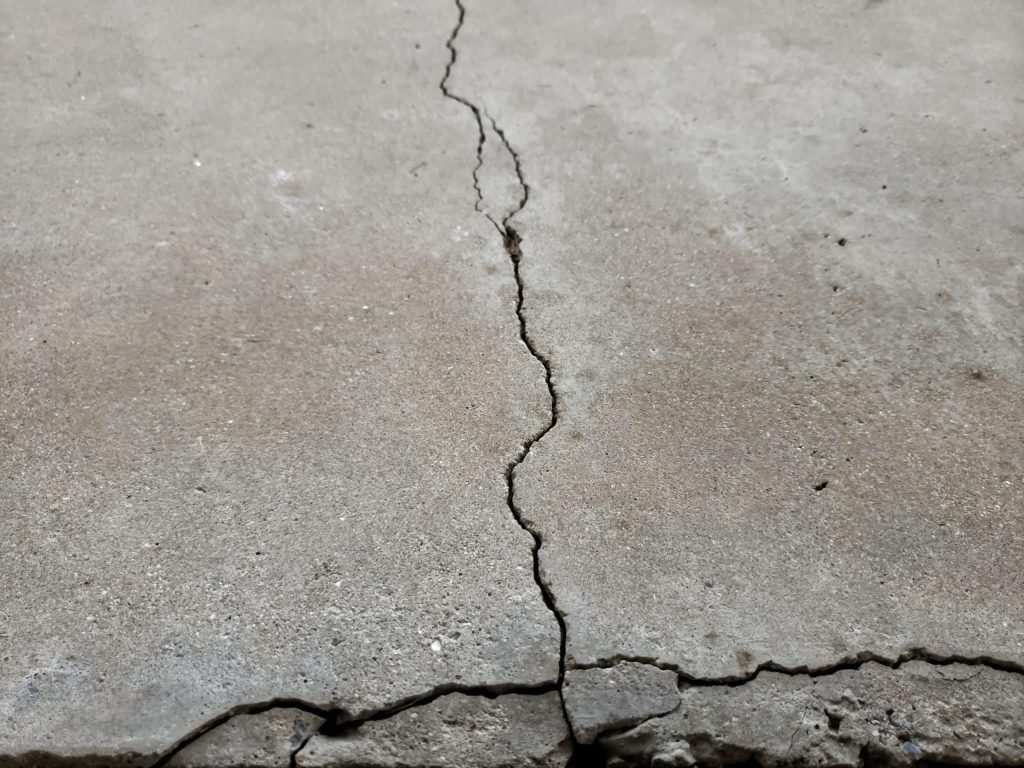
- Repair significant cracks first: Fill structural cracks and deep voids before applying any levelling compound. Pouring self-levelling compound over open cracks allows it to flow through and undermine the pour.
- Apply primer if required: Most self-levelling and polymer-modified products require a compatible primer. The primer seals the surface and prevents the slab from drawing moisture out of the compound too quickly, which can cause premature drying and surface weakness.
- Mix the levelling compound correctly: Follow the manufacturer’s water-to-powder ratios exactly. Too much water reduces compressive strength, and too little water causes lumps and uneven flow.
- Pour, spread, and allow proper curing: Pour the compound, spread it with a gauge rake to the required depth, and allow it to cure fully before walking on it or installing flooring.
Temperature affects how a levelling compound behaves during curing. Hot conditions accelerate drying, which can cause surface cracking. Cold conditions slow curing and may prevent proper hardening. Most manufacturers specify an acceptable application temperature range of between 5°C and 30°C. The regulatory standards for concrete slab construction and finishing in Australian residential building set the broader compliance context for slab work, including surface preparation requirements.
What Common Mistakes Should You Avoid When Using a Floor Leveler for a Concrete Slab?
Most floor levelling failures trace back to shortcuts taken during preparation or application. These are the mistakes that repeatedly appear in remediation work across residential and commercial projects.
- Skipping surface preparation: Pouring compound onto a dirty or weak surface can cause adhesion failure, and the levelling layer can separate from the slab and crack.
- Ignoring moisture issues: Applying levelling compound over a slab with high moisture vapour emission causes the compound to blister, delaminate, or soften over time.
- Mixing with incorrect water ratios: Adding more water than specified to make the compound easier to pour significantly lowers its compressive strength, and the result will not perform as rated.
- Applying beyond the recommended thickness: Single pours beyond the stated maximum depth cause the compound to crack as it shrinks during curing, and multiple layers are needed for deeper fills.
- Installing flooring before full curing: A compound that looks dry on the surface may still be curing internally, and installing adhesive-fixed flooring too early traps moisture and causes the bond to fail.
Rushing the flooring installation is one of the most common causes of callbacks in residential renovation. The minimum competency requirements for concrete construction work in Australia set out why following the correct application sequence is a professional standard, not a suggestion. The product’s technical data sheet specifies two different figures: minimum cure time before foot traffic and minimum cure time before flooring installation. Read both before proceeding.
When Should You Use a Floor Leveler Instead of Replacing a Concrete Slab?
A floor leveller is a surface preparation product, not a structural repair solution. This distinction matters before you begin any project involving uneven concrete.
Floor levellers work well when the slab surface is rough, pitted, or slightly uneven due to age or wear. They are the right choice when you are preparing a slab for a new floor covering and need a flat, smooth substrate. Minor height variations, within the product’s stated application depth, are what levelling compounds are designed to address.
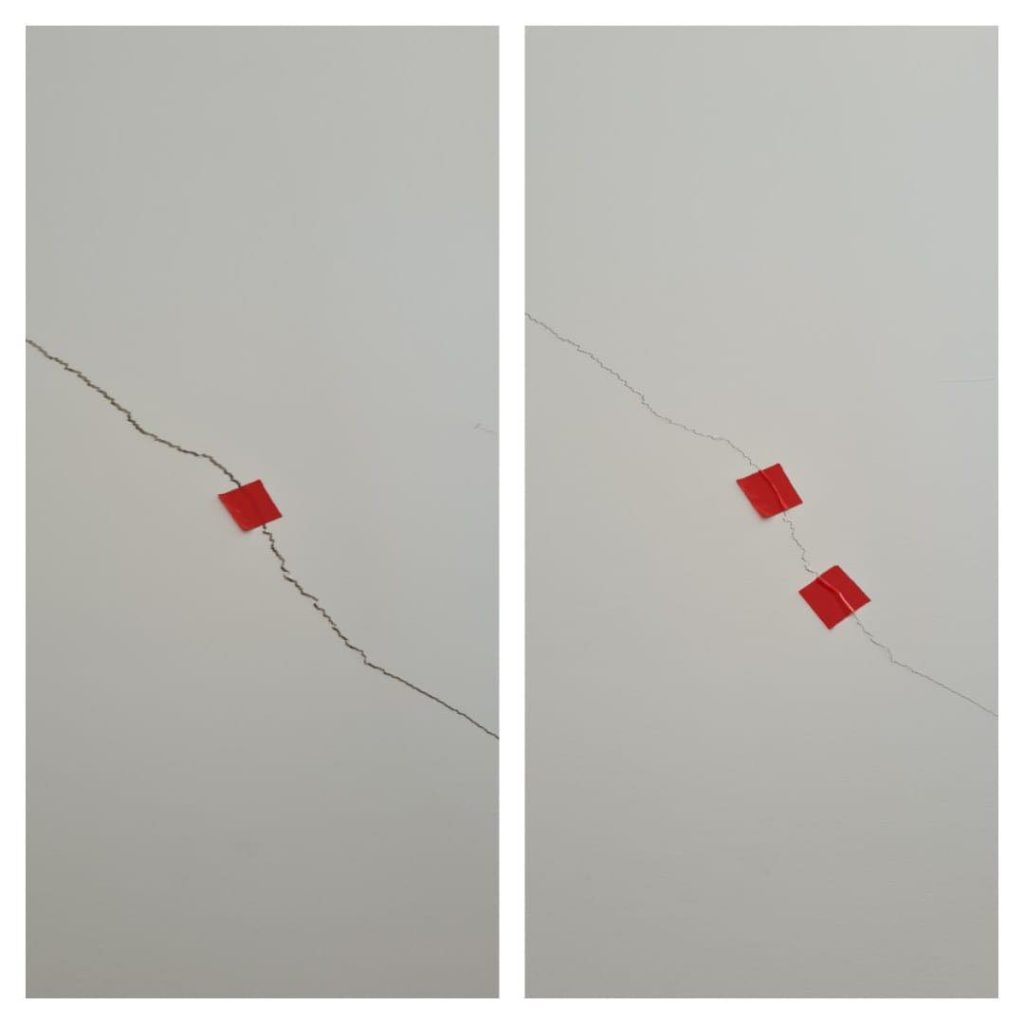
Floor levelling is not the right approach when the slab shows signs of ongoing movement or settlement, when cracking is widening over time, when voids are forming under the slab due to soil loss, or when the unevenness is caused by subsidence rather than surface wear. Research on floor system performance and subgrade support requirements identifies load distribution and subgrade stability as primary factors in long-term floor durability. A levelling compound applied over an unstable slab will crack and fail in the same locations.
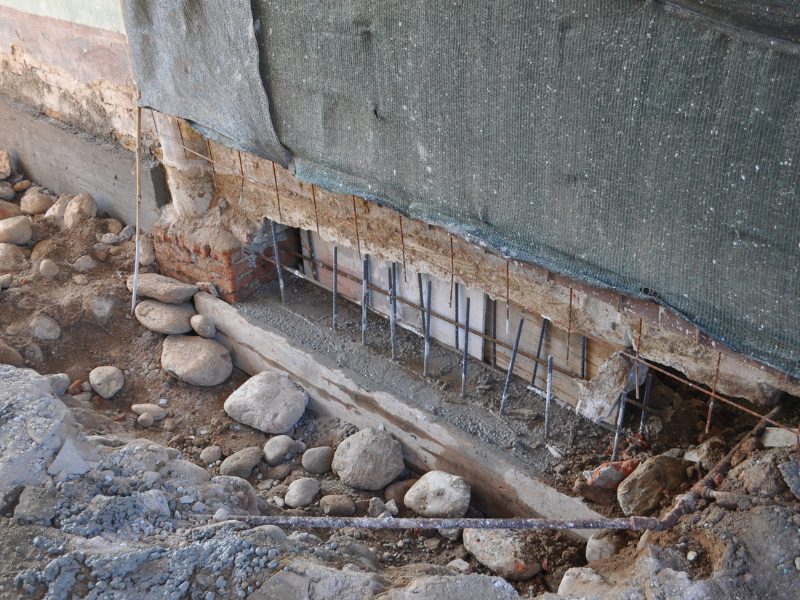
These situations require structural intervention before any surface work begins. Slab jacking lifts and stabilises sunken concrete by filling the void beneath it. Underpinning services address the foundation when soil movement is the underlying cause. Structural repair solutions address the slab itself when cracking has progressed beyond the surface. The assessment standards for concrete and masonry construction work outline the skills required to distinguish surface conditions from structural ones, which reflects why professional assessment before any levelling work matters.
If you are unsure which path applies to your slab, professional concrete levelling services in Australia can help you identify whether surface levelling or a structural solution is the appropriate first step.
Selecting the right floor leveller for a concrete slab is about more than product choice. Preparation, moisture management, correct application depth, and full curing time all determine whether the result holds. When the slab itself is the problem rather than its surface, a levelling compound will not fix it. Knowing the difference between a surface issue and a structural one separates a durable result from a costly redo.
If your slab has more than surface imperfections, get in touch with the Raise and Relevel team for a professional assessment before you start.
Frequently Asked Questions
What is a floor leveler for a concrete slab?
A floor leveller is a cementitious or polymer-modified compound applied to an existing concrete slab to fill low spots, correct unevenness, and create a flat surface ready for floor coverings. It is not a structural product. It addresses only surface-level imperfections and must be applied to a structurally sound, properly prepared slab. Products vary in depth capacity, setting time, and suitability for different flooring types, so selecting the right one for the application is important.
How thick can a floor leveler be applied to a concrete slab?
Maximum application thickness depends on the specific product being used. Most standard self-levelling compounds are rated for pours of 10mm to 20mm in a single application, while some heavy-build products allow depths of 40mm or more. Exceeding the manufacturer’s stated maximum in a single pour causes shrinkage cracking during curing. Where greater depths are required, multiple pours with adequate curing time between layers are the correct approach.
Can I apply a floor leveler over cracked concrete?
It depends on the type and cause of the cracking. Stable, non-moving surface cracks can be filled and repaired before a levelling compound is applied. Cracks that are active, widening, or caused by structural movement or subsidence cannot be resolved with a surface levelling product. Applying compound over active cracks will cause the compound to crack at the same location. The underlying cause of the cracking must be identified and addressed before any levelling work begins.
How long does a floor leveler take to dry?
Most self-levelling compounds allow light foot traffic within two to four hours of application. However, a surface that is dry enough to walk on is not the same as one that is ready for flooring installation. Typically, the full cure before adhesive-fixed floor coverings can be installed ranges from 24 hours to several days, depending on the product, ambient temperature, and humidity levels. Always follow the manufacturer’s technical data sheet for the specific product, as minimum cure times vary between products.
Do I need to prepare the concrete slab before applying a floor leveler?
Yes, surface preparation is not optional. The slab must be clean, dry, and free of dust, grease, paint, adhesive residue, and any loose or weak material before application begins. Significant cracks and voids should be repaired before the levelling compound is poured. Many products also require a compatible primer coat to ensure proper adhesion to the existing concrete surface. Skipping preparation is the most common cause of levelling compound failure in both residential and commercial applications.
Sources
- Australian Building Codes Board. National Construction Code 2016 Volume Two, Part 3.2 Footings and Slabs. https://ncc.abcb.gov.au/editions/2016/ncc-2016-volume-two/part-32-footings-and-slabs/part-32-footings-and-slabs
- Government of Western Australia. Industry Bulletin 31: Placement, Curing and Finishing of Residential Concrete Floor Slabs (updated 2024). https://www.wa.gov.au/system/files/2024-10/ib_031_placement_curing_and_finishing_of_residential_concrete_floor_slabs_nov_2013_0.pdf
- Government of Western Australia. Technical Guidance TG002: Moisture Content in Concrete Slabs (2022). https://www.wa.gov.au/system/files/2022-06/TG002-Moisture-content-in-concrete-slabs.pdf
- RMIT University Learning Lab. BuildRight: Concrete Slab General, Floor Systems Page 1. https://learninglab.rmit.edu.au/Toolbox/buildright/content/bcgbc4010a/10_floor_systems/01_concrete_slab_general/page_001.htm
- RMIT University Learning Lab. BuildRight: Concrete Slab General, Floor Systems Page 3. https://learninglab.rmit.edu.au/Toolbox/buildright/content/bcgbc4010a/10_floor_systems/01_concrete_slab_general/page_003.htm
- James Cook University. Section 10.0 Floors, Construction and Building Technology Resource. https://www.jcu.edu.au/__data/assets/pdf_file/0005/2342390/Section-10.0-Floors.pdf
- Australian Government, training.gov.au. CPCCCA3028: Construct Advanced Concrete Formwork and Reinforcement. https://training.gov.au/TrainingComponentFiles/CPC/CPCCCA3028_R1.pdf
- Australian Government, training.gov.au. CPCPCM2054 Assessment Requirements: Carry Out Concreting to Simple Forms. https://training.gov.au/TrainingComponentFiles/CPC/CPCPCM2054_AssessmentRequirements_R1.pdf
- Government of Western Australia. Industry Bulletin 31 Publication Page. https://www.wa.gov.au/government/publications/industry-bulletin-31-placement-curing-and-finishing-of-residential-concrete-floor-slabs
- Concrete Institute of Australia. Recommended Practice Z7/01: Guide to Industrial Floors and Pavements. https://www.concrete.net.au/shop/publications/recommended-practices
- Victorian Building Authority. Structural, Foundation and Slab Requirements for Residential Construction. https://www.vba.vic.gov.au/consumers/building/new-home
- Standards Australia. AS 3600-2018 Concrete Structures. https://www.standards.org.au/standards-catalogue/sa-snz/building/bd-002/as–3600-2018