In many Australian homes, these signs are linked to ground movement and changes in soil moisture. Sometimes it’s minor seasonal movement you can monitor. Other times, it’s a red flag that needs timely assessment to avoid bigger (and more expensive) problems later.
This guide walks you through what to look for, what it can mean, how to document it properly, and when it’s time to bring in professional help.
Why these three signs matter (and why they often show up together)
Foundation or footing movement rarely announces itself with one perfect symptom. More often, you’ll see a cluster of changes across the home.
• Cracks can form as walls and frames flex.
• Doors and windows can stick as openings rack out of square.
• Floors can feel uneven when one area settles or heaves more than another (called differential movement).
In Australian conditions, movement is commonly associated with one (or a mix) of these factors:
• Reactive clay soils that shrink during dry periods and swell after rain
• Poor stormwater drainage or downpipes dumping water near footings
• Plumbing leaks (even small, long-term leaks) saturating soils under/near the slab
• Tree roots influencing moisture levels or drying out soil near the home
• Erosion, fill settlement, or changes after landscaping/renovations
• Long drought-to-deluge cycles (something many households in Sydney, Melbourne, and Brisbane have felt in recent years)
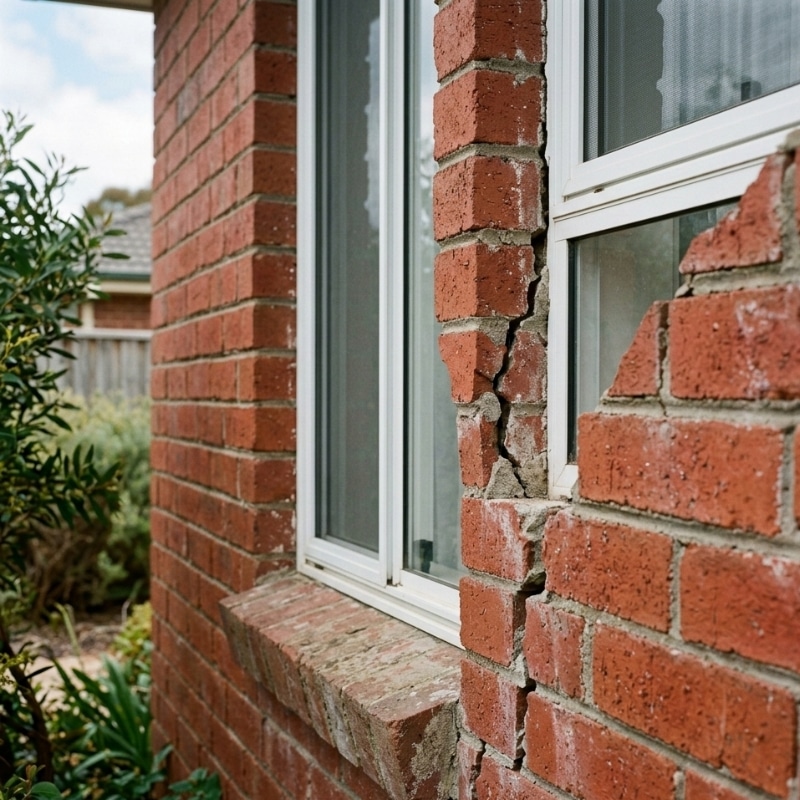
What “stair-step” cracks actually look like (and why they’re different)
Stair-step cracks usually appear in brickwork or blockwork, following the mortar joints in a stepped pattern. They often show up:
• Around windows and doors
• Along external walls, particularly corners
• Near changes in height (split-levels) or where extensions join older structures
What stair-step cracking can indicate
Brickwork is relatively brittle. When the ground beneath one section of a wall shifts more than another, bricks don’t “stretch” much, so the mortar joints become the path of least resistance.
Stair-step cracks can be associated with:
• Localised settlement (one part sinking)
• Heave (one part lifting) after moisture increases in reactive soils
• Lateral movement in retaining wall areas
• Stress concentrations around openings (windows/doors)
Cosmetic vs concerning: a practical way to think about it
A single hairline crack that hasn’t changed for years is often less concerning than a crack that is:
• Getting longer or wider over weeks/months
• Appearing in multiple places at once
• Paired with a new door sticking or floor slope
• Showing daylight through an external wall (even slightly)
• Reappearing quickly after repairs
Sticking doors and windows: the “out of square” warning sign
When a door that used to close cleanly starts rubbing, jamming, or latching poorly, it can be a hint that the frame has shifted.
Before assuming foundation movement, check the simple stuff first:
• Humidity can swell timber doors (common in Brisbane summers)
• Hinges can loosen
• Latches can misalign over time
• Paint build-up can cause rubbing
But if multiple doors start sticking around the same time, or the issue coincides with new cracks or floor changes, it’s worth paying closer attention.
Quick home check: Is the opening still square?
A basic indicator is whether the gap around the door is even.
• Is the top gap larger on one side than the other?
• Is the door rubbing the frame at the top corner?
• Has the latch stopped lining up without any hinge movement?
If you’re seeing a new “twist” in the opening, movement may be affecting the frame.
Uneven floors: how to tell what you’re feeling
Floors can feel uneven for a few reasons, and not all of them are structural:
• Natural wear and minor settlement in older homes
• Joist deflection in timber floors (particularly with older stumps/bearers)
• Poorly laid flooring overlays
• Structural movement (settlement or heave)
A simple, safe way to check
You don’t need fancy gear to get a rough sense of whether the floor is changing.
• Use a small ball on the floor in a few areas (it will roll toward the low point)
• Use a long spirit level if you have one
• Repeat the same check every few weeks and record what you notice
The goal isn’t to diagnose. It’s to detect change.
The 15-minute homeowner inspection (safe, non-invasive)
You’re not trying to “confirm” a cause — you’re collecting clues.
1) Walk the outside first
• Look for stair-step cracks in brickwork and note where they start/end
• Check if cracks are wider at one end
• Look around windows/doors for cracking patterns
• Scan for gaps between wall and eaves, or between bricks and frames
2) Check drainage and water behaviour
• Are the downpipes connected and directing water away?
• Do you see pooling near the slab edge after rain?
• Are garden beds built up against walls (trapping moisture)?
• Are there signs of water running under the house during storms?
3) Walk the inside
• Note any diagonal cracks above doors/windows
• Check skirting boards for new gaps
• Test a few doors/windows for sudden sticking
• Notice whether the floor feels different in one zone (hallway vs living, etc.)
4) Look for timing patterns
Ask yourself:
• Did symptoms appear after heavy rain?
• Did they worsen after a long dry spell?
• Did you recently change landscaping, drainage, or remove/add a tree?
Patterns matter because moisture-driven soils often produce seasonal or event-driven movement.
Q&A: Are stair-step cracks always serious?
Not always. Stair-step cracks can range from minor to significant. The more helpful question is: are they stable or changing?
If the crack is hairline and unchanged for years, you may monitor it. If it’s growing, appearing in multiple locations, or combined with sticking doors and uneven floors, it’s wise to escalate.
How to monitor cracks properly (so you’re not guessing)
Monitoring turns worry into useful information.
Step 1: Photograph with a reference
• Take a clear photo straight-on (not at an angle)
• Place a coin or ruler next to the crack
• Use the same lighting where possible
Step 2: Record the basics
• Date
• Location (e.g., “front right corner, below lounge window”)
• Approximate length and widest point
• Any recent weather events (heavy rain, heatwave, long dry period)
Step 3: Mark endpoints lightly (optional)
If appropriate, you can lightly pencil-mark the ends of a crack on internal plaster so you can see if it extends. Avoid marking external brickwork if you’re unsure about finish/appearance.
Step 4: Watch for change, not perfection
You’re looking for trends like:
• Crack widening
• Crack lengthening
• New cracks forming nearby
• Doors/windows worsening
• Floor slope feels more pronounced
What usually causes these issues in Australian homes?
Reactive clay soils (a big one)
Many Australian suburbs sit on clay-rich soils. These soils expand when wet and contract when dry. That cycle can nudge footings over time — especially if moisture changes are uneven around the home (one side consistently wetter or drier).
If you want a solid regulator-style overview of moisture management and movement minimisation, the Victorian Building Authority has a helpful consumer guide: Minimising foundation movement.
Poor drainage and downpipe discharge
Even a well-built home can develop movement issues if stormwater is repeatedly dumped near the slab edge. Over time, water can soften soils, wash out fines, or create uneven moisture zones.
Common culprits:
• Broken or disconnected downpipes
• Blocked stormwater lines
• Negative fall (ground sloping toward the house)
• Garden beds that trap water against walls
Plumbing leaks (often overlooked)
A small leak can create a persistently wet patch in the soil, leading to localised movement. If symptoms cluster near wet areas (bathrooms, laundry, kitchen), a leak investigation can be a smart early step.
Trees and landscaping changes
Trees don’t automatically “cause” foundation movement, but they can influence moisture levels. Removing a large tree can also change soil moisture behaviour over time. Similarly, new paving, garden beds, or irrigation can shift moisture patterns around the home.
Q&A: Why do doors stick more after rain?
After rain, soils (especially reactive clays) can swell. If one side of the home gets wetter than the other — say, because of downpipes or pooling — the swelling can be uneven. That uneven movement can slightly rack door openings, making doors stick or latches misalign.
When it’s time to escalate (and not just keep watching)
Monitoring is useful, but there are clear “don’t wait” triggers.
Escalate soon if you notice:
• Stair-step cracks that are growing or multiplying
• Doors/windows that are worsening (not just one sticky door)
• New gaps around frames or between skirting and floor
• A floor area that feels increasingly sloped or “springy”
• Cracks that reappear quickly after patching
Treat as urgent if you see:
• Rapid changes over days/weeks
• Significant cracking around structural elements (lintels, load-bearing areas)
• Bulging brickwork, leaning walls, or separation at corners
• Water consistently pools at the base of walls during storms
A timely structural assessment can clarify what’s happening and what options make sense — often before the damage becomes harder to address.
What not to do (common mistakes that worsen movement)
• Don’t repeatedly patch cracks without documenting and checking whether they’re changing
• Don’t ignore drainage problems — water control is one of the most practical levers homeowners can address
• Don’t overwater gardens close to the house edge if movement is suspected
• Don’t DIY structural modifications based on guesswork
• Don’t assume “it’s just an old house” if symptoms are new or clearly accelerating
What solutions exist (high-level, informational overview)
The right response depends on the cause, the soil behaviour, the construction type (slab vs timber), and the severity/pattern of movement. Common categories of action include:
• Drainage improvements (downpipes, stormwater, surface grading)
• Moisture management around the footing zone (consistent conditions matter)
• Leak detection and repairs
• Structural remediation options when movement is ongoing or significant
In some cases, stabilisation work may be recommended after proper assessment. If you’re at the stage where you need to understand what that can involve, this page provides a general overview of underpinning solutions for Australian homes.
A practical decision guide (monitor vs act)
Monitor (with documentation) if:
• Cracks are hairline and unchanged
• One isolated symptom exists (e.g., a single door sticking) and there’s a simple explanation
• No new gaps, no worsening floor slope, no rapid change
Investigate soon if:
• You have two or more symptoms together (cracks + sticking doors, or cracks + uneven floors)
• Cracks have visibly changed since you first noticed them
• Symptoms appear after weather extremes and don’t settle back
Escalate promptly if:
• Changes are accelerating
• Multiple areas of the home are affected
• You’re seeing separation, bulging, or significant distortion
Q&A: Does uneven flooring always mean the foundations are failing?
No. Uneven floors can come from older timber floor systems, stump issues, or general settling — and sometimes it’s just a flooring overlay problem. The key is whether the unevenness is new, worsening, and linked to other signs like stair-step cracks and sticking openings.
Understanding “differential movement” in plain English
Homes can tolerate small, uniform movement better than uneven movement.
• Uniform movement: the whole house shifts slightly together
• Differential movement: one part moves more than another
Differential movement is more likely to create the patterns you’re worried about: stair-step brick cracking, racked door frames, and localised floor slope.
Where these signs show up most often (common hotspots)
• Corners of the home (stress concentrations)
• Around window and door openings
• Junctions between the original house and extensions
• Areas with poor drainage or consistent wetting
• Near large trees or significant landscaping changes
If you’re seeing symptoms clustered in one area, that can be useful information for an assessor.
How to talk to a professional (and get a clearer answer faster)
If you do decide to get advice, having a clean summary helps.
Bring:
• Your photos with dates
• Notes on when symptoms started
• Any known drainage or plumbing issues
• A quick map of where cracks are (even a hand sketch)
If you’re unsure whether the pattern suggests escalation, this explains when underpinning may be needed, and can help you understand the kinds of scenarios where structural stabilisation is sometimes considered.
FAQ
What crack width is “too big”?
There isn’t a single magic number without context (materials, location, pattern, and whether it’s changing). More important than width alone is whether the crack is growing, whether there are multiple related symptoms, and whether the pattern suggests differential movement (like stair-step cracking in bricks).
Are diagonal cracks above doors a concern?
Diagonal cracks can occur from minor settling, but they can also indicate movement around openings. If they’re new, spreading, or appearing with sticking doors and uneven floors, it’s worth investigating.
Can drought cause foundation movement in Australia?
Yes. In reactive soils, long dry periods can shrink the ground, leading to settlement or changes in support under footings. The risk can increase when a drought is followed by heavy rain that rapidly rehydrates the soil unevenly.
Why do I see cracks inside but not outside (or vice versa)?
Different materials behave differently. Plasterboard can crack with minor movement, while external brickwork might show stepped cracking along mortar joints. Sometimes one side of the home moves more due to moisture differences, so symptoms don’t appear uniformly.
Should I repair cracks now or wait?
If cracks are actively changing, repairing too early often means they return. It’s usually better to document and understand whether movement is ongoing before cosmetic repairs, unless a professional advises otherwise.
What’s the first thing I should check at home?
Drainage and water behaviour around the house: downpipes, pooling near walls, stormwater flow paths, and any signs of persistent wetting near footings.