House movement can be unsettling — especially when you notice a new crack, a door that suddenly sticks, a sinking slab, or a floor that feels slightly out of level. The tricky part is that some movement can be part of normal “settling” and seasonal change, while other movement can be a sign of a bigger structural issue that needs timely attention.
If you’re in Australia (and especially in many Sydney suburbs where soil moisture can swing from very wet to very dry), it helps to understand what’s typical, what’s not, and how to track changes in a calm, methodical way.
This guide will help you:
• recognise common, “often normal” changes
• spot red flags that suggest a structural problem
• monitor movement over time (without guesswork)
• know when it’s time to escalate to an independent professional opinion
First: what “normal” house movement can look like in Australia
Most houses aren’t perfectly static. Materials expand and contract with temperature, timber dries and seasons, and the ground beneath a home can change slightly as moisture levels shift.
In many cases, “normal” movement:
• Is slow and minor
• Stabilises after a period (for example, after a renovation or after a prolonged wet or dry spell)
• Shows up as hairline cracking that doesn’t keep widening
• Doesn’t come with multiple other symptoms (like sloping floors, new cracks plus doors jamming)
Normal settling vs structural movement: what’s the difference?
People often use “settlement” as a catch-all term. In plain English:
• Settling is often used to describe small movements as a building and its materials adjust over time.
• Structural movement is movement that affects how the building is performing — often progressive, uneven (differential), or linked to changes in the ground conditions that can keep driving movement.
A simple way to think about it:
• If the change is minor, slow, and stable, it’s more likely to be a normal adjustment.
• If the change is noticeable, worsening, or uneven across the building, it’s more likely to be a structural concern.
Quick self-check question
If you had to answer honestly:
“Has anything been changing quickly over the last few weeks?”
If yes, you’re in “monitor closely or escalate” territory.
The biggest clue: is the movement getting worse?
A one-off hairline crack that appears and then stays the same for months is very different from a crack that keeps widening, lengthening, or multiplying.
Here’s a simple approach:
• Stable = photograph it, measure it, and recheck periodically
• Progressive = treat it as a warning sign and investigate further
If you want a structured approach, use this house movement and crack monitoring guide.
Cracks: which ones are usually less concerning, and which are red flags?
Cracks are common — but patterns matter more than the mere existence of a crack.
Often less concerning (but still worth monitoring)
These can be associated with normal ageing, minor shrinkage, or cosmetic movement:
• Hairline plaster cracks (especially around cornices and ceiling joins)
• Small, vertical cracks in plasterboard near joins
• Tiny cracks that don’t grow or reopen after patching
• Minor gaps between skirting boards and walls that stay consistent
These aren’t automatically “fine,” but they’re often in the “monitor” category unless other symptoms appear.
More concerning crack patterns (red flags)
Cracks are more likely to point to a structural issue when they show one or more of the following characteristics:
• Diagonal cracks running from the corners of doors and windows
• Stair-step cracking through brick mortar joints
• Horizontal cracks (particularly in masonry or retaining walls)
• Cracks that are wide, widening, or reappearing quickly after being repaired
• Cracks that appear alongside misaligned frames (doors/windows out of square)
If you’re trying to interpret what you’re seeing, this section is a good moment to consult signs of structural movement.
Q&A: “How wide is too wide for a crack?”
There’s no single magic number because location, material, and pattern all matter. What’s more important than the initial width is:
• Whether it’s getting wider
• Whether it’s paired with other symptoms (sticking doors, floor slope, new gaps)
• Whether it’s in brickwork or structural elements, rather than just plaster
If you’re unsure, measure and monitor first — and escalate if it’s changing.
Doors and windows: the “everyday symptom” that can mean a lot (or nothing)
Doors can stick for ordinary reasons — humidity, paint build-up, swelling timber, or a hinge issue. But sudden and persistent sticking across multiple doors/windows can be a clue that parts of the home have moved out of alignment.
Signs it may be more than a door problem
• Multiple doors start sticking around the same time
• Latches don’t line up anymore
• You notice new gaps at the top/bottom of the door
• Windows become hard to open or close and feel “racked”
Q&A: “One door sticks — should I worry?”
Not automatically. Start with:
• Check hinges and screws
• Check for paint rubbing
• Note recent weather changes (very wet or very humid weeks can change timber)
But if several openings change together, treat it as a broader movement clue.
Floors: when a slope is a warning sign
A slightly uneven floor doesn’t always mean an active structural problem. Older homes can have minor variations from original construction or historic movement. What you’re looking for is change and unevenness that’s increasing.
Clues that floor movement may be structural
• The slope feels new or noticeably worse
• Furniture starts “creeping” in one direction
• You see floor gaps opening up (especially with other symptoms)
• You can link the slope to cracking in nearby walls or brickwork
A simple DIY check (no fancy gear)
• Use a small ball (like a marble) on a hard floor — does it roll strongly in one direction?
• Use a basic spirit level (or a level app as a rough guide) in several rooms.
• Record the locations and repeat the check in 4–8 weeks.
Roofline, ceilings, and external brickwork: higher priority symptoms
Some signs are higher priority because they can indicate structural stress or movement affecting load paths.
Higher-priority signs to take seriously
• Noticeable changes in the roofline (sagging or waviness)
• Ceiling cracks that are widening and paired with other changes
• Separation at wall/ceiling junctions that keeps growing
• External brick cracking in stair-step or horizontal patterns
If any of these are happening alongside rapid change, it’s generally sensible to seek independent advice sooner rather than later.
Common drivers of movement in Sydney and across Australia (kept practical)
Movement causes are often multi-factorial. In many Australian homes, a major theme is moisture changes in the ground around the house, which can affect how the footing system behaves over time. A useful national reference that discusses footing performance and maintenance concepts is CSIRO’s guidance on foundation maintenance and footing performance.
1) Drainage and stormwater issues
Poor drainage is one of the most common contributors to changing ground moisture around a home.
Look for:
• Overflowing gutters during rain
• Downpipes discharging right beside the footing
• Pooling water near walls
• Soggy areas that persist for days after rain
2) Seasonal moisture swings (wet/dry cycles)
Even without a dramatic “event,” repeated wet and dry cycles can cause soils to expand and contract. The risk increases when moisture levels are uneven around the home (wetter on one side, drier on the other).
3) Trees and vegetation
Trees can influence moisture levels in the ground. The point isn’t “trees are bad” — it’s that large vegetation close to the home can contribute to uneven moisture conditions.
If you suspect vegetation is a factor, avoid drastic changes (like suddenly removing a large tree) without advice — sudden moisture shifts can sometimes create new movement.
4) Plumbing leaks (often overlooked)
A slow leak can quietly change moisture conditions in one area for months.
Clues can include:
• Unexplained wet patches
• Higher water bills
• Persistent damp smells
• Localised cracking near wet areas
A calm decision framework: monitor, fix contributing factors, or escalate
Here’s a practical way to decide what to do next.
Monitor (often reasonable when)
• Cracks are hairline and not worsening
• You have one symptom only (e.g., a small crack)
• Doors/windows are mostly fine
• There’s no clear progression
Fix contributing factors first (often sensible when)
• You see drainage problems (overflow, pooling, downpipes)
• Wet areas persist near the house
• You suspect a plumbing issue
• Subfloor ventilation or moisture seems problematic
Escalate for independent advice (recommended when)
• Cracks are widening or multiplying
• You have multiple symptoms together (cracks + sticking doors + floor slope)
• Movement feels sudden after a major weather period or a leak
• You’re seeing higher-priority signs (brick stair-step cracks, horizontal cracks, roofline changes)
• You’re concerned about safety or rapid deterioration
If you want a “what now” pathway in one place, use what to do when you notice new cracks
How to monitor movement properly (without overthinking it)
Monitoring is about turning a worry into evidence.
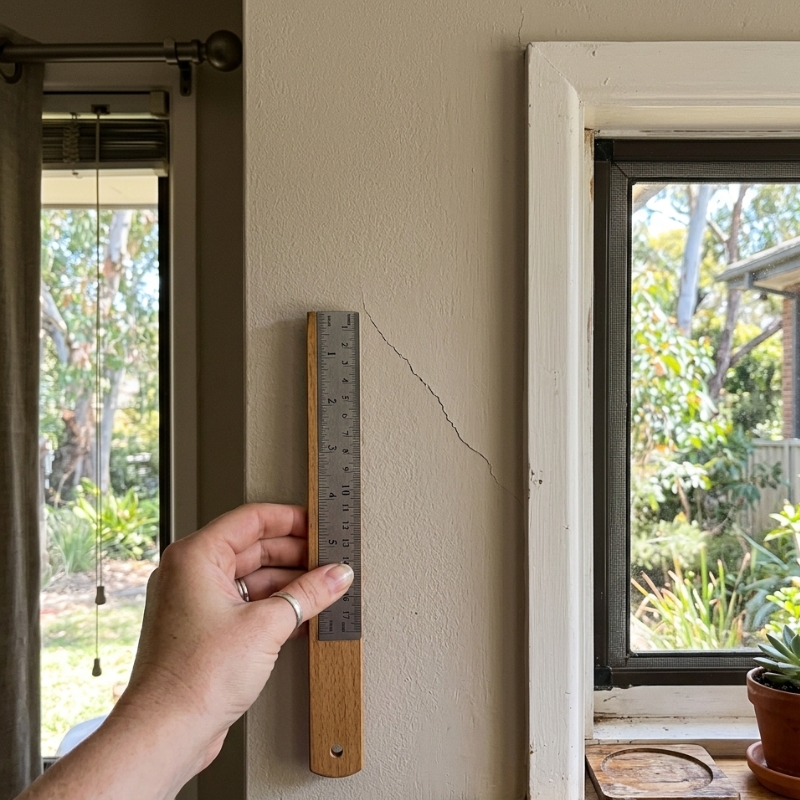
Step-by-step crack monitoring
• Take a clear photo square-on (not angled)
• Place a ruler or tape measure beside the crack in the photo
• Write down the date and location (e.g., “living room, NE corner window”)
• Repeat photos from the same angle every 2–4 weeks at first
• Note any related changes (rain periods, plumbing work, tree removal, drainage changes)
Q&A: “Should I patch the crack now?”
If you patch immediately, you can lose a useful baseline. Often it’s better to:
• Document and measure first
• Monitor for a short period
• Then repair cosmetically once you’re confident it’s stable
If the crack is clearly worsening or paired with other symptoms, prioritise assessment over patching.
What not to do (common mistakes)
• Don’t assume “all cracks are harmless” — but don’t assume “all cracks are structural” either.
• Don’t ignore drainage issues and hope cracks magically stop.
• Don’t make major site changes abruptly (like removing a large tree) without advice if movement is suspected.
• Don’t rely on a single symptom — patterns and progression matter.
FAQs
Is house movement normal in Australia?
Some minor movement can be normal due to seasonal changes, material shrinkage, and small adjustments over time. The key is whether movement is stable or progressing, and whether multiple symptoms are appearing together.
How can I tell if a crack is structural?
Structural concern increases when cracks are diagonal from corners, stair-step through brickwork, horizontal in masonry, widening over time, or paired with sticking doors/windows and sloping floors.
Can heavy rain cause house movement?
Rain can change soil moisture conditions, especially if drainage concentrates water near one part of the home. If new symptoms appear after prolonged wet weather, it’s worth monitoring closely and checking stormwater management.
What’s the difference between settlement and subsidence?
People use these terms differently, but generally, “settlement” refers to minor adjustment over time, while “subsidence” suggests more significant downward movement of the ground or footing system, often unevenly.
How long should I monitor before escalating?
If symptoms are mild and stable, 4–8 weeks of consistent monitoring can provide useful evidence. If changes are rapid, severe, or you have multiple red flags, escalate sooner.
Are sticking doors always a sign of structural movement?
No. Humidity, hinges, paint build-up and timber swelling can all cause sticking. It’s more concerning when multiple doors/windows change suddenly and other movement signs are present.