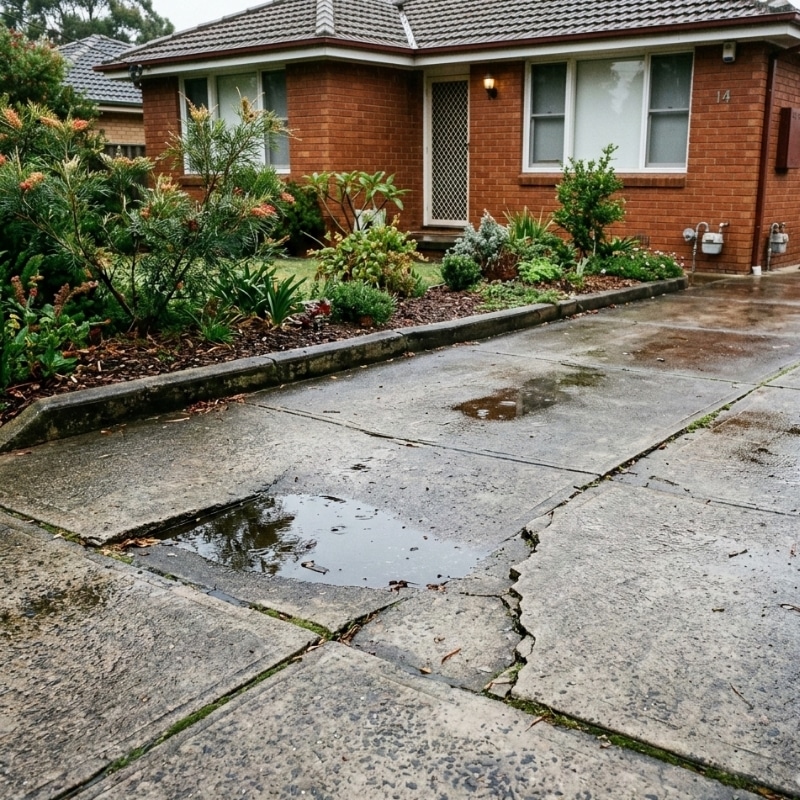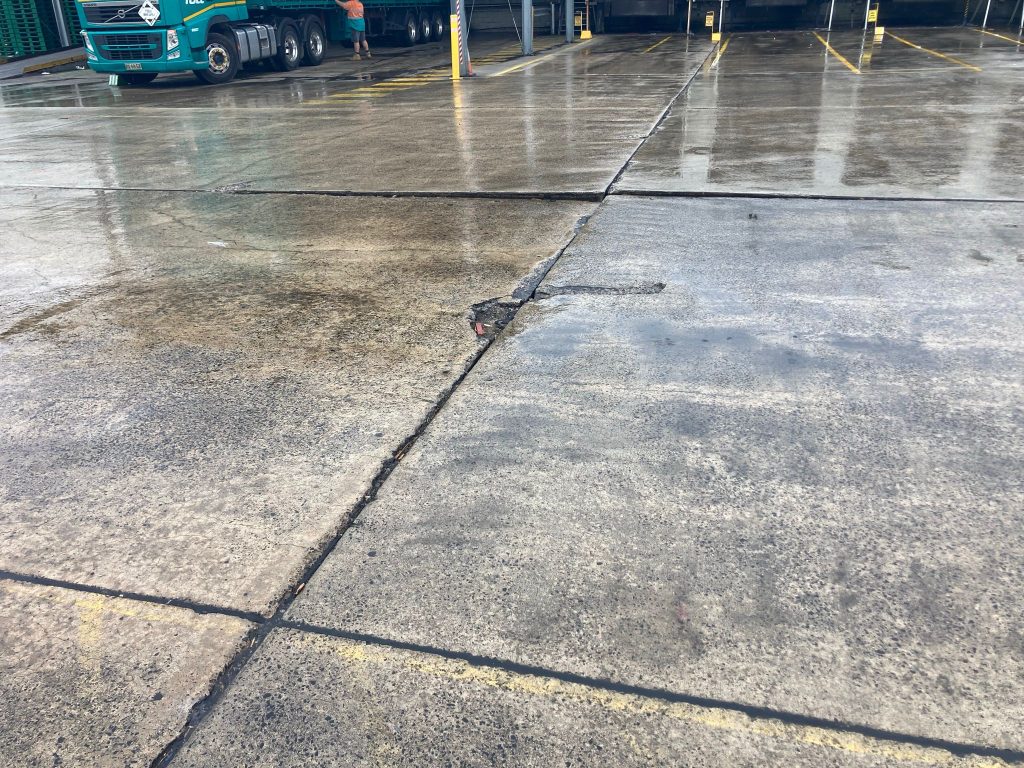
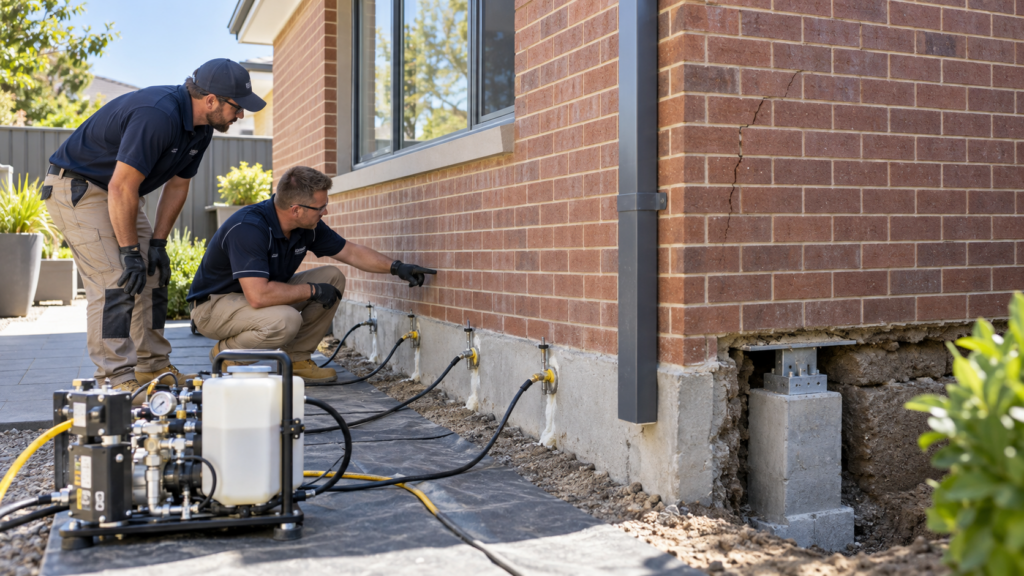
Concrete does not sink on its own. The slab is usually fine, and the ground underneath it is not. Soil settles, water washes fines away, reactive clay changes volume with the seasons, or the fill was never compacted properly in the first place. What you see is a sunken driveway, a path with a trip edge, or a patio where water now pools instead of draining away. Concrete levelling is the repair that addresses the loss of support, and in many cases, it means the existing slab stays where it is, rather than going into a skip.
Not every slab qualifies. Badly broken concrete or movement that has reached a house footing calls for a different answer.
Definition: Concrete levelling is a repair process used to raise or stabilise an uneven slab by restoring support beneath it or correcting differences between adjoining sections. You will also see it written as concrete levelling in imported product literature.
An inspection comes first, because the same sunken corner can be a non-structural paving problem, a drainage problem or a structural foundation problem, and those three have very different price tags. This guide covers what levelling can realistically achieve, what rules a slab out entirely, where the line sits between levelling and underpinning, and the safety and compliance constraints that catch people out.
What Are the Signs That Concrete Needs Levelling?
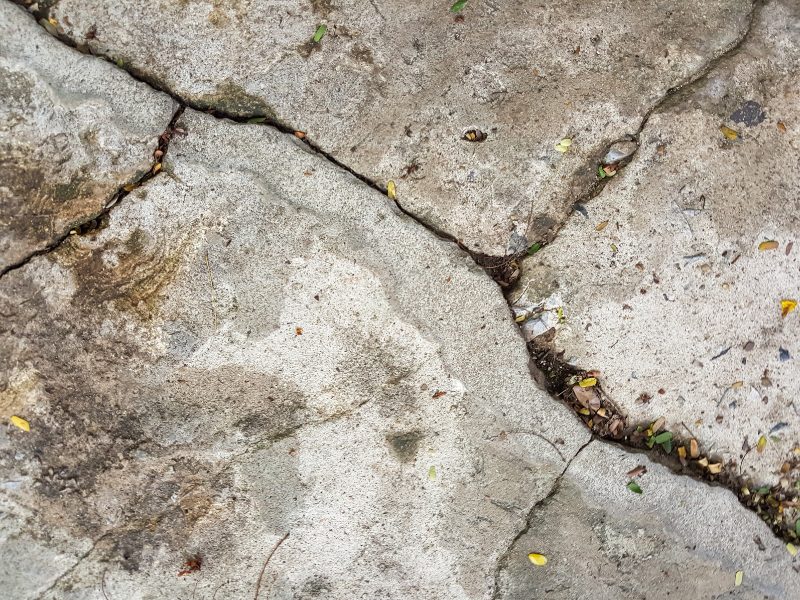
The common signs are uneven joins between slab sections, sunken areas, water ponding after rain and trip edges along paths. Cracking by itself proves very little, since concrete cracks for reasons that have nothing to do with support.
The signs most worth acting on are one slab section sitting lower than the next, water pooling after rain, a driveway sloping back towards the garage or house, a trip edge at a path join, gaps visible beneath a slab edge, concrete that sounds hollow when tapped, and a slab that rocks under foot or vehicle load. For the fuller picture, our guides to the early signs of a concrete slab sinking, why concrete slabs sink over time and what causes voids under concrete slabs in Australia each cover a different part of it.
What matters more than the list is what each observation should prompt you to do.
| Observation | Possible Issue | Recommended Response |
|---|---|---|
| Small difference between path sections | Local settlement or tree-root influence | Arrange a levelling assessment |
| Water ponding on a slab | Incorrect fall or settlement | Review drainage and slab levels |
| Hollow sound beneath concrete | Possible void | Investigate support beneath the slab |
| Wide or displaced crack | Structural loss or severe damage | Assess whether replacement is more suitable |
| Driveway falling towards the house | Drainage and settlement concern | Obtain prompt professional advice |
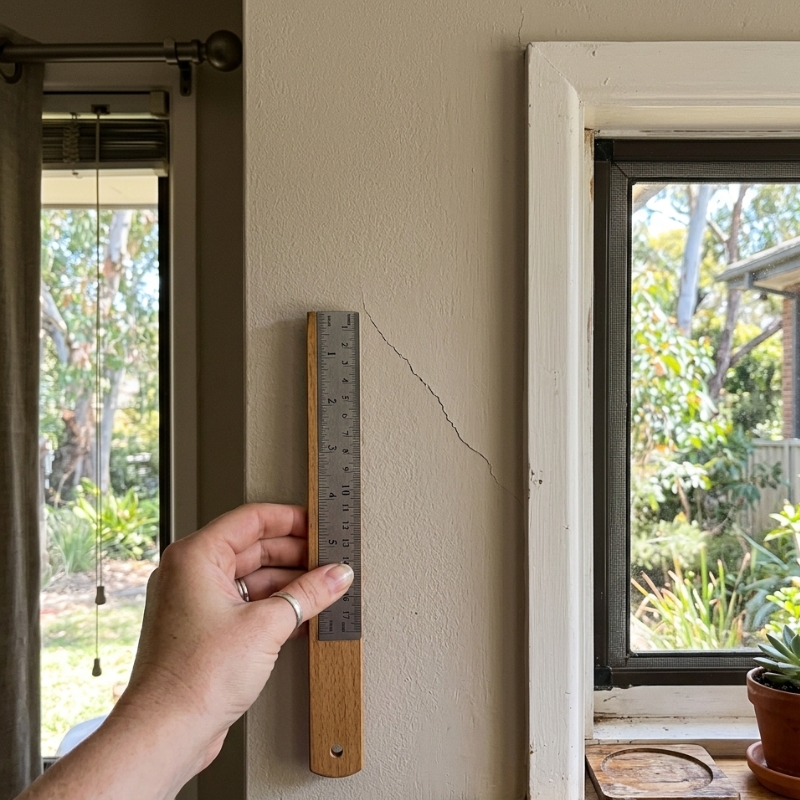
| Interior floor movement | Possible structural foundation issue | Arrange a structural assessment |
| Slab moves under foot or vehicle load | Loss of support | Stop heavy use and arrange an inspection |
| Sudden movement after excavation | Potential ground instability | Seek professional advice promptly |
| Damaged pool surround | Levelling and barrier implications | Use appropriate pool-area specialists |
| Broken underground service suspected | Plumbing or utility issue | Contact the relevant licensed professional |
Sorting a cosmetic crack from a structural one takes more than a photo, and the difference between a crack and a structural issue is often about how the crack behaves rather than how wide it is today.
What Is Concrete Levelling and How Does It Work?
Concrete levelling corrects an uneven slab by raising low sections, stabilising areas that have lost support, or removing small height differences between adjoining sections. The method depends on the slab itself and on what caused the movement.
A typical project runs like this:
- Inspect the slab, cracks and surrounding surfaces.
- Measure levels and identify the affected area.
- Review drainage, soil and nearby services.
- Determine whether the slab supports a structure.
- Identify voids or areas with inadequate support.
- Select the appropriate repair method.
- Mark drilling, access or grinding locations.
- Apply the selected lifting or stabilising process.
- Monitor movement during the work.
- Stop at the agreed level or the practical limit.
- Fill access holes and complete local finishing.
- Check drainage and adjoining surfaces.
- Explain curing, access and maintenance requirements.
- Provide the relevant project documentation.
Steps 1 to 6 are the diagnosis. Steps 7 to 14 are the repair. Skipping to step 8 is how homeowners pay for the wrong solution.
Locating Services Before Anyone Drills
Step 3 matters more than most homeowners expect, and it is the step most often skipped on a cheap quote. Drilling into a slab without knowing what runs beneath it is how a stormwater line, a water main or an electrical conduit gets damaged.
Before You Dig Australia runs a free enquiry service that returns utility plans for a site, and its advice to homeowners is blunt: “Never assume the depth of pipes and cables as they can be buried just below the surface.” Ask any contractor how they identify buried services before they drill. If the answer is that they have done a lot of these and will be careful, that is not a procedure.
What a Levelling Project Can Actually Achieve
This is the part most quotes leave vague, and it is the single most common source of disappointment at handover.
| Possible Outcome | What It Means |
|---|---|
| Levelling | The surface is moved closer to the agreed level |
| Re-alignment | Adjacent slab edges are brought closer together |
| Stabilisation | Support beneath the slab is improved |
| Void filling | Empty space beneath the slab is filled |
| Drainage correction | The fall is adjusted where feasible |
| Trip-edge reduction | A height difference is reduced |
| Partial improvement | The slab cannot safely reach its original position |
| No treatment recommended | Replacement or structural repair is more appropriate |
Notice that “back to exactly how it was” is not on that list. A slab that has settled unevenly, cracked and been patched twice will not lift back to a factory finish, and levelling does not remove existing cracks. A slab that lifts successfully will still show every crack it had beforehand. A good contractor tells you which outcome is realistic before the machine arrives, not afterwards.
What Gets Measured, and What You Should Receive
Ask for the starting levels to be recorded before any material goes in, and for the finished levels to be recorded afterwards. A before-and-after level record should identify the points measured, where they are, the reading at each one before and after, and the target that was agreed upon. That document is what turns “it looks better” into something you can check, and it is what a future buyer’s inspector will want to see.
If the Lift Stops Short
Sometimes it does. A slab reaches a practical limit before it reaches the agreed level, because lifting further risks cracking it or disturbing an adjoining structure. That is a legitimate outcome, not a failure, and stopping is the right call.
What matters is that you agree in advance on what happens commercially if it occurs. Ask before the work starts: who decides that the limit has been reached, does the price change if the target level is not achieved, and what is the position if you are not satisfied with a partial result? Getting that answer in writing costs nothing beforehand and is very difficult to negotiate afterwards.
What Rules a Slab Out?
Some slabs cannot be levelled, and knowing why you are paying for a repair with no future.
Slab thickness and strength are real constraints, not sales excuses. The Housing Industry Association notes that AS 3727.1, the standard for residential pavements, requires concrete of at least N20 strength laid no less than 75mm deep where it carries pedestrian traffic only, rising to N25 at a minimum 100mm depth where light vehicles cross, and N32 at a minimum 150mm depth for commercial vehicles under ten tonnes. It also notes that the standard can only be applied where the site has a soil classification of A, S or M. HIA’s summary of designing pavements to avoid cracking sets out the detail.
That distinction matters more for driveways than for paths. A driveway poured at path thickness was underspecified for the loads it carries from the day it went in, and a pavement built thinner than it should have been, on ground more reactive than the standard covers, has a limited future, no matter what is injected under it.
Levelling may not be suitable when:
- The slab has fragmented extensively.
- Surface deterioration is severe.
- Reinforcement is exposed or corroding.
- The slab lacks the structural capacity for its use.
- Erosion or a leak has not been resolved.
- Major tree roots have displaced the concrete.
- The slab cannot be moved without damaging adjoining structures.
- Slab thickness or original construction was inadequate.
- Drainage needs a full redesign.
- Movement is affecting load-bearing footings.
- Access is unsafe.
- Replacement would cost about the same or less.
Replacement is the better answer in most of those cases, because it lets the base, the falls and the drainage be rebuilt properly. Our comparison of levelling foam against full replacement covers makes that decision in more detail.
Concrete Levelling or Underpinning?
These are different repairs to different problems, and confusing them is expensive in both directions.
| Consideration | Concrete Levelling | Structural Underpinning |
|---|---|---|
| Typical application | Driveways, paths, patios and selected slabs | Building footings and load-bearing foundations |
| Primary goal | Raise, align or stabilise a slab | Add structural support beneath a building |
| Structural engineer | Project dependent | Commonly required |
| Common methods | Resin, grout, grinding or local repair | Concrete underpins, beams, piers or piles |
| Building load | Often limited or non-structural | Carries walls, columns or the building |
| Cost | Usually lower for suitable pavement work | Generally higher |
| Risk | Depends on slab, services and surroundings | Significant structural and excavation risk |
| Contractor requirements | Depend on scope and jurisdiction | Specific licensing may apply |
Plenty of people arrive at this problem convinced they need underpinning. Work out which one you are dealing with first, because that answer decides which trade you need. A sunken driveway and a cracked load-bearing wall are different problems, and paying for underpinning when a driveway needs levelling is an expensive detour.
Structural underpinning becomes the relevant repair when:
- A load-bearing wall or footing has moved.
- Interior floors and walls show related movement.
- The slab forms part of the building’s structural foundation.
- Movement continues despite surface treatment.
- An engineer identifies inadequate foundation support.
- Additional building loads must be carried.
- The problem clearly extends deeper than a pavement slab.
Key Point
Underpinning is not the premium version of concrete levelling. The two services solve different problems, and a contractor who blurs the line between them is worth a second look. If interior floors are involved, start with the sinking floors rather than the driveway.
Safety and Compliance Around the Work
Three constraints sit outside the slab itself and are easy to miss until they cause a problem.
Trip edges. A raised path join is a genuine hazard, not just an eyesore. Safe Work Australia lists ground surfaces that are “slippery, uneven or cluttered” among the causes of slips, trips and falls on construction sites, and a raised join at a front door is the household version of the same hazard. If the property is tenanted or open to visitors, it is worth treating a trip edge as the priority rather than the cosmetic problem.
Pool surrounds. This is the obligation most often missed. Pool barrier rules set minimum heights and require a clear zone around the fence, both measured relative to the surrounding surface. Raising or replacing paving next to a pool barrier can therefore affect compliance even when the fence itself is untouched. Before any work near a pool fence, confirm the requirements that apply to your property. In New South Wales, the Swimming Pool Register publishes self-assessment checklists for pool owners, and other states and territories run their own schemes. If in any doubt, ask your council or a certifier before the work rather than after.
Shared and common property. A path, driveway or courtyard that is common property in a strata scheme, or shared with a neighbour under an easement or a shared-driveway arrangement, is not yours alone to alter. Levelling changes surface heights and can change where water goes, both of which affect the other party. Establish who owns the surface and whose approval is needed before you book the work, because retrofitting consent afterwards is considerably harder.
Which Methods Are Available?
The common responses are polyurethane resin injection, cementitious grout lifting, grinding and replacement. Where movement has reached a structural footing, underpinning replaces all of them as the relevant repair.
| Method | Primary Use | Disruption | Relative Cost | Main Limitation |
|---|---|---|---|---|
| Resin injection | Lifting and stabilising suitable slabs | Low | Medium | Does not suit every ground condition |
| Cementitious grout lifting | Filling voids and lifting pavement slabs | Low to medium | Low to medium | Adds material weight and may need curing |
| Grinding | Removing minor raised edges | Low | Low | Does not restore underlying support |
| Local patching | Repairing selected surface damage | Low | Low | Does not correct slab movement |
| Partial replacement | Rebuilding badly damaged sections | Medium to high | Medium | New and old concrete may differ visually |
| Full replacement | Rebuilding the slab and base | High | High | More demolition, time and waste |
| Underpinning | Supporting structural foundations | High | High | Unnecessary for non-structural paving |
Two things the table cannot show. Grinding treats the symptom, quickly and cheaply, without touching the cause, which makes it right for a minor trip edge on sound concrete and wrong for anything else. And resin injection does not repair the concrete or remove cracks; it addresses what is underneath it.
Our concrete levelling guide compares the lifting methods in detail, the best method for slab repair covers how contractors weigh them against each other, and the slab jacking and resin injection pages explain how each is applied. Where the goal is treating the ground rather than lifting the surface, specialised grouting and void filling are the relevant work.
A Note on “Precision Levelling”
Precision levelling services use laser measurement, controlled injection and progressive monitoring while the slab moves. Treat the word “precision” as a description of how the work is controlled, not as a separate repair method, because the underlying technique is still resin or grout. Ask any contractor offering it how the starting levels are recorded, what target level is proposed, how movement is monitored during lifting, at what point lifting will stop, and which outcomes cannot be guaranteed. Good answers to those five questions are the actual service. The word is just a label.
How Much Does Concrete Levelling Cost?
It depends on the treatment area, how much movement has to be corrected, the method, site access and the underlying cause. Two points are worth knowing before you ring anyone.
Most contractors apply a minimum service charge, so a single sunken path section rarely costs a fraction of a full driveway. Ask about that minimum before you book. And what each method is priced on differs: resin by treatment area or material volume, grout by slab area, grinding by linear edge, replacement by square metre. Two totals priced on different bases are not comparable, which is why the pricing basis matters more than the headline figure.
For indicative Australian figures by method, see our concrete levelling guide. Costs also shift with the property itself, which this comparison by property type covers.
Ask each quote to state plainly whether the figure includes GST, the site inspection, a level survey, access-hole drilling, injection material, lifting and monitoring, hole patching, crack repair, drainage correction, clean-up, travel, warranty and engineering. Most disputes start with a line everyone assumed was covered.
What Makes One Quote Higher Than Another
The slab and the repair
- Number of affected slabs and total treatment area
- Size and thickness of the concrete
- Amount of movement to be corrected
- Size of any voids, and resin or grout volume required
- Level of monitoring specified
- Surface finishing and reinstatement
The site
- Access, and whether the work is inside or outside
- Nearby walls, structures and adjoining surfaces
- Underground services
- Pool or drainage features
- Soil conditions
Everything around the repair
- Any minimum service charge
- Structural engineering, where required
- Travel and mobilisation
What Should a Quote Include?
- The surface and area covered.
- The identified or suspected cause.
- The proposed method and material
- The number and location of access holes
- The target level or a stated practical tolerance
- Whether the scope is stabilisation, lifting, or both
- Drainage requirements and underground-service checks
- Crack treatment and surface reinstatement
- Expected access restrictions during the work
- Curing or return-to-use time
- Inclusions, exclusions and the variation process
- The circumstances that may require additional material
- GST
- Product warranty and workmanship warranty
- Post-work inspection or monitoring
All prices are indicative until someone has been on site. A proper quote follows an inspection that measures the movement, investigates the cause and establishes whether levelling, replacement or structural repair is the right response.
Licensing
Requirements depend on the scope of the work and where your property is. Levelling a path is not the same as work that touches a structural footing, and the licensing follows that split.
In New South Wales, underpinning and piering is a listed category of licensed trade work, and a contractor licence is required for residential building work valued at more than $5,000 in labour and materials, including GST. Other states and territories run their own schemes with their own categories and thresholds, so confirm the position where your property is.
| Where your property is | Regulator | Check a licence |
|---|---|---|
| New South Wales | NSW Government, Fair Trading | Categories of licensed building and trade work |
| Victoria | Building and Plumbing Commission, formerly the Victorian Building Authority | Find and check a practitioner |
| Queensland | Queensland Building and Construction Commission | QBCC registers, including the licensee register |
| Australian Capital Territory | Access Canberra | Building and construction public registers |
Verify the licence number with the regulator rather than relying on the logo on the quote. Our own licence numbers are NSW 377694C, VIC CDB-U 73507, QLD 15300551 and ACT 20211579.
Choosing a Provider
Five questions separate a contractor who has assessed your slab from one who has priced it.
- What caused the movement? If the answer is “the ground has settled” followed straight by a price, nothing has been investigated.
- Is this slab structural or non-structural? This decides whether you need levelling or a structural assessment, and it should be established before a method is proposed.
- What level can realistically be achieved, and will the cracks still show? Compare this against the outcomes table above.
- How are underground services identified before drilling? A procedure, not a reassurance.
- What happens if more material is needed than quoted? Get the variation position in writing.
Beyond that, check the contractor’s licence and insurance, ask for before-and-after level records, and read the product warranty and workmanship warranty as two separate documents. Our fuller guide to choosing a concrete levelling service covers licensing, insurance and warranty terms in detail.
Frequently Asked Questions
How long does concrete levelling take?
Many straightforward residential jobs are completed within a day, and some smaller ones in a few hours. Larger areas, multiple slabs, difficult access or a cause that needs investigating first will stretch that out. The inspection, preparation, chosen method, material quantity and access all affect the timeframe, and curing or return-to-use requirements vary by product. Ask for the expected on-site duration and the return-to-use time as two separate figures.
What types of concrete surfaces can be levelled?
Driveways, paths, patios, pool surrounds, garage floors, and selected slabs can all be candidates. Suitability depends on the concrete’s condition, its reinforcement and thickness, the support beneath it and what sits nearby. Building foundations and load-bearing slabs is a different matter. Those need a structural assessment and may require underpinning rather than standard pavement levelling, so the first question is always what the slab is carrying.
How long does concrete levelling last?
There is no universal lifespan, and anyone quoting one is guessing. Performance depends on the cause of the original movement, the repair method, the soil, the drainage, the slab’s condition, the material used and the quality of the workmanship. If erosion, a leaking pipe or unstable ground was behind the settlement and stays untreated, the movement can return. Compare the product warranty and the workmanship warranty as separate documents rather than relying on a general durability claim.
Can badly cracked concrete still be levelled?
Sometimes. Cracked slabs can often be stabilised or lifted if the concrete is still substantially intact, but badly fragmented, deteriorated or structurally inadequate slabs usually need replacing. Levelling also does not remove existing cracks, so a slab that lifts successfully will still show every crack it had beforehand. A contractor should inspect the crack pattern, slab condition, underlying support and drainage before recommending either path.
When can you use the surface after concrete levelling?
It depends on the method, the material, the slab and the loads it will carry. Some polyurethane systems allow relatively quick access, while cementitious materials and new concrete need longer to cure before they take on weight. Pedestrian access usually returns before vehicle access. Get the return-to-use instructions in writing, covering foot traffic, cars, trailers and any heavy equipment separately, rather than relying on a verbal “should be right tomorrow”.
Making the Call
Concrete levelling is worth serious consideration when the slab itself is sound, and the ground beneath it has let go. It keeps the existing surface, produces far less waste than demolition, and generally costs less than a rebuild for suitable jobs. It is the wrong tool for a slab that has broken up, for a pavement that was underspecified for its loads, for drainage that needs redesigning, and for movement that has reached the footings of your house. Those need replacement or structural repair, and no amount of injected material changes that.
The step that saves money is the assessment. If a driveway, path or patio has dropped, get the cause, the slab’s condition and a realistic outcome established in writing before anyone commits to a method. Specialists in slab jacking and concrete relevelling can measure the levels, check the drainage, locate services and tell you whether driveway relevelling, replacement or structural repair suits your property.
Book a Site Inspection
We measure the levels, check the drainage and locate services before quoting anything. You get the cause, the slab’s condition and a realistic outcome in writing first.